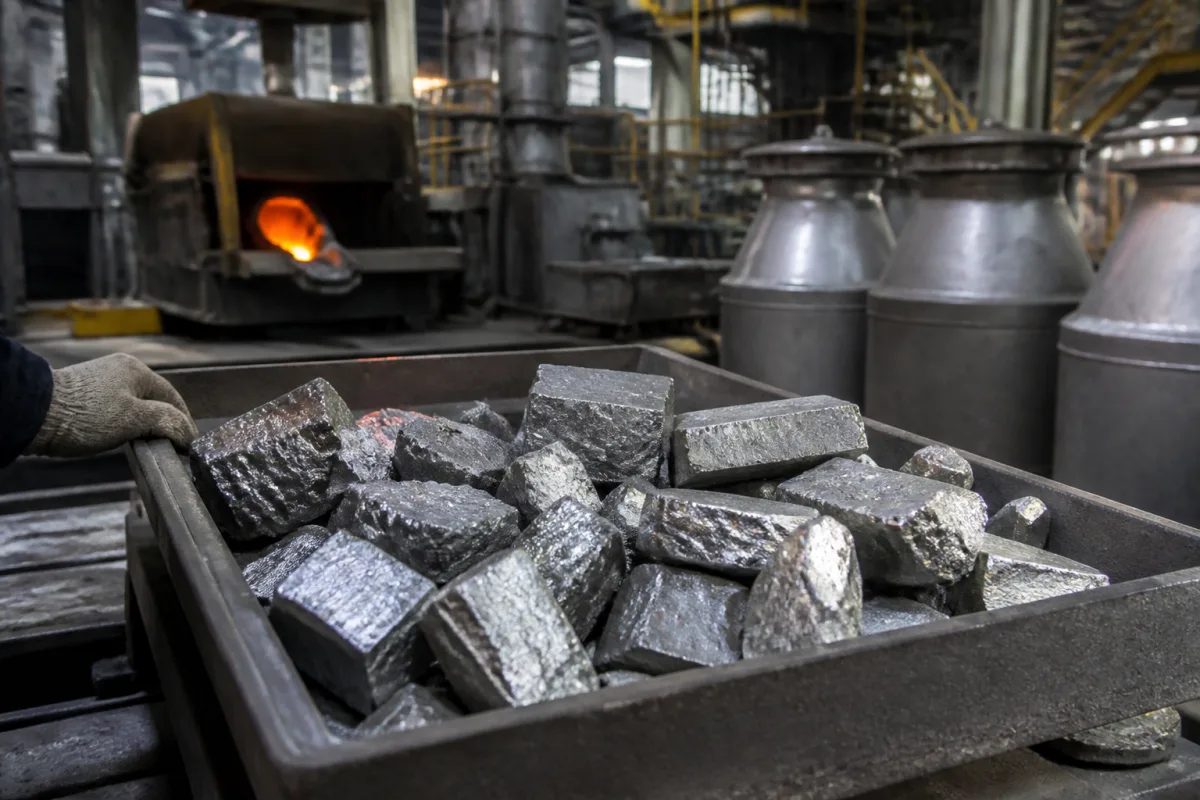
Ferroniobium (ferrocolumbium) for steel and superalloys · Grade by phosphorus, sulfur and silicon, standard vs vacuum grade, lump or powder sizing, packaging and trade data
Ferroniobium (also called ferrocolumbium) is an iron–niobium alloy added to steel to introduce niobium. Settle three things before ordering: the grade — standard or vacuum grade — with the niobium content and the phosphorus, sulfur, silicon and other limits your melt needs, the form and size range for your addition practice, and the packaging, assay certificate and trade paperwork.
Ferroniobium (ferrocolumbium) in standard and vacuum grades, as lump, sized or powder product for steelmaking and foundry use. Niobium metal, niobium oxide, nickel-niobium master alloy and niobium ores and concentrates are outside this page.
CNFX editorial research · Sources checked October 12, 2026 · 4 sources
The USGS Mineral Commodity Summaries 2025 entry for niobium (columbium) reports that in the United States “Niobium was consumed mostly in the form of ferroniobium by the steel industry and as niobium alloys and metal by the aerospace industry”, with end use estimated at about 77% steels and 21% superalloys. It gives an average unit value for ferroniobium of $21/kg in 2020–21, $25/kg in 2022–23 and $26/kg in 2024 (estimated). [1]
The US tariff lines quoted by USGS split ferroniobium into product with less than 0.02% phosphorus or sulfur, or less than 0.4% silicon (7202.93.4000), and other ferroniobium (7202.93.8000), both at 5% ad valorem. [1] CBMM lists vacuum-grade ferroniobium and nickel-niobium alloys for sensitive applications, as lump packed in drums or big bags, alongside its standard ferroniobium line, and offers customised alloys and specifications. [3][2]
Editorial note: state the niobium range and maximum phosphorus, sulfur, silicon, aluminium and other residuals on the order, and whether vacuum grade is required; the tariff split above means the certificate values also matter for customs. [1][3]
Give the supplier the grade (standard or vacuum), niobium range, maximum P, S, Si, Al, Ta and other residuals, form (lump, sized, powder), size range and fines limit, packaging (can, drum, big bag), lot size, sampling and assay method, certificate, REACH and SDS needs, delivery terms and annual quantity.
02
Set form, size and packaging
CBMM's ready-to-order ferroniobium line lists lump at 0–50 mm packed in cans of up to 10 kg, 250 kg drums or 1,000 kg big bags; powder at 45–250 µm in 250 kg drums; and a sized form of 25 × 15 × 60 mm in 200 kg drums or 500 kg big bags. It says it also customises alloys, specifications, weights, packaging and sizes on request, and lists ISO 9001, AS9100 and ISO/IEC 17025 (niobium assay laboratory) certifications. [2]
USGS reports US imports of niobium of 7,170 to 10,100 t (niobium content) a year in 2020–24, with ferroniobium making up 71% of niobium material imports, and ferroniobium and niobium metal imports coming from Brazil (66%), Canada (29%) and others in 2020–23; net import reliance was 100%. [1]
Editorial calculation: at the 2024 average unit value of $26/kg, a 250 kg drum of ferroniobium represents about $6,500 and a 1,000 kg big bag about $26,000 before freight and duty. [1][2]
03
Assay certificate, size analysis and packaging to ask any ferroniobium supplier for
Ask any supplier for the assay certificate with niobium and impurity values, the size analysis and the packaging available. [2][1]
04
Agree lot make-up and size grading before ordering
The Bureau of Indian Standards specification IS 3014:1993, drafted with reference to ISO 5453:1980 and ASTM A550-78, limits the niobium content of all its grades to 55–70% and covers seven grades in its Table 1, one designated FeNb65. It recognises three ways of making up a consignment: a tapped lot from one melt or one part of a continuous tap; a graded lot of more than one melt of one designation, whose niobium contents must not differ from each other by more than 3 percentage points; and a blended lot of melts of one designation crushed below 50 mm and mixed. [4]
Its Table 2 sets four size designations, from 15–50 mm down to up to 2 mm, with oversize limited to 10% for each and undersize to 5% for the three coarser sizes, the undersize being valid at the point of delivery. It says material from an out-of-specification cast must not be blended with another cast, and that closer niobium ranges or other element limits are agreed between purchaser and manufacturer. Column headings were read from the scanned IS 3014 table; confirm against the official copy. [4]
Editorial note: CBMM lists its lump at 0–50 mm, wider than any single IS 3014 size designation; state the size designation, the under- and oversize tolerances and the lot method on the order. [2][4]
IS 3014 size designation
Size range, mm
Undersize / oversize, % max (headings read from scanned table; confirm)
Niobium content, P, S and Si, vacuum grade, form and size, packaging and assay
Phosphorus, sulfur and silicon do double duty: they set the melt chemistry and, at 0.02% P or S and 0.4% Si, the US tariff line the certificate will be read against. [1]
Niobium, carbon, silicon, phosphorus and sulfur, particle size and packaging for a ferroniobium order
Write the size range against a designation: CBMM's 0–50 mm lump is wider than any single IS 3014 size class, which run from 15–50 mm down to under 2 mm with stated oversize and undersize limits. [2][4]
1 company lists this product among what they make. Company figures are quoted from each
company's own website; every card states where the relationship came from.
Ximei Resources (Guangdong) Limited
Manufacturing site to be confirmed for the order
Lists ferroniobium grades FeNb70 to FeNb20 to GB/T 7737-2007 under its tantalum and niobium metals and alloys range.
Explore company information and manufacturing capabilities, then discuss the scope of your project with a relevant supplier.
Share this page
Compiled and source-reviewed by the CNFX editorial team.
Each manufacturer above links to the page on that company's own website where the product is listed, with the date we checked it. How we source and review
· Page last updated 13 October 2026
Buyer questions
What is ferroniobium used for?
USGS puts steels at about 77% and superalloys at about 21% of US niobium end use, and says “Niobium was consumed mostly in the form of ferroniobium by the steel industry”. [1]
Is ferrocolumbium the same as ferroniobium?
Yes; columbium is the older name for niobium, and USGS titles its summary Niobium (Columbium). [1]
What sizes is ferroniobium supplied in?
CBMM lists lump 0–50 mm and powder 45–250 µm, among other forms. [2]
How is ferroniobium classified for US import?
USGS lists 7202.93.4000 for material below 0.02% P or S or below 0.4% Si, and 7202.93.8000 for other. [1]
How is ferroniobium size-graded for delivery?
The Bureau of Indian Standards' IS 3014:1993 sets four size designations, from 15–50 mm down to up to 2 mm, with oversize limited to 10%. [4]
Sources and what still needs a direct check
Sources checked 2026-10-12. The USGS 2025 niobium summary gives use, price, trade and tariff data; CBMM publishes its ferroniobium forms and packaging; the Bureau of Indian Standards' IS 3014:1993 sets grades, lot make-up and size designations.