Industry-Verified Manufacturing Data (2026)

High-Purity Ferromolybdenum Master Alloy

Based on aggregated insights from multiple verified factory profiles within the CNFX directory, the standard High-Purity Ferromolybdenum Master Alloy used in the Other Basic Metal Production sector typically supports operational capacities ranging from standard industrial configurations to heavy-duty production requirements.

Technical Definition & Core Assembly

A canonical High-Purity Ferromolybdenum Master Alloy is characterized by the integration of Molybdenum Matrix and Iron Carrier. In industrial production environments, manufacturers listed on CNFX commonly emphasize Molybdenum trioxide (MoO3) construction to support stable, high-cycle operation across diverse manufacturing scenarios.

High-purity iron-molybdenum alloy for steel alloying

Product Specifications

Technical details and manufacturing context for High-Purity Ferromolybdenum Master Alloy

Definition
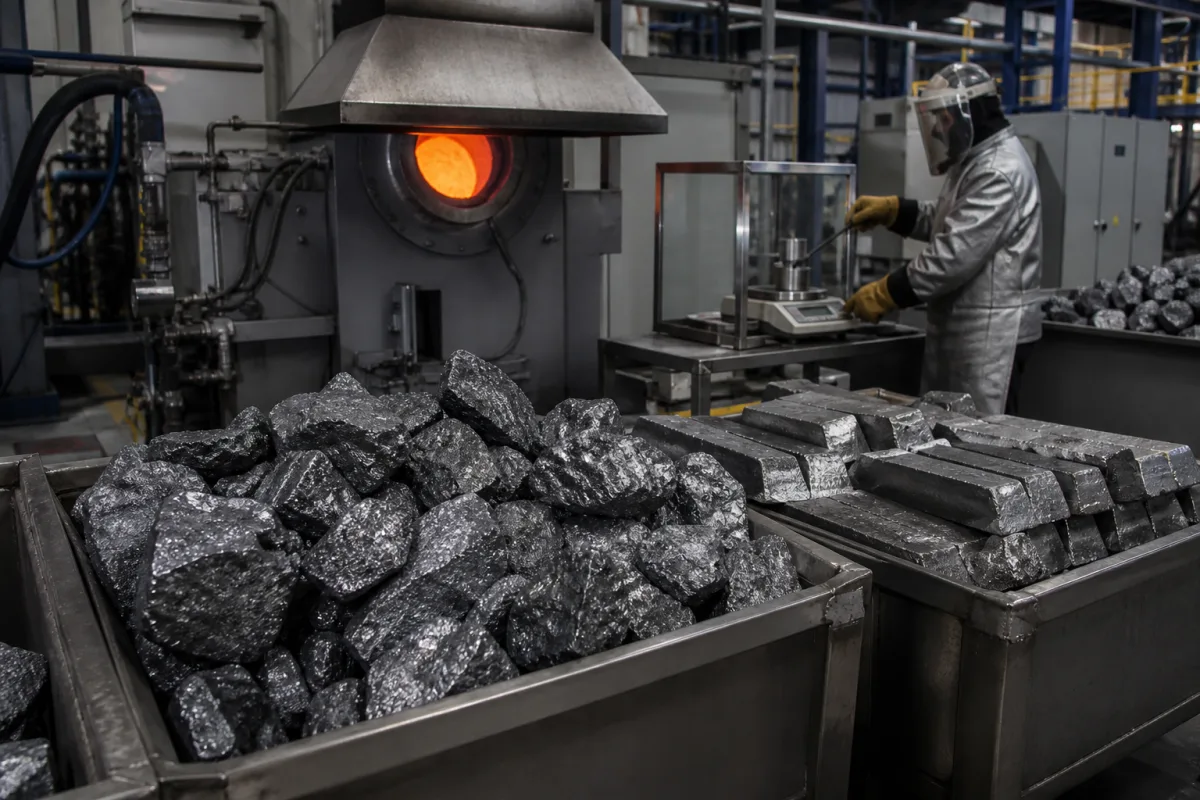
High-purity ferromolybdenum is a master alloy consisting primarily of iron and molybdenum, produced through aluminothermic reduction or electric furnace processes. It serves as a crucial additive in steelmaking to introduce molybdenum, which enhances hardenability, strength at high temperatures, and corrosion resistance. This material is essential for producing alloy steels, stainless steels, and tool steels where precise molybdenum content control is required. Its high purity ensures minimal introduction of unwanted impurities like phosphorus or sulfur into the final steel product.
Working Principle
Acts as a carrier alloy that dissolves in molten steel to efficiently and uniformly distribute molybdenum atoms throughout the steel matrix during the alloying process.
Common Materials
Molybdenum trioxide (MoO3), Iron oxide (Fe2O3), Aluminum powder (reductant)
Technical Parameters
  • Molybdenum content range (%) Per Request
  • Maximum impurity levels (%) Per Request
Components / BOM
  • Molybdenum Matrix
    Primary alloying element providing enhanced properties
    Material: Molybdenum atoms in iron lattice
  • Iron Carrier
    Base metal facilitating dissolution in molten steel
    Material: Pure iron
  • Reduction Byproducts Optional
    Slag residues from production process
    Material: Aluminum oxide and other oxides
Engineering Reasoning
Molybdenum content: 60-70 wt%, Iron content: 30-40 wt%, Impurity limits: Oxygen <0.05 wt%, Carbon <0.03 wt%, Sulfur <0.01 wt%
Molybdenum content below 58 wt% causes insufficient hardenability in steel, Oxygen content above 0.08 wt% creates brittle oxide inclusions, Carbon content above 0.05 wt% forms detrimental carbides
Design Rationale: Gibbs free energy minimization drives formation of FeMo intermetallic phases (Fe7Mo6, Fe2Mo) at incorrect stoichiometry, Oxygen solubility limit of 0.08 wt% in liquid Fe-Mo alloy at 1600°C, Carbon-Molybdenum affinity forming Mo2C precipitates above 0.05 wt% C
Risk Mitigation (FMEA)
Trigger Incomplete reduction of molybdenum trioxide (MoO3) during aluminothermic process
Mode: Residual oxide inclusions (Al2O3, MoO2) exceeding 0.08 wt% oxygen equivalent
Strategy: Two-stage reduction with calcium-silicon alloy secondary treatment at 1650°C for 45 minutes
Trigger Carbon pickup from graphite crucible lining during vacuum induction melting
Mode: Formation of molybdenum carbide (Mo2C) stringers at grain boundaries above 0.05 wt% C
Strategy: Magnesia-lined crucible with argon gas flushing at 10 L/min during 1550-1600°C holding

Industry Taxonomies & Aliases

Commonly used trade names and technical identifiers for High-Purity Ferromolybdenum Master Alloy.

Industrial Ecosystem & Supply Chain DNA

Complementary Systems
Downstream Applications
Specialized Tooling

Application Fit & Sizing Matrix

Operational Limits
pressure: Atmospheric to 1 bar (standard ladle addition)
flow rate: Batch addition - not applicable
temperature: Ambient to 1600°C (melting point dependent on steel grade)
slurry concentration: Solid alloy addition - not applicable
Media Compatibility
✓ Basic oxygen furnace (BOF) steelmaking ✓ Electric arc furnace (EAF) steel production ✓ Secondary ladle metallurgy processes
Unsuitable: Acidic environments or chloride-containing molten metals
Sizing Data Required
  • Target molybdenum content in final steel (%)
  • Batch size of molten steel (tons)
  • Required molybdenum recovery rate (%)

Reliability & Engineering Risk Analysis

Failure Mode & Root Cause
Oxidation-induced embrittlement
Cause: Exposure to oxygen at high temperatures during processing or storage, leading to formation of brittle oxide phases that reduce ductility and cause cracking under thermal or mechanical stress.
Thermal fatigue cracking
Cause: Repeated thermal cycling during alloying processes (e.g., in electric arc furnaces) creates stress concentrations at grain boundaries and inclusions, propagating microcracks that compromise structural integrity.
Maintenance Indicators
  • Visible surface discoloration or powdery white/gray oxide layer formation on alloy surfaces
  • Audible popping or cracking sounds during heating/cooling cycles indicating internal stress relief or crack propagation
Engineering Tips
  • Implement controlled atmosphere storage (argon/nitrogen blanketing) and processing to minimize oxygen exposure, maintaining oxygen levels below 50 ppm during critical operations.
  • Optimize thermal profiles during alloy production to reduce thermal gradients, incorporating gradual heating/cooling rates (max 100°C/hour) and intermediate temperature holds to relieve residual stresses.

Compliance & Manufacturing Standards

Reference Standards
ASTM A132 - Standard Specification for Ferromolybdenum ISO 5452 - Ferromolybdenum - Specification and conditions of delivery DIN 17561 - Ferromolybdenum - Chemical composition and delivery conditions
Manufacturing Precision
  • Molybdenum content: +/- 0.5%
  • Particle size distribution: +/- 5% of specified mesh range
Quality Inspection
  • Spectrographic Analysis for chemical composition verification
  • X-ray Fluorescence (XRF) for elemental purity confirmation

Factories Producing High-Purity Ferromolybdenum Master Alloy

Verified manufacturers with capability to produce this product in China

✓ 98% Supplier Capability Match Found

T Technical Director from Singapore Jan 10, 2026
★★★★★
"Found 10+ suppliers for High-Purity Ferromolybdenum Master Alloy on CNFX, but this spec remains the most cost-effective."
Technical Specifications Verified
P Project Engineer from Germany Jan 07, 2026
★★★★☆
"The technical documentation for this High-Purity Ferromolybdenum Master Alloy is very thorough, especially regarding Molybdenum Content (%). (Delivery took slightly longer than expected, but technical support was excellent.)"
Technical Specifications Verified
S Sourcing Manager from Brazil Jan 04, 2026
★★★★★
"Reliable performance in harsh Other Basic Metal Production environments. No issues with the High-Purity Ferromolybdenum Master Alloy so far."
Technical Specifications Verified
Verification Protocol

“Feedback is collected from verified sourcing managers during RFQ (Request for Quote) and factory evaluation processes on CNFX. These reports represent historical performance data and technical audit summaries from our B2B manufacturing network.”

13 sourcing managers are analyzing this specification now. Last inquiry for High-Purity Ferromolybdenum Master Alloy from Poland (1h ago).

Frequently Asked Questions

What are the main applications of high-purity ferromolybdenum master alloy?

This master alloy is primarily used in steel production to enhance strength, hardness, and corrosion resistance. It's essential for manufacturing tool steels, stainless steels, and high-strength low-alloy steels.

How does the reduction process work in producing ferromolybdenum?

The production involves aluminothermic reduction where aluminum powder reduces molybdenum trioxide and iron oxide. This exothermic reaction produces the iron-molybdenum alloy while generating aluminum oxide as a byproduct.

Why is controlling impurity levels important in ferromolybdenum?

Precise control of carbon, phosphorus, silicon, and sulfur content ensures consistent steel quality. Low impurity levels prevent brittleness, improve weldability, and maintain desired mechanical properties in final steel products.

Can I contact factories directly on CNFX?

CNFX is an open directory, not a transaction platform. Each factory profile provides direct contact information and production details to help you initiate direct inquiries with Chinese suppliers.

Get Quote for High-Purity Ferromolybdenum Master Alloy

Request technical pricing, lead times, or customized specifications for High-Purity Ferromolybdenum Master Alloy directly from verified manufacturing units.

Your business information is encrypted and only shared with verified High-Purity Ferromolybdenum Master Alloy suppliers.

Thank you! Your message has been sent. We'll respond within 1–3 business days.

Need to Manufacture High-Purity Ferromolybdenum Master Alloy?

Connect with verified factories specializing in this product category

Add Your Factory Contact Us
Previous Product
High-Purity Ferromanganese Master Alloy
Next Product
High-Purity Ferrosilicon Barium Master Alloy