Industry-Verified Manufacturing Data (2026)

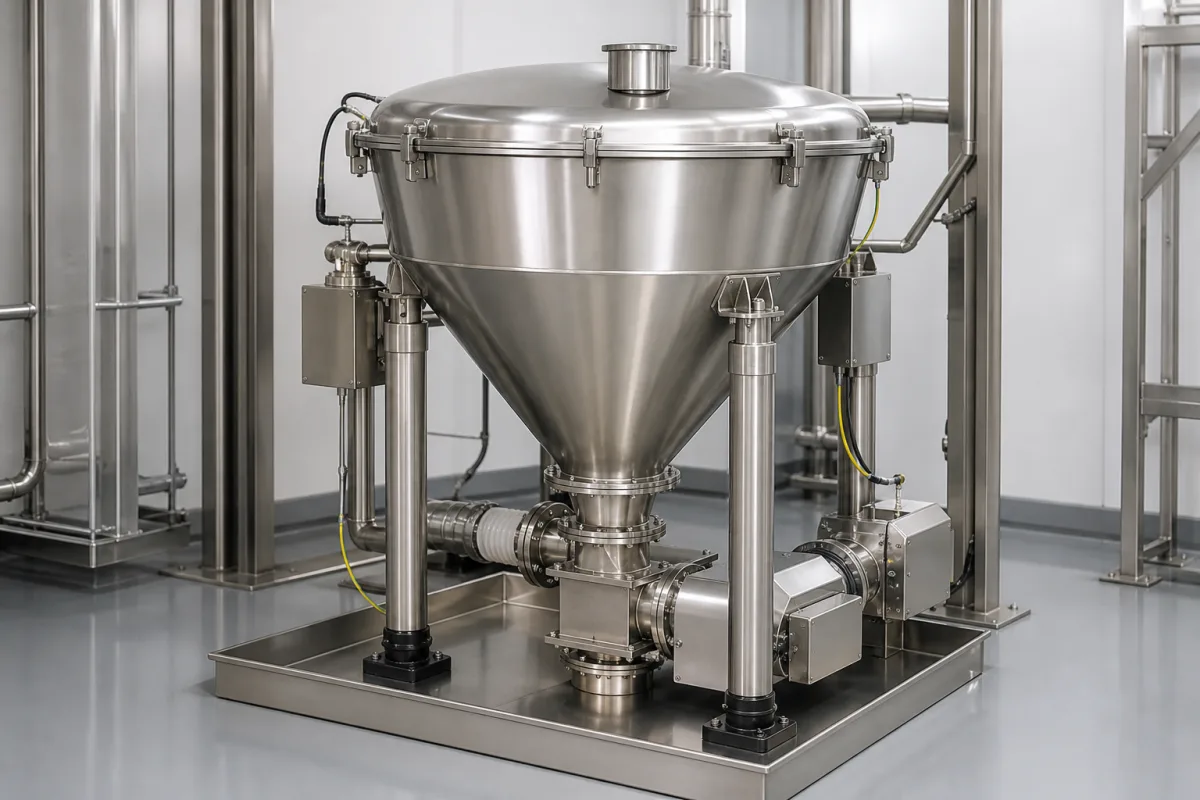
Main Hopper

Based on aggregated insights from multiple verified factory profiles within the CNFX directory, the standard Main Hopper used in the Other Transport Equipment Manufacturing sector typically supports operational capacities ranging from standard industrial configurations to heavy-duty production requirements.

Technical Definition & Core Assembly

A canonical Main Hopper is characterized by the integration of Hopper Body and Discharge Cone. In industrial production environments, manufacturers listed on CNFX commonly emphasize Stainless Steel 316L construction to support stable, high-cycle operation across diverse manufacturing scenarios.

The primary storage and feeding vessel for propellant within a precision metering and charging system.
Product Specifications

Technical details and manufacturing context for Main Hopper

Definition
The Main Hopper serves as the central reservoir component of the Precision Propellant Metering and Charging Station, designed to store bulk propellant material and provide controlled, consistent feed to downstream metering mechanisms. It ensures continuous material supply while maintaining propellant integrity through environmental protection features.
Working Principle
Propellant is loaded into the hopper, where it is stored until needed. Controlled discharge is achieved through gravity feed, often assisted by vibration, agitation, or auger systems to prevent bridging and ensure consistent material flow to the precision metering unit. The hopper maintains material level and provides buffer capacity for continuous operation.
Common Materials
Stainless Steel 316L, Aluminum Alloy
Technical Parameters
  • Nominal capacity of the hopper (L) Customizable
Components / BOM
  • Hopper Body
    Primary containment vessel for propellant storage
    Material: Stainless Steel
  • Discharge Cone
    Tapered section that directs material flow to outlet
    Material: Stainless Steel
  • Agitator Assembly
    Prevents material bridging and ensures consistent flow
    Material: Stainless Steel
  • Level Sensor
    Monitors propellant quantity in hopper
    Material: Electronic Components
  • Access Hatch
    Provides entry for cleaning and maintenance
    Material: Stainless Steel
Engineering Reasoning
0.1-15 MPa (1-150 bar) at 15-35°C
Material yield strength of 275 MPa (AISI 316L stainless steel) or 0.2% plastic deformation threshold
Design Rationale: Stress corrosion cracking due to chloride ion concentration exceeding 25 ppm in propellant at temperatures above 60°C, following Arrhenius corrosion kinetics with activation energy of 75 kJ/mol
Risk Mitigation (FMEA)
Trigger Cyclic pressure loading at 0.5-15 MPa with frequency >0.1 Hz exceeding 10^6 cycles
Mode: Fatigue crack initiation and propagation at weld seams following Paris' Law with C=1.5e-12 and m=3.2
Strategy: Post-weld heat treatment at 1050°C for 1 hour followed by rapid quenching to reduce residual stresses below 50 MPa
Trigger Electrochemical potential difference >0.5 V between dissimilar metals (316L SS and Inconel 625) in propellant electrolyte
Mode: Galvanic corrosion at flange connections with corrosion rate >0.5 mm/year following mixed-potential theory
Strategy: Dielectric isolation using PTFE gaskets with thickness >3 mm and electrical resistance >10^9 Ω·cm

Industry Taxonomies & Aliases

Commonly used trade names and technical identifiers for Main Hopper.

Applied To / Applications

This component is essential for the following industrial systems and equipment:

Industrial Ecosystem & Supply Chain DNA

Complementary Systems
Downstream Applications
Specialized Tooling

Application Fit & Sizing Matrix

Operational Limits
pressure: 0 to 10 bar (gauge)
flow rate: Up to 500 kg/hr
temperature: -40°C to 150°C
slurry concentration: Up to 70% solids by weight
Media Compatibility
✓ Propellant powders (e.g., nitrocellulose-based) ✓ Granular solid propellants ✓ Dry chemical compounds with controlled moisture
Unsuitable: Highly corrosive acidic or alkaline slurries with pH <2 or >12
Sizing Data Required
  • Required propellant batch volume (liters)
  • Maximum fill/discharge rate (kg/min)
  • Required level of agitation (rpm or shear rate)

Reliability & Engineering Risk Analysis

Failure Mode & Root Cause
Material buildup and bridging
Cause: Moisture ingress, improper material flow characteristics, or inadequate hopper design leading to material accumulation that obstructs discharge
Structural fatigue and cracking
Cause: Cyclic loading from material impact, vibration from connected equipment, or thermal stress from process temperature variations
Maintenance Indicators
  • Audible change in material flow pattern (e.g., from steady flow to intermittent thumping or complete silence)
  • Visible material leakage at welds, seams, or discharge points indicating structural compromise
Engineering Tips
  • Implement regular internal inspections with ultrasonic thickness testing to monitor wall erosion and schedule preventive lining replacement
  • Install vibration monitoring sensors and temperature probes at critical stress points to detect abnormal operating conditions before catastrophic failure

Compliance & Manufacturing Standards

Reference Standards
ISO 9001:2015 - Quality Management Systems ASME B29.100 - Precision Power Transmission Roller Chains, Attachments, and Sprockets DIN 15236-1 - Continuous mechanical handling equipment - Safety and EMC requirements
Manufacturing Precision
  • Wall Thickness: +/-0.5mm
  • Discharge Opening Alignment: +/-1.0mm
Quality Inspection
  • Ultrasonic Thickness Testing
  • Dimensional Verification with CMM

Factories Producing Main Hopper

Verified manufacturers with capability to produce this product in China

✓ 98% Supplier Capability Match Found

T Technical Director from Singapore Jan 18, 2026
★★★★★
"Reliable performance in harsh Other Transport Equipment Manufacturing environments. No issues with the Main Hopper so far."
Technical Specifications Verified
P Project Engineer from Germany Jan 15, 2026
★★★★☆
"Testing the Main Hopper now; the technical reliability results are within 1% of the laboratory datasheet. (Delivery took slightly longer than expected, but technical support was excellent.)"
Technical Specifications Verified
S Sourcing Manager from Brazil Jan 12, 2026
★★★★★
"Impressive build quality. Especially the technical reliability is very stable during long-term operation."
Technical Specifications Verified
Verification Protocol

“Feedback is collected from verified sourcing managers during RFQ (Request for Quote) and factory evaluation processes on CNFX. These reports represent historical performance data and technical audit summaries from our B2B manufacturing network.”

6 sourcing managers are analyzing this specification now. Last inquiry for Main Hopper from Germany (1h ago).

Supply Chain Compatible Machinery & Devices

Floating Crane

A specialized marine vessel equipped with a crane for lifting heavy loads in port operations, offshore construction, and salvage operations.

Explore Specs →
Container Crane

A large crane designed specifically for loading and unloading intermodal containers from container ships at port terminals.

Explore Specs →
Ship-to-Shore Crane

A large gantry crane used at container terminals to load and unload containers from ships.

Explore Specs →
Offshore Crane

A heavy-duty crane specifically designed and engineered for marine and offshore operations, capable of lifting and moving loads in challenging sea environments.

Explore Specs →

Frequently Asked Questions

What materials are available for the Main Hopper?

The Main Hopper is constructed from either Stainless Steel 316L for superior corrosion resistance or Aluminum Alloy for lightweight applications, both suitable for propellant handling in transport equipment manufacturing.

What are the key components in the Main Hopper BOM?

The Bill of Materials includes the Hopper Body, Access Hatch, Agitator Assembly to prevent bridging, Discharge Cone for controlled flow, and a Level Sensor for accurate propellant monitoring.

How does the Main Hopper integrate into a precision metering system?

As the primary storage and feeding vessel, it ensures consistent propellant delivery to downstream charging components via its discharge cone and agitator, maintaining system accuracy in transport equipment applications.

Can I contact factories directly on CNFX?

CNFX is an open directory, not a transaction platform. Each factory profile provides direct contact information and production details to help you initiate direct inquiries with Chinese suppliers.

Get Quote for Main Hopper

Request technical pricing, lead times, or customized specifications for Main Hopper directly from verified manufacturing units.

Your business information is encrypted and only shared with verified Main Hopper suppliers.

Thank you! Your message has been sent. We'll respond within 1–3 business days.

Need to Manufacture Main Hopper?

Connect with verified factories specializing in this product category

Add Your Factory Contact Us
Previous Product
Main Control Console
Next Product
Marine Ballast Water Treatment System Filter Cartridge