Editorial Technical Reference

Hopper Body

This page explains how Hopper Body is classified within Machinery and Equipment Manufacturing. Technical values and manufacturer relationships are research references; confirm the current specification and supplier evidence for each order.

Technical Definition & Core Assembly

The main structural container of an ingredient hopper that holds and guides materials during processing.
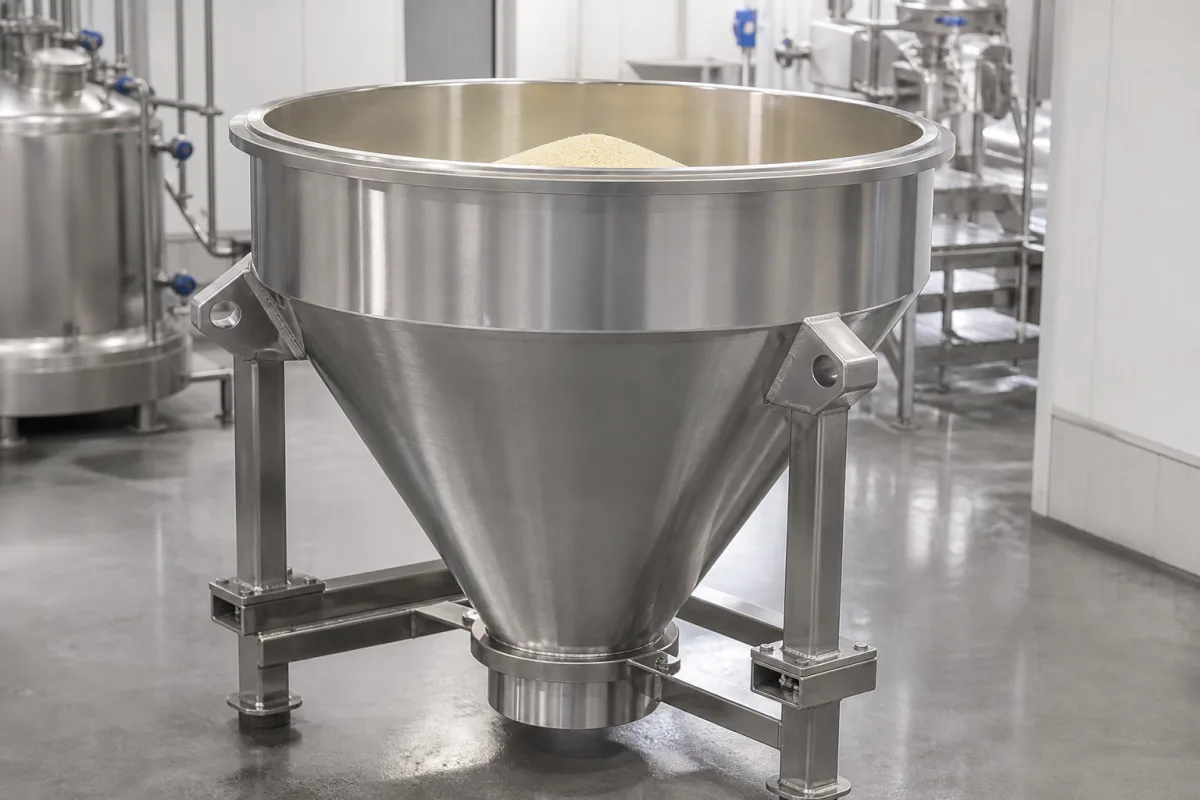
Representative product image. Confirm appearance and specifications with the manufacturer.

Product Specifications

Technical details and manufacturing context for Hopper Body

Definition
The hopper body is the primary structural component of an ingredient hopper system, serving as the containment vessel that stores bulk materials and facilitates their controlled flow into downstream processing equipment. It typically features a tapered design to prevent material bridging and ensure consistent discharge. The hopper body is manufactured from materials such as Stainless Steel 304, Carbon Steel, or Food-Grade Polyethylene, depending on the application requirements. The choice of material affects corrosion resistance, food safety compliance, and durability. The overall dimensions, including height, top diameter/width, bottom discharge diameter, and wall thickness, are specified in millimeters and must be verified for the specific model and application. The hopper body interfaces with feeding systems at the top and discharge equipment at the bottom. Its geometry, typically conical or pyramidal, utilizes gravity to direct materials toward the discharge outlet. Smooth interior surfaces and appropriate wall angles minimize friction and prevent material adhesion, ensuring reliable material flow. When selecting a hopper body, consider the material properties (e.g., flow characteristics, abrasiveness), required capacity, and the dimensions of existing equipment. Verify that the chosen material is compatible with the process conditions and any applicable regulations. For maintenance, regularly inspect for wear, corrosion, or material buildup. Failure to maintain proper wall angles or surface finish can lead to bridging or erratic flow. Always confirm model-specific specifications and standards with the legal manufacturer or supplier before procurement.
Working Principle
The hopper body receives bulk materials from feeding systems and temporarily stores them. Its geometry, typically conical or pyramidal, utilizes gravity to direct materials toward the discharge outlet at the bottom. The smooth interior surfaces and appropriate wall angles minimize friction and prevent material adhesion, ensuring reliable material flow. The tapered design helps prevent material bridging, which can obstruct discharge. The hopper body's dimensions and material selection influence flow characteristics and structural integrity. Proper design and maintenance are essential to avoid flow disruptions and ensure consistent processing.
Common Materials
Stainless Steel 304, Carbon Steel, Food-Grade Polyethylene
Technical Parameters

What to specify in your RFQ

  • Overall dimensions including height, top diameter/width, bottom discharge diameter, and wall thickness. in mm

These are the quantities to specify to the manufacturer when sizing or requesting a quote. The manufacturer's own documentation governs the exact figures and applicable standard.

Components / BOM
  • Support Legs/Brackets Part
    Provides structural support and stability for the hopper body, mounting it to the frame or floor.
    Material: Carbon Steel
  • Flange Connection Part
    Secures the hopper body to the hopper top cover or feeding system and to the discharge mechanism below.
    Material: Stainless Steel
  • Inspection Port/Cover
    Provides access for visual inspection, cleaning, and maintenance of the hopper interior.
    Material: Stainless Steel or Polycarbonate
  • Hopper Wall
    The tapered wall that holds the material and whose angle decides whether it flows or bridges.
  • Discharge Outlet
    The bottom opening the material is funnelled to; its size is what sets flow and bridging risk.

Applied To / Applications

This component is essential for the following industrial systems and equipment:

Industrial Ecosystem & Supply Chain Structure

Complementary Systems
Downstream Applications
Specialized Tooling

Application Fit & Sizing Matrix

Operational Limits
pressure: Atmospheric to 0.5 bar gauge
flow rate: 0.1 to 100 m³/h
temperature: -40°C to 150°C
slurry concentration: Up to 70% solids by weight
Media Compatibility
✓ Food-grade powders (e.g., flour, sugar) ✓ Plastic pellets (e.g., PP, PE) ✓ Dry bulk chemicals (e.g., sodium carbonate)
Unsuitable: Highly corrosive acidic slurries (e.g., concentrated sulfuric acid mixtures)
Sizing Data Required
  • Material bulk density (kg/m³)
  • Required storage capacity (m³ or kg)
  • Discharge rate requirement (kg/h or m³/h)

Reliability & Engineering Risk Analysis

Failure Mode & Root Cause
Abrasive wear and material buildup
Cause: Continuous flow of abrasive materials causing erosion of internal surfaces, combined with material adhesion leading to bridging and flow obstruction.
Structural fatigue and cracking
Cause: Cyclic loading from material impact and discharge operations, thermal expansion/contraction stresses, and vibration from connected equipment.
Maintenance Indicators
  • Visible material leakage from seams or welds indicating structural compromise
  • Unusual vibrations or audible impact noises during operation suggesting internal damage or material bridging
Engineering Tips
  • Install wear liners or apply abrasion-resistant coatings to high-impact areas, and implement regular cleaning schedules to prevent material buildup
  • Conduct periodic non-destructive testing (ultrasonic thickness testing) on critical structural areas and implement vibration monitoring to detect early fatigue issues

Indicative industry ranges for design and RFQ preparation. Confirm the exact figures and applicable standard with the manufacturer before specifying.

Compliance & Manufacturing Standards

Applicable Standards
ANSI MH14.1 - Standard for Industrial and Commercial Metal Containers DIN 6618 - Hoppers for Bulk Materials

Quoted from the published standard.

Manufacturing Precision
  • Wall Thickness: +/-0.5mm
  • Overall Dimensions: +/-2mm
Quality Inspection
  • Dimensional Verification Test
  • Leak Test (Pressure or Vacuum)

Manufacturers of Hopper Body

Manufacturer profiles associated with Hopper Body.

Sourcing Hopper Body from China?
Tell us your specification and target quantity — we will match it against manufacturer records and come back with the factories that fit.
Request manufacturers We manufacture this

Manufacturer listings support early research and capability understanding. They are not certification, ranking, or transaction guarantees.

Technical documentation
Request current drawings, revision history, and a signed specification sheet.
Manufacturing capability
Verify equipment lists, process limits, capacity, and representative production evidence.
Inspection readiness
Confirm test methods, calibrated equipment, sampling plans, and traceable reports.
Supplier transparency
Check the legal entity, factory address, ownership, certifications, and direct contacts.

CNFX does not score or rank suppliers. Buyers must verify all claims and documents with the legal manufacturer before ordering.

Supply Chain Compatible Machinery & Devices

Hydraulic Press

Industrial machine using hydraulic pressure to compress, form, or assemble materials

Explore Specs →
Heavy-Duty CNC Plasma Cutting Machine

The Heavy-Duty CNC Plasma Cutting Machine is a standalone industrial device designed for cutting conductive metals such as steel, stainless steel, aluminum, and copper alloys.

Explore Specs →
Automated Powder Coating System

Integrated industrial system for applying dry powder coatings to metal substrates.

Explore Specs →
Centrifugal Pump Impeller

The centrifugal pump impeller is a critical rotating component that converts mechanical energy from the motor into kinetic energy in fluid systems.

Explore Specs →

Frequently Asked Questions

What materials are available for the hopper body?

The hopper body can be made from Stainless Steel 304, Carbon Steel, or Food-Grade Polyethylene, as listed in the product data. The choice depends on the application, such as corrosion resistance or food contact requirements.

How do I determine the correct hopper body dimensions?

The overall dimensions, including height, top diameter/width, bottom discharge diameter, and wall thickness, are specified in millimeters. These must be matched to your process requirements and existing equipment. Always verify model-specific values with the manufacturer.

What is the function of the tapered design?

The tapered design, typically conical or pyramidal, uses gravity to guide materials toward the discharge outlet. It helps prevent material bridging and ensures consistent flow, which is critical for reliable processing.

Are there any standards or certifications for the hopper body?

No specific standards are listed in the product data. It is essential to verify any applicable standards or certifications with the legal manufacturer or supplier for your intended use.

Data Basis

Editorial classification, named public sources where available, and source-reviewed manufacturer records.

Preliminary Technical Classification
This page supports structured research, RFQ preparation, and supplier evaluation. It does not replace buyer-led supplier qualification, standards review, or technical approval.
Buyer enquiry

Request manufacturing insight for Hopper Body

Ask for use case, specification boundaries, supplier type, and RFQ preparation information for this product.

Where it goes
Straight to the CNFX editorial desk, and to the manufacturer if this product is linked to a claimed profile. Nothing is broadcast to a supplier list.
Your details stay here
We do not sell or rent enquiry data, and we do not add you to a mailing list. Used only to answer this request.
No commission, no middleman
CNFX is a directory. We take no cut of any order and never negotiate on a supplier's behalf.
What we don't claim
A listing is not an endorsement. Qualify every supplier and verify every figure yourself before ordering.

Your business information is used only to process this request.

Thank you! Your message has been sent. We'll respond within 1–3 business days.
Sorry, we couldn't send your message. Please try again, or email us at contact@cnfx.com.

Need to Manufacture Hopper Body?

Compare manufacturer profiles with relevant product and process capability.

Previous Product
Z-axis Ram/Spindle
Last Product
Get QuotesChat