Industry-Verified Manufacturing Data (2026)

Level Sensor

Based on aggregated insights from multiple verified factory profiles within the CNFX directory, the standard Level Sensor used in the Chemical Manufacturing sector typically supports operational capacities ranging from standard industrial configurations to heavy-duty production requirements.

Technical Definition & Core Assembly

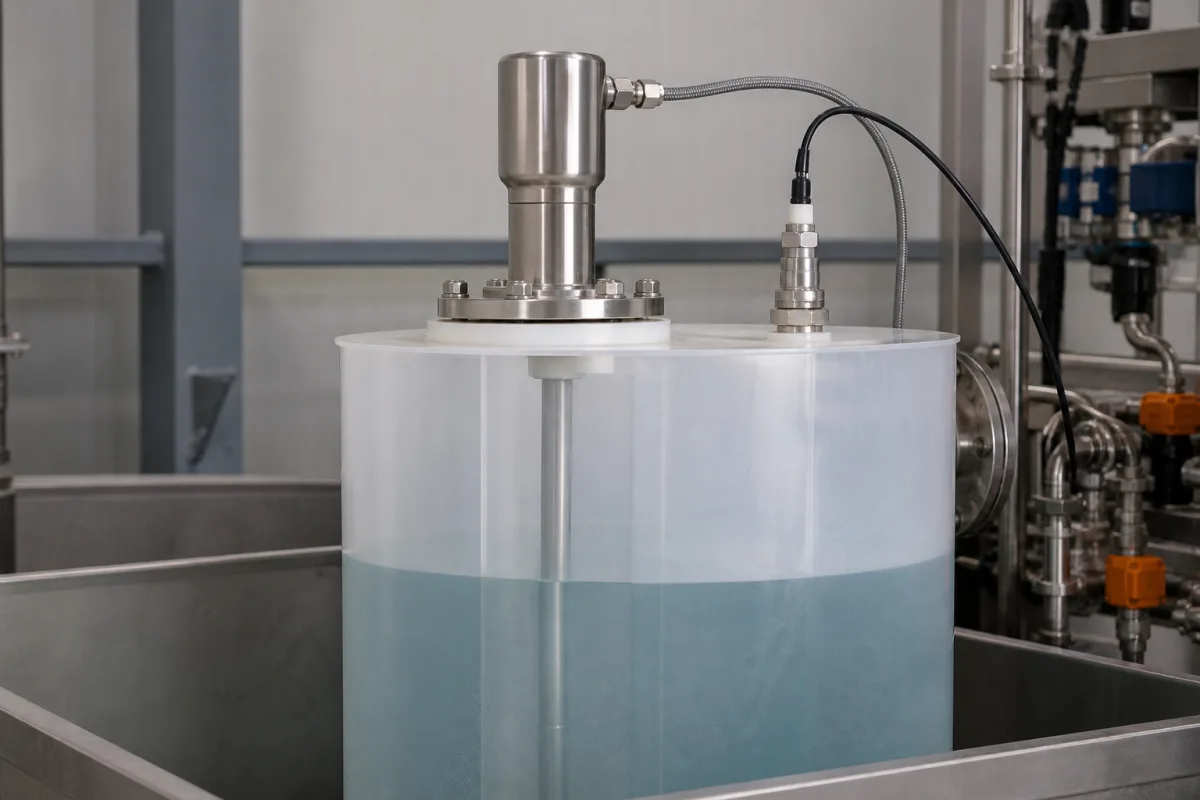
A canonical Level Sensor is characterized by the integration of Sensing Probe and Transmitter Electronics. In industrial production environments, manufacturers listed on CNFX commonly emphasize Stainless Steel (316L) construction to support stable, high-cycle operation across diverse manufacturing scenarios.

A device that measures and monitors the liquid level within a reagent storage tank.
Product Specifications

Technical details and manufacturing context for Level Sensor

Definition
A critical component of reagent storage tanks that continuously detects and reports the volume or height of stored liquid reagents, enabling precise inventory management, process control, and safety monitoring in chemical manufacturing and related industrial applications.
Working Principle
Operates by detecting changes in physical properties (such as pressure, capacitance, ultrasonic echo time, or optical reflection) caused by the presence of liquid at different levels, converting these changes into electrical signals that are processed to determine the exact liquid level.
Common Materials
Stainless Steel (316L), PTFE (Polytetrafluoroethylene), Ceramic
Technical Parameters
  • Measurement range indicating the minimum and maximum liquid levels the sensor can accurately detect (mm) Per Request
Components / BOM
  • Sensing Probe
    Directly interacts with the liquid to detect its presence and level
    Material: Stainless Steel 316L
  • Transmitter Electronics
    Processes the raw signal from the probe and converts it into a standardized output signal
    Material: Epoxy-encapsulated PCB
  • Housing/Enclosure
    Protects internal components from environmental factors and provides mounting structure
    Material: Stainless Steel 304
  • Process Seal
    Ensures a leak-proof connection between the sensor and the tank
    Material: PTFE or Viton
Engineering Reasoning
0-15 m H2O (0-147.1 kPa)
Exceeds 20 m H2O (196.1 kPa) differential pressure or operates below -40°C
Design Rationale: Diaphragm rupture due to overpressure exceeding yield strength of 316L stainless steel (205 MPa) or diaphragm stiffening below glass transition temperature of FKM elastomer (-20°C)
Risk Mitigation (FMEA)
Trigger Electrolytic corrosion from chloride concentration >1000 ppm at pH <4
Mode: Sensor membrane perforation causing dielectric breakdown
Strategy: Apply 50 μm PFA coating with 0.2% molybdenum disulfide filler
Trigger Cumulative fatigue from 10^7 pressure cycles at 0.5 Hz with 2 kPa amplitude
Mode: Capacitance plate detachment creating 15 pF baseline drift
Strategy: Implement dual-redundant MEMS sensors with cross-validation algorithm

Industry Taxonomies & Aliases

Commonly used trade names and technical identifiers for Level Sensor.

Applied To / Applications

This component is essential for the following industrial systems and equipment:

Industrial Ecosystem & Supply Chain DNA

Complementary Systems
Downstream Applications
Specialized Tooling

Application Fit & Sizing Matrix

Operational Limits
pressure: 0 to 10 bar
flow rate: Not applicable (static measurement)
temperature: -40°C to 85°C
slurry concentration: Up to 60% solids by weight
Media Compatibility
✓ Water-based reagents ✓ Corrosive acids (with appropriate wetted materials) ✓ Hydrocarbon-based liquids
Unsuitable: High-viscosity slurries with rapid settling solids
Sizing Data Required
  • Tank height and diameter
  • Required measurement accuracy (±mm)
  • Process connection type and size

Reliability & Engineering Risk Analysis

Failure Mode & Root Cause
Sensor drift or calibration loss
Cause: Material buildup on sensing element, temperature fluctuations affecting electronics, or aging of components leading to inaccurate readings.
Electrical failure or signal loss
Cause: Moisture ingress corroding connections, vibration-induced wire fatigue, or power supply issues damaging internal circuitry.
Maintenance Indicators
  • Erratic or inconsistent level readings compared to manual verification
  • Complete loss of signal output or alarm activation without level change
Engineering Tips
  • Implement regular calibration checks using certified reference methods and maintain environmental seals to prevent contamination.
  • Install vibration dampeners on mounting hardware and use shielded, properly routed cabling with drip loops to protect electrical connections.

Compliance & Manufacturing Standards

Reference Standards
IEC 61508 (Functional Safety) ISO 9001 (Quality Management Systems) ATEX Directive 2014/34/EU (Explosive Atmospheres)
Manufacturing Precision
  • Measurement Accuracy: +/-0.5% of full scale
  • Repeatability: +/-0.1% of full scale
Quality Inspection
  • Pressure Leak Test (IP67/IP68 rating verification)
  • Calibration Verification against NIST-traceable standards

Factories Producing Level Sensor

Verified manufacturers with capability to produce this product in China

✓ 95% Supplier Capability Match Found

T Technical Director from Brazil Feb 15, 2026
★★★★★
"Testing the Level Sensor now; the technical reliability results are within 1% of the laboratory datasheet."
Technical Specifications Verified
P Project Engineer from Canada Feb 12, 2026
★★★★☆
"Impressive build quality. Especially the technical reliability is very stable during long-term operation. (Delivery took slightly longer than expected, but technical support was excellent.)"
Technical Specifications Verified
S Sourcing Manager from United States Feb 09, 2026
★★★★★
"As a professional in the Chemical Manufacturing sector, I confirm this Level Sensor meets all ISO standards."
Technical Specifications Verified
Verification Protocol

“Feedback is collected from verified sourcing managers during RFQ (Request for Quote) and factory evaluation processes on CNFX. These reports represent historical performance data and technical audit summaries from our B2B manufacturing network.”

12 sourcing managers are analyzing this specification now. Last inquiry for Level Sensor from India (23m ago).

Supply Chain Compatible Machinery & Devices

Automated Batch Crystallization System

Automated system for controlled crystallization of chemical compounds in batch processes.

Explore Specs →
Automated pH Monitoring and Dosing System

Automated system for continuous pH monitoring and chemical dosing in process streams.

Explore Specs →
Automated Powder Dispensing and Blending System

Automated system for precise dispensing and homogeneous blending of powdered chemicals.

Explore Specs →
Automated Solvent Recovery and Purification System

Automated system for recovering and purifying industrial solvents.

Explore Specs →

Frequently Asked Questions

Why is 316L stainless steel used for this chemical level sensor?

316L stainless steel offers superior corrosion resistance against harsh chemicals commonly used in reagent storage, including acids and chlorides, ensuring long-term durability in chemical manufacturing environments.

How does the PTFE and ceramic construction benefit chemical level monitoring?

PTFE (Teflon) provides excellent chemical inertness and resistance to virtually all industrial chemicals, while ceramic components offer thermal stability and wear resistance, making the sensor suitable for aggressive chemical applications.

What maintenance is required for this level sensor in chemical tanks?

Minimal maintenance is needed due to the corrosion-resistant materials. Periodic visual inspection of the process seal and calibration checks of the transmitter electronics are recommended to ensure accurate readings in chemical processing applications.

Can I contact factories directly on CNFX?

CNFX is an open directory, not a transaction platform. Each factory profile provides direct contact information and production details to help you initiate direct inquiries with Chinese suppliers.

Get Quote for Level Sensor

Request technical pricing, lead times, or customized specifications for Level Sensor directly from verified manufacturing units.

Your business information is encrypted and only shared with verified Level Sensor suppliers.

Thank you! Your message has been sent. We'll respond within 1–3 business days.

Need to Manufacture Level Sensor?

Connect with verified factories specializing in this product category

Add Your Factory Contact Us
Previous Product
Level Indicator
Next Product
Level Sensor/Transmitter