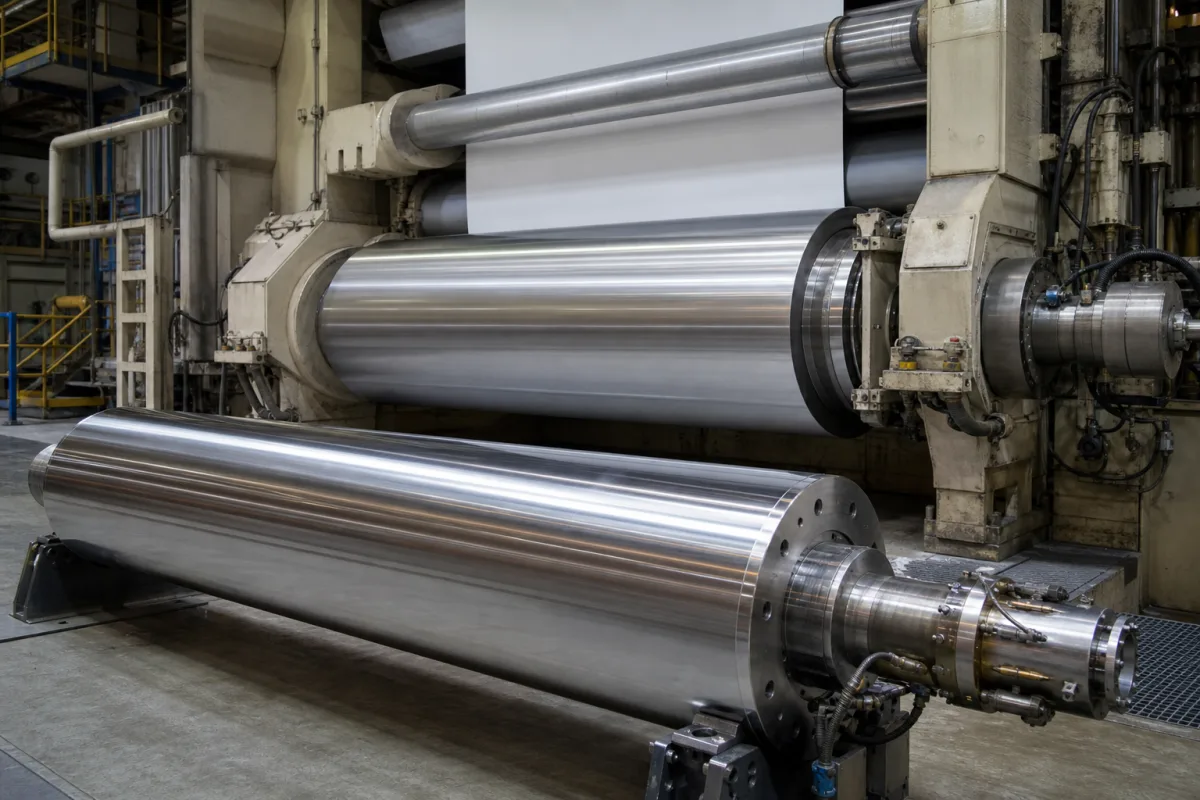
Bottom roll (support drum of a two-drum paper winder or rewinder, carrying and driving the rolls being wound)
Bottom (support) drums for two-drum paper rewinders · front and rear drum, shell and tungsten carbide coating, roughness and hardness, balancing speed, drum torque ratio and roll hardness
A bottom roll is one of the two parallel drums of a two-drum winder that carry the paper rolls being wound from the parent reel; at least one is driven, and a rider roll presses the set down onto them at the start. Ask three things first: which drum (front or rear) and machine speed it is for, what shell, surface coating and roughness grip the paper, and how the drum is driven and balanced for the torque ratio that sets roll hardness.
Bottom or support drums (front and rear) of two-drum winders and rewinders for paper and board, as new drums, replacements and recoats. Press rolls and the press section are covered on the Paper machine press section page; rider rolls, slitters, unwinds and complete winders are outside this page.
CNFX editorial research · Sources checked October 12, 2026 · 4 sources
Specify the shell, surface coating, journals and balancing
Shandong Daxing lists one rewinder bottom roll, built for a customer in Indonesia, at 450 mm diameter, 1,880 mm face length and 25 mm shell thickness, with a shell of Q235B steel plate, a plain surface coated with tungsten carbide 0.1 mm thick at roughness Ra 5-8 and hardness 1100-1200 HV, a 42CrMo shaft, SKF 2220EK bearings in cast steel housings and dynamic balance G2.5 at 900 m/min. The same page advertises "3000m/min" rewinder bottom rolls, so the balancing speed belongs to that example roll, not to the range. [1]
Editorial calculation: drum speed in min⁻¹ is web speed ÷ (π × diameter), so the 450 mm example at 900 m/min turns at 900 ÷ (3.1416 × 0.45) ≈ 637 min⁻¹; at 3,000 m/min the same diameter would turn at about 2,122 min⁻¹. Give the roll maker your maximum winder speed so it balances for that speed. [1]
For the rider roll that sits on top of the set, Daxing lists segment rider rolls of 200-300 mm diameter in segments of 800-1100 mm face at a working speed of 2,800 m/min. [2]
Give the roll maker the winder type and maximum speed, which drum (front or rear), diameter and face length, shell material and thickness, surface (plain, grooved, coated) and coating type, thickness, roughness and hardness, journal drawing and bearings, drive side and coupling, balancing grade and speed, and whether this is a new drum or a recoat.
02
Plan drive, rider roll and torque ratio for roll hardness
A Beloit patent describes the two-drum winder as "two parallel horizontal side-by-side drums with at least one driven in rotation" that support and rotate the roll being wound, with a rider roll applying a downward force at the start of winding to raise the nip pressure. It notes that because caliper and basis weight vary across the web, the roll is "usually only supported at the high profile points", which creates high nip pressure and high wound-in tension at those points; its invention uses a deformable drum surface for area contact. [4]
Valmet writes that paper rolls must be wound with uniform or diminishing hardness from core to outside, and that "as a general rule, roll hardness should be controlled mostly by the drum torque ratio rather than by web tension or rider roll pressure". It says web tension acts mainly between the unwind and the rear drum nip, so it affects roll separation more than hardness, and gives tension levels found suitable such as 2.5-3.5 pli for fine papers and 6.0-10.0 pli for liner board. [3]
Editorial conversion: 1 pli (pound-force per linear inch) is about 0.175 kN/m, so 2.5-3.5 pli is about 0.44-0.61 kN/m and 6.0-10.0 pli about 1.05-1.75 kN/m. [3]
03
Daxing rewinder bottom roll example
Shandong Daxing publishes a rewinder bottom roll example with shell, coating, bearing and balancing data. Ask for the coating process and thickness, roughness and hardness measurements, and the balancing report at your speed.
04
Steel shell, carbide coating, journals, bearings and drive
The surface does the gripping: in Daxing's example a 0.1 mm tungsten carbide layer at Ra 5-8 over a plain steel shell.
Part
Role
Fix in the order
Shell
Carries the wound rolls; steel plate in the example. [1]
Material, thickness.
Surface coating
Grip and wear; tungsten carbide in the example. [1]
Diameter, coating roughness and hardness, and balancing speed for a winder drum
All the example values come from one 450 mm roll balanced G2.5 at 900 m/min; the 3000 m/min figure on the same page is the advertised range, not this roll.
Explore company information and manufacturing capabilities, then discuss the scope of your project with a relevant supplier.
Share this page
Compiled and source-reviewed by the CNFX editorial team.
Each manufacturer above links to the page on that company's own website where the product is listed, with the date we checked it. How we source and review
· Page last updated 13 October 2026
Buyer questions
How is a bottom roll different from a press roll?
A bottom roll is a support drum of a two-drum winder that carries the rolls being wound; press rolls form dewatering nips in the press section, covered on the Paper machine press section page. [4][1]
What surface do rewinder bottom rolls have?
Daxing's example has a plain surface with a 0.1 mm tungsten carbide coating at Ra 5-8 and 1100-1200 HV. [1]
What sets the hardness of the wound roll?
Valmet says roll hardness "should be controlled mostly by the drum torque ratio rather than by web tension or rider roll pressure". [3]
Why do high spots in the web matter?
A Beloit patent explains the roll rests on its high profile points, creating high nip pressure and wound-in tension there. [4]
Sources and what still needs a direct check
Sources checked 2026-10-12. Shandong Daxing publishes its rewinder bottom and rider rolls; Valmet explains winding principles; a Beloit patent describes two-drum winder drums.