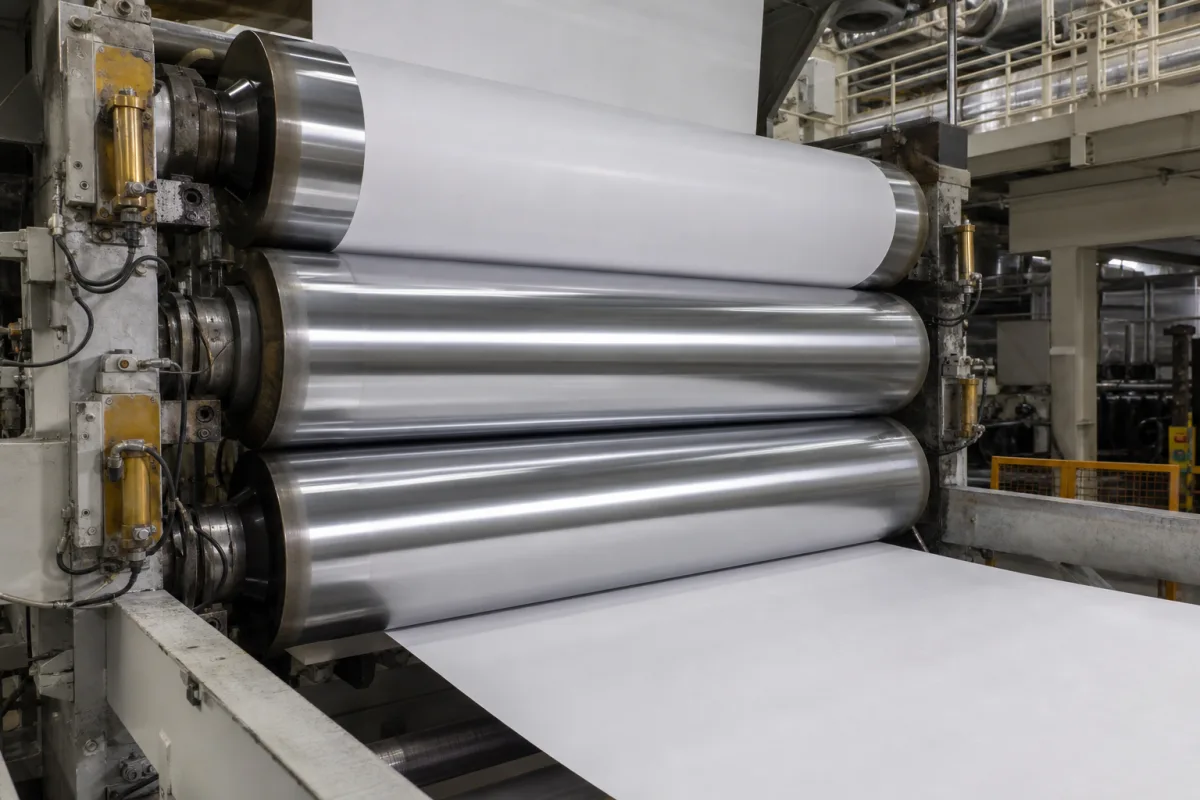
A calender presses the sheet between rolls, which may be heated, to make it smoother and more even in thickness. Every gain in smoothness and gloss costs density, stiffness and bulk, so start from the surface and caliper targets for your grade and let the nip type, load and temperature follow.
Machine calenders, hard-nip and soft-nip calenders and multi-nip stacks on paper and board machines. Off-line supercalenders share the principles but are purchased as separate machines.
CNFX editorial research · Sources checked October 12, 2026 · 6 sources
Valmet's calendering notes list the favourable changes as large gains in smoothness and gloss with lower air permeability and oil absorption, and the unfavourable ones as higher density, lower caliper, stiffness and compressibility, and smaller losses in opacity, brightness and tensile strength. [1]
The variables you can set
Valmet groups the variables as the paper (moisture, temperature, furnish, formation), any coating, the nip mechanics (number of nips, linear load as maximum pressure and nip width, roll dimensions, soft cover modulus and roughness), the thermo roll (surface temperature and roughness) and machine speed. [1]
Maximum compression rises with linear load and cover modulus and as roll diameter falls. Dwell time depends on load, roll diameters, cover modulus, speed and the number of nips. Valmet notes that the largest bulk changes happen in the first nips and that "the significance of dwell time in a single nip decreases as the number of nips increases - normally after nine nips". [1]
Heat and moisture make the sheet plastic
Valmet gives lignin a softening temperature of about 115 °C regardless of moisture, while hemicellulose and cellulose soften at lower temperatures as moisture rises. Heat therefore plasticises lignin and moisture softens the carbohydrates; both let the surface deform with less loss of bulk than load alone. [1]
Too much moisture under compression lets flocs bond and turn more transparent, which shows as blackening. Agree the sheet moisture at the calender with the dryer-section design. [1]
02
Choose between hard and soft nips
Toscotec describes two machine-calender concepts, each with a heated roll and a deflection-compensating roll that sets the cross-direction line load. Its hard-nip calender uses two hard-surfaced rolls for smoothness and precise caliper before coating; its soft-nip calender has a soft cover of fibre-reinforced epoxy on the compensating roll and gives higher smoothness, with effects on density and printability. [4]
Nip type
What it does
Ask the supplier for
Hard nip (steel/chilled-iron rolls)
Presses the high points of the sheet hardest, evening caliper. Chilled-iron rolls are smoother than polymer rolls and reproduce a smoother surface. [4][1]
Load range, heated-roll temperature and the caliper profile achieved on your grade.
Soft nip (polymer-covered roll)
A compliant cover lowers the modulus in the nip, which widens it; Toscotec credits the soft nip with higher smoothness and more uniform density. [4][1]
Cover material, hardness and temperature limit; load range and nip width.
Multi-nip stack
A series of nips using elastic polymer rolls, as in supercalenders. [2]
Number of nips, roll sequence, which side each nip finishes, and roll-change logistics.
Gloss develops against the harder roll, and the paper surface reproduces the roll surface, so the steel roll must be very smooth. Valmet advises running the rougher side of the sheet against the early-nip steel rolls. [1]
Toscotec offers deflection-compensated rolls with an oil-filled pressure chamber to give uniform force across the width. Ask how the offered roll corrects the CD caliper profile and what profile it will hold at your load. [4]
03
Choose roll covers by hardness, temperature and position
Valmet's roll-cover white paper (2014) gives hardness, thickness and temperature limits for each cover family, calling the rubber figures a "typical range". Treat them as one supplier's ranges and ask for the limits of the actual cover offered. [2]
Cover family (Valmet)
Published properties
Use in calendering
Rubber
Hardness 2–200 P&J, thickness 10–50 mm (Valmet's "typical range"); cover temperature "ordinarily limited to 90 °C", HNBR to 160–170 °C; high heat generation in the loading cycle. [2]
Valmet names guide rolls for fabrics and the paper web, size press rolls, mating rolls of blade coaters and soft reeling cylinders as "The most typical applications". [2]
Polyurethane
Lower heat generation and better wear than rubber; about 90 °C in wet and 110–120 °C in dry conditions; absorbs some water. [2]
Some calendering applications.
Composite
85–95 Shore D; up to about 100 °C; very low heat generation. [2]
Calender nips where pressures can reach 100 MPa; Valmet credits composite covers with making online calendering possible.
Carbide and ceramic hard coatings
Above 1100 HV; for glossy grades they are periodically superfinished, with a "typical maintenance interval" of 6 to 12 months. [2]
Thermo rolls and other hard-roll positions.
In multi-nip calenders Valmet describes the top roll as wearing fastest because of paper roughness and the bottom roll as carrying the heaviest load and being "the most frequently changed", since it is the last nip to affect quality. It uses nodular cast iron for polymer-roll shells for its vibration damping and can circulate water through the roll to even out shell temperature at high speed. [2]
Barring and vibration are recurring cover problems. Ask for the cover's maximum load, temperature and speed, its regrind interval and the vibration-monitoring arrangement. [2]
04
Thermo roll, deflection-compensated roll, loading hydraulics, heating and doctors in a calender stack
Roll materials, sizes and ratings come from the drawings of the calender you order.
Assembly
Role and published construction
Fix in the order
Thermo (heated) roll
Hard roll with a heated surface for a uniform temperature profile. [4] Rotary joints carry hot water or hot oil into heated calender rolls. [5]
Shell material and surface finish, heating medium and temperature, rotary joint, and regrind allowance.
Deflection-compensated roll
Sets a controllable cross-direction line load; may carry a soft cover. [4]
Compensation principle, zone control, load range and cover.
Intermediate and polymer rolls (multi-nip)
Elastic rolls between hard rolls; shells in nodular cast iron for damping, optionally water-circulated. [2]
Cover type and limits, shell material, cooling and change sequence.
Top and bottom rolls of a stack
The top roll has the highest wear; the bottom roll carries the heaviest load. [2]
Roll diameters, crowns or compensation, and spare-roll policy.
Hydraulic loading system
Applies and releases the nip load; in a stack the hydraulics also move the bottom roll and platforms. [3]
Load range, opening speed for web breaks, and lock-out points.
Roll heating and cooling system
Supplies the heating medium to the thermo roll and cooling where needed; temperature scanners can control cooling devices. [5][3]
Heating unit, medium, temperature control and the allowed rate of temperature change.
Doctors, threading and web-break devices
Doctor blades keep rolls clean; threading platforms or rope carriers lead the tail through; web-break detection protects soft rolls from wraps. [3][6]
Doctor positions, threading method, break detection and nip opening on breaks.
Guards, platforms and walkways
Keep people away from nips and moving rolls. [3][6]
Nip guards, gates, steps and handrails, and their interlocks.
Lubrication and drives
Bearings and drives of each roll.
Bearing type, lubrication method and drive arrangement.
05
Operate the stack without damaging rolls or people
Valmet's calender safety notes treat every nip as a danger area and warn against threading closed nips by hand, passing broke through nips, or reaching under moving components unless the hydraulics are locked out. [3]
Protect the rolls from thermal shock and overheating
Valmet warns not to spray calender rolls with water or steam because sudden temperature change can crack chilled-iron rolls, and states that surface temperature changes should not exceed 50 °F (28 °C) within twenty minutes. It also warns that overheating or running loaded polymer rolls without a web can crack the covers. [3]
Low-moisture paper calendered by non-conducting polymer rolls can build up static. Include static control and the heating-system limits in the scope. [3]
Build safe threading and access into the design
For US workplaces, OSHA 29 CFR 1910.261(k) requires a feeder belt or other effective device for starting paper through the calender stack, steps or ladders with handrails at each stack, and an effective barrier at calender nip points or feeding by rope carrier, air jets or hand-feeding devices. [6]
Valmet also recommends long-handled roll-cleaning tools and hose nozzles too large to enter a nip. Ask the supplier which of these are included. [3]
06
Nips, width, line load, speed, roll and heating values for a calender quotation
Values in this table come from Valmet's calendering notes and roll-cover white paper and from Kadant; where neither states a value, the row says what to obtain from the supplier.
Field
What it means and published values
Ask the supplier for
Number of rolls / nips
Bulk loss is greatest in the first nips; single-nip dwell time matters less as nips are added. [1]
Nip count and roll sequence for each grade.
Maximum web width (mm)
Set by the machine trim.
Roll face length against trim and edge allowance.
Maximum line load (kN/m)
With roll diameters and cover modulus, sets maximum compression. [1]
Minimum and maximum load per nip and the CD profile control range.
Nip width (mm)
Widens with softer covers and larger rolls; sets dwell time with speed. [1]
Nip width at operating load for each nip.
Maximum speed (m/min)
Affects dwell time and cover heat build-up. [1][2]
Design speed and the cover and roll limits at that speed.
The sheet reproduces the roll surface; glossy grades need periodically superfinished hard rolls. [1][2]
Surface roughness at delivery and the refinishing interval.
Drive power (kW)
Depends on speed, nip count and load.
Drive list per roll and the drive arrangement.
Machine weight (t)
Needed for foundations and roll-change lifting.
Mass of each roll and frame and the heaviest lift.
07
Send the grade and surface targets together
Paste it into your enquiry below or into an email to a maker, then replace every bracket.
Machine and grade: [grades; basis weight; coated or uncoated; design and operating speed; trim width]
Targets: [smoothness and gloss; caliper and CD caliper profile; minimum bulk and stiffness]
Sheet at the calender: [moisture; temperature; which side is rougher]
Calender type: [hard nip, soft nip or multi-nip; number of nips; roll sequence]
Rolls: [diameters; shell materials; covers with hardness and temperature limits; surface finish]
Load and profile: [load range per nip; deflection compensation; CD profile control]
Heating: [medium; thermo-roll temperature; heating unit; allowed rate of temperature change]
Operation: [threading method; web-break detection and nip opening; doctors; static control]
Safety: [nip guards; platforms, steps and handrails; interlocks and lock-out points]
Handover: [roll-change procedure; regrind intervals; spare rolls; manuals and training]
Explore company information and manufacturing capabilities, then discuss the scope of your project with a relevant supplier.
Share this page
Compiled and source-reviewed by the CNFX editorial team.
Each manufacturer above links to the page on that company's own website where the product is listed, with the date we checked it. How we source and review
· Page last updated 13 October 2026
Buyer questions
Can calendering improve smoothness without losing bulk?
Not entirely. Valmet lists higher density and lower caliper and stiffness among the unfavourable changes. Heat and moisture let the surface deform with less loss, and the first nips cause the largest bulk change, so the nip arrangement and sheet condition decide how much bulk you keep. [1]
Is a soft-nip calender always better than a hard nip?
Toscotec presents the soft nip as giving higher smoothness and more uniform density, and the hard nip as cost-effective with precise caliper before coating. Choose from your grade's targets and test results. [4]
Why must calender roll temperature change slowly?
Valmet warns that sudden temperature change can crack chilled-iron rolls and limits surface changes to 50 °F (28 °C) within twenty minutes. Overheating can also crack polymer covers. [3]
Sources and what still needs a direct check
Sources checked 2026-10-12. Valmet, Toscotec and Kadant are supplier publications: their ranges and recommendations describe their own products and experience. OSHA applies to US workplaces.