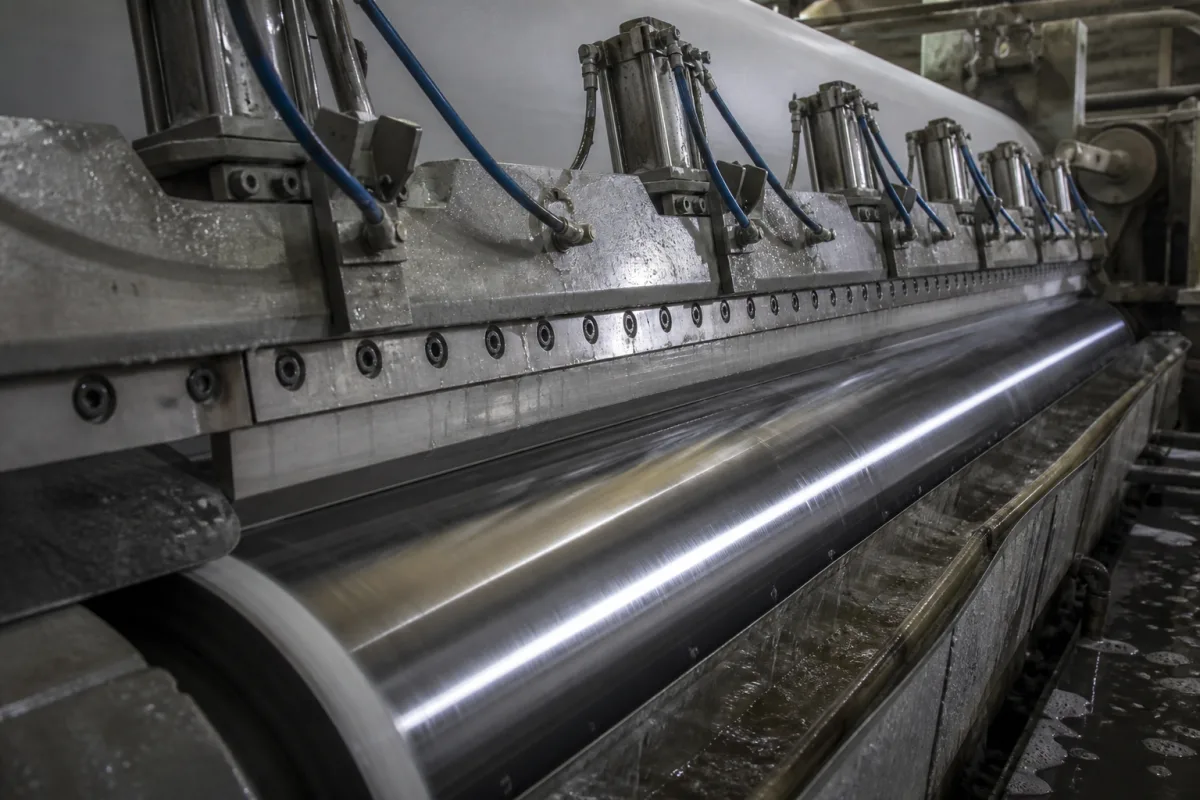
Paper machine doctoring system (doctor beam, blade holder, loading and oscillation)
Paper machine doctoring systems · doctor beam, blade holder, loading, oscillation and blade material for cleaning, sheet shedding and creping
A doctoring system is the assembly that holds a blade against a rotating roll or cylinder on a paper machine to keep it clean, peel the sheet off it, or crepe tissue from a Yankee dryer. It is made of a doctor beam on bearings, a blade holder, a loading and relief device, an oscillator, showers and the doctor blade itself. Ask three things first: which duty each doctor position has, how the beam and holder apply an even load across the roll, and which blade material suits the roll cover.
Doctoring assemblies on paper, board and tissue machines: doctor beams and bearings, blade holders, loading and oscillation devices, showers and doctor blades for cleaning, sheet-shedding and Yankee creping positions across forming, press, dryer and calender sections. Press nips, shoe presses, press rolls and felts are covered on the Paper machine press section page. Coating blades and gravure printing doctor blades are outside this page.
CNFX editorial research · Sources checked October 12, 2026 · 5 sources
Valmet's Doctoring 101 paper lists four ways to load a doctor: a mechanical spring, a pneumatic or hydraulic cylinder, gravity, or a hose-loaded blade holder with the beam locked by turnbuckles. It warns that a doctor beam's cross-section is very small compared with its length, so the beam is weak in torsion; a spring at the tending side loads one end only and the blade load falls along the doctor, and cylinders at both ends still leave the load decreasing towards the centre. [1]
Gravity loading on a beam of uniform cross-section gives an even load over the full length, but Valmet notes that the load is hard to adjust once the journal position is fixed, and that high loads need a heavy beam. A hose-loaded holder gives even loading similar to gravity; Valmet says the cylinders that press the beam to a mechanical stop should carry at least three times the maximum total load the hose-loaded holder will apply. [1]
Valmet also explains why sheet-removal and cleaning doctors are built differently: when the doctor removes a sheet, the sheet force shifts the resultant force on the blade, so a journal placed for cleaning can create a moment that lifts the blade (a sheet skip) or, the other way, makes it dig in and chatter. The journal location therefore follows the doctor's intended use. [1]
Kadant's tube-loaded holders show the load ranges involved on Yankee dryers: its Conformatic L holder is designed for loading requirements up to 25 PLI and the Conformatic XL up to 80 PLI; the Conformatic AL creping holder lists a conforming liquid tube capable of loads to 50 PLI, with optional vibration accelerometers and blade load sensors. [2][3] Editorial calculation: 1 PLI (pound-force per linear inch) ≈ 0.175 kN/m, so 25, 50 and 80 PLI are about 4.4, 8.8 and 14.0 kN/m.
Give the supplier each doctor position (roll, section, cleaning, sheet shedding or creping), roll diameter, cover and face length, machine speed, existing beam and journal positions, the loading medium available (air or hydraulics), and the blade load range required.
02
Set blade material, angle and oscillation for the duty
A patent filed by Thermo Web Systems (now part of Kadant) describes creping doctors as running at blade angles of 10°-30°, which it calls the creping angle, with blade loads of 15-40 PLI, and states that the low loads on cleaning doctors deflect the blade so little that the angle change has a negligible effect on cleaning and sheet-shedding performance. [4] Editorial calculation: 15–40 PLI ≈ 2.6–7.0 kN/m.
Valmet groups doctor blades into three types: metal (carbon steel, stainless steel, Monel, bronze, and thermal-coated with ceramic or carbide), plastic (polyethylene) and composites of laminated resin with a binding material. It traces high-density polyethylene blades to the soft roll covers introduced from the early 1980s, which metal and composite blades damaged, and describes composite blades made by pressing or by continuous pultrusion. [1]
Clouth's VERTURA-100S is one composite example: a carbon-fibre fabric with an epoxy-resin system, bending strength up to 800 N/mm², temperature resistance (Tg) of 185 °C, standard thicknesses of 1.5 and 1.9 mm in widths of 50 and 75 mm, and a 20° bevel, single or double. [5]
On oscillation, Valmet reports that recent mill experience shows very good doctoring without it, but where it is used, it gives as good practice 1 to 10 cycles per minute, a stroke length of 10 to 16 mm, smooth linear motion, moderate dwell at the ends and no significant backlash. It describes pneumatic oscillators of the piston-and-cylinder type as preferable to bellows types, which give jerky motion. [1]
03
Gravity, pneumatic or creping: how published holders differ by position
The table sets published holders and doctors side by side; each row comes from the maker cited. No supplier card has been confirmed for this product yet.
Ask each supplier to state the holder type, rated load, blade sizes it accepts and the beam and bearing design for your roll.
Explore company information and manufacturing capabilities, then discuss the scope of your project with a relevant supplier.
Share this page
Compiled and source-reviewed by the CNFX editorial team.
Each manufacturer above links to the page on that company's own website where the product is listed, with the date we checked it. How we source and review
· Page last updated 13 October 2026
Buyer questions
How far should a doctor oscillate?
Valmet gives 1 to 10 cycles per minute and a 10 to 16 mm stroke as good practice where oscillation is used. [1]
What blade load does a Yankee doctor holder take?
Kadant rates its Conformatic L holder to 25 PLI and Conformatic XL to 80 PLI; a patent gives 15–40 PLI for creping doctors. [2][4]
Why does beam loading method matter?
Valmet notes the beam is weak in torsion, so end loading lets blade load fall along the doctor, while gravity or hose loading gives an even load. [1]
Sources and what still needs a direct check
Sources checked 2026-10-12. Valmet's paper is a doctoring overview by a paper machine supplier; Kadant and Clouth describe their own holders and blades; the patent was filed by a predecessor of Kadant. Ask for the rated load and blade data for the exact holder you buy.