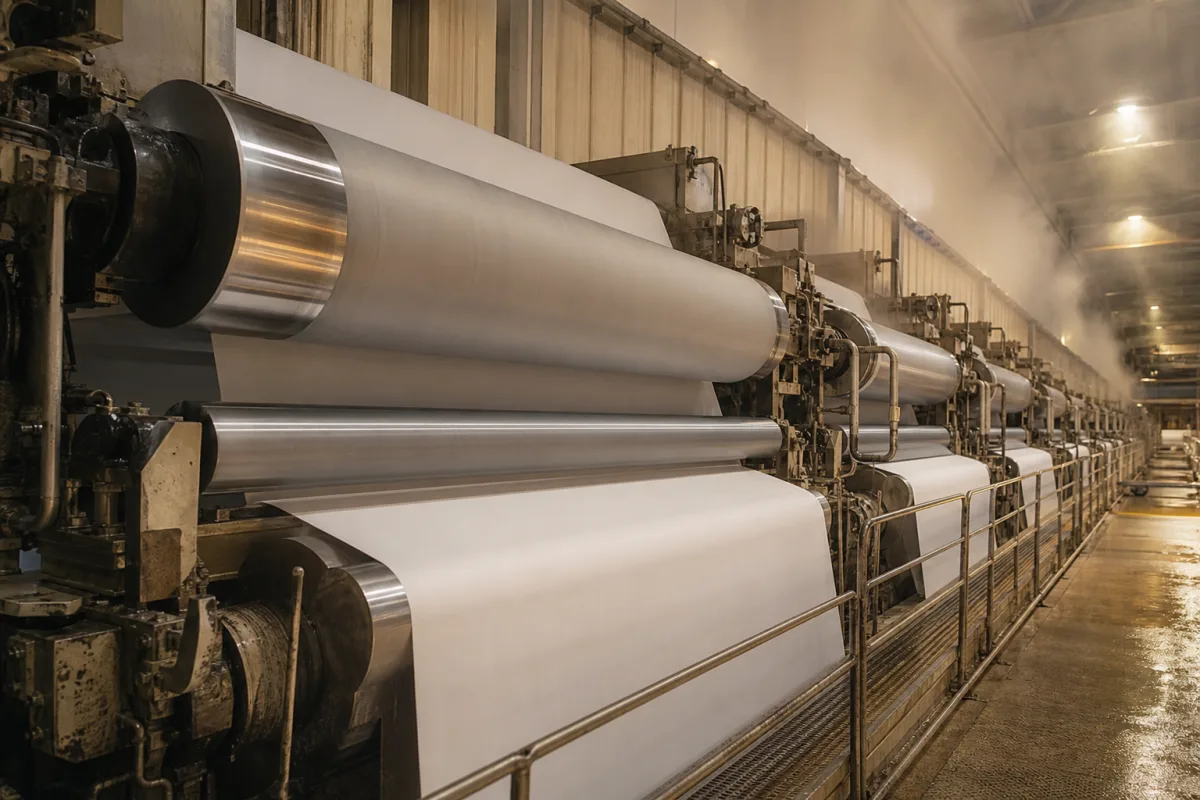
Papermaking · Steam-heated cylinders after the press
The dryer section evaporates the water the press could not remove, using steam-heated cylinders in contact with the sheet. How much heat actually reaches the sheet depends on getting condensate out of every cylinder, so the syphons, dryer bars and steam system matter as much as the number of cylinders.
Multi-cylinder dryer sections of paper and board machines: dryer cylinders, steam and condensate equipment, fabrics and their rolls, and cylinder inspection. Yankee dryers on tissue machines and the hood air system need separate assessment.
CNFX editorial research · Sources checked October 12, 2026 · 10 sources
Steam enters each cylinder through a rotary joint, condenses on the inside of the shell and gives up its heat through the shell to the paper. The condensate must leave through a syphon. Kadant notes that every steam-heated drying cylinder has at least one rotary joint and syphon, and that the design and operation of the syphon and dryer bars bear on a cylinder's heat-transfer capacity. [1]
Condensate changes behaviour with speed
At low speed condensate collects as a puddle at the bottom of the cylinder (ponding). As speed rises it is carried up the shell and falls back (cascading). At high speed it forms a layer that rotates with the whole shell (rimming). A stagnant rimming layer insulates the shell from the steam, even when thin. [4]
Dryer bars fixed axially inside the shell set up turbulence in that layer and raise heat transfer. Kadant lists machine speed, condensing load, steam pressure, syphon location and clearance, and the number and arrangement of bars as the factors that set the result, with the best transfer when syphon clearance is near its optimum. [3]
Ask for the heat path, not only the cylinder count
A quotation that lists cylinder diameter and number but leaves out the syphon type, clearance setting, bars and steam/condensate system does not tell you how much of the installed surface will actually dry paper at your speed. Ask the supplier to state these items for each dryer group.
02
Choose rotary or stationary syphons from the condensate state
Kadant uses rotary syphons, which turn with the dryer, for lower speeds where condensate pools, and stationary syphons for higher speeds where condensate rims. Its published speed limits for paper-machine syphons illustrate the split; they are one maker's product limits, not general rules. [2]
Syphon type (Kadant)
Condensate state and use
Published speed limit
Rotary scoop syphon
Non-rimming cylinders with a manhole; a wide shoe collects condensate as it rotates; slow machines. [2]
Up to 650 fpm (about 198 m/min)
Heavy-duty rotary syphon
Rimming applications; a spring holds the stainless pick-up foot in position against the shell. [2]
Below 3,300 fpm (about 1,006 m/min)
Internally supported stationary syphon
Small-bore journals and open-gear machines at medium to high speed; carried on an internal carbon bushing. [2]
Dryer bars belong to the rimming range. Kadant's patent describes embodiments with 18 and 21 bar rows and a preferred number of rows of three to four times the dryer diameter in feet; for a 5 ft dryer that is 15–20 rows. Bars must fit through the head manholes if the heads are not removed. [4]
Kadant reports that its bars increase drying rate and reduce cross-machine temperature variation. Treat the size of any gain as the supplier's claim and ask how it will be measured on your machine. [3]
For a rebuild that raises speed, re-check the syphon type and clearance for every cylinder: a syphon chosen for cascading condensate may be outside its range once the condensate rims.
03
Arrange single- and double-tier groups for runnability and curl
In a single-tier group the sheet runs on the fabric over top cylinders and under vacuum rolls; in a double-tier group it contacts upper and lower cylinders in turn. Toscotec describes two concepts: a hybrid with single-tier groups at the front and double-tier groups at the rear, drying both sides to limit curl in a shorter section, and an all single-tier layout for the highest speeds, where suctioned stabiliser rolls hold the web to the fabric. [5]
These are the supplier's design descriptions. Ask which groups are single- or double-tier in the offered layout, where the first open draw sits, how the tail is threaded, and how both sides of the sheet are dried for the grades you make.
YUELI lists the aims of its dryer section as drying to the required moisture, uniform cross- and machine-direction moisture profiles, avoiding curl and good runnability. Ask how each is measured at acceptance. [10]
04
Cylinders, joints, syphons, fabrics and guards in a dryer section
Rotary joints, syphons and dryer bars set how much heat each cylinder delivers; the other rows cover the sheet path, gear guarding and air handling. Quantities, materials and ratings come from the drawings of the section you order. [1][3]
Assembly
Role and published construction
Fix in the order
Dryer cylinders
Steam-heated pressure vessels that carry the sheet. Typical paper dryers are 4, 5 or 6 ft in diameter, with some up to 7 ft. [4] VANVEO lists steel cylinders of 1000–5000 mm diameter and 1500–8000 mm face, 0.8–1.2 MPa working steam pressure and ≤180 °C design temperature. [8] Toscotec states that welded steel shells are thinner than cast iron, giving higher heat transfer, and are ductile. [5]
Shell material and thickness, design pressure and temperature, construction code, face length and diameter, and the pressure-vessel documentation.
Rotary joints
Connect the stationary steam and condensate piping to the rotating cylinder. [1] VANVEO offers single-pass or dual-pass steam joints on its steel cylinders. [8]
Joint type and size, support arrangement, and the steam pressure and speed it is rated for.
Syphons
Lift condensate out of the cylinder; rotary or stationary according to speed and condensate state. [2]
Syphon type, shoe clearance and setting method for each cylinder.
Dryer bars
Axial bars inside the shell that turn the rimming condensate layer turbulent. [4][3]
Whether bars are fitted, number of rows, bar material and fixing method.
Steam and condensate system
Supplies steam to each dryer group and removes condensate and blow-through steam. Its design, with the syphons and bars, sets how much heat each cylinder delivers. [1][3]
Group pressures and differential pressure, condensate separators, and controls.
Dryer fabrics and their rolls
Hold the sheet against the cylinders. Daxing describes canvas (fabric) rolls with seamless or welded steel shells, HT250 or QT500-7 heads, 42CrMo journals, rubber or chrome covers, up to 1000 mm diameter and 14000 mm face. [9]
Fabric runs, roll diameters and covers, balance speed and the fabric tension and guide system.
Vacuum and stabiliser rolls
In single-tier groups, suctioned rolls hold the web on the fabric between cylinders. [5]
Roll positions, vacuum supply and the threading arrangement.
Fabric cleaning
Removes contamination from dryer fabrics; Toscotec lists Voith's four-directional water-jet cleaner as an option. [5]
Cleaning method, water and position for each fabric.
Drives and gears
Rotate the cylinders. OSHA requires dryer gears to be guarded unless the oilers' walkway is out of reach of the gear nips and spokes. [7]
Drive arrangement (open or closed gears), lubrication method and guarding.
Hood and moisture-profile control
Enclose the section and manage the moist air, and correct the cross-machine moisture profile.
Hood type, air system and the profile-measurement and actuator arrangement. These were not reviewed in the sources for this page.
05
Inspect each cylinder as a pressure vessel
TAPPI's TIP 0402-16 (2026) gives guidelines for inspecting and non-destructively testing steam-heated grey cast iron cylinders used as paper dryers. Its summary notes that grey cast iron needs extra care because it lacks a well-defined elastic limit, that the TIP does not judge the significance of damage, and that it does not replace local jurisdictional rules. [6]
Know what an inspection covers
The TIP covers the dryer pressure vessel itself, not the steam and condensate piping, relief valves, bearings, gears or doctors, and it excludes large Yankee dryers. For judging corrosion or wear it points to API 579-1/ASME FFS-1 fitness-for-service rules. These points come from TAPPI's published summary; the full TIP was not read for this page. [6]
For a new or replacement cylinder, ask for the design code and documentation that let your inspector work to the applicable rules: design pressure and temperature, minimum shell thickness and the material record.
Plan safe access around the dryers
For US workplaces, OSHA 29 CFR 1910.261(k) requires a guardrail or apron guard in front of the first dryer of each section, insulation or guarding of exposed steam and hot-water pipes within 7 ft of the floor or platform, guarded dryer gears, and automatic oilers or remote grease fittings where gear bearings are oiled while running. Other jurisdictions apply their own rules. [7]
06
Cylinder size and steam pressure are published; drying rate is not
The published figures here come from VANVEO's steel-cylinder page and the dryer-bar patent; drying rate and steam consumption depend on the whole section, so ask for the basis behind any number quoted. [8][4]
Field
What it means and published values
Ask the supplier for
Number of cylinders
Set by the water to be evaporated, speed and grade, and split into steam groups.
Cylinders per group and the single- or double-tier arrangement of each group.
Cylinder diameter (mm)
Typical paper dryers are 4–6 ft (about 1.2–1.8 m), some 7 ft. [4] VANVEO lists 1000–5000 mm for its steel cylinders. [8]
Syphon type and clearance, bar rows, and the speed range they cover.
Moisture profile and temperature control
YUELI lists uniform CD and MD moisture profiles as a design aim. [10]
How profile and temperature are measured and corrected, and the acceptance tolerance.
Drive power (kW)
Depends on speed, cylinder count and condensate state.
A drive list by group, with gear or direct-drive arrangement.
Machine weight and footprint
Needed for foundations, building and crane.
Mass of each cylinder and frame, total footprint and the heaviest lift.
Electrical supply
Set by the mill's supply and local rules.
Voltage and frequency, and protection ratings for hot, humid locations.
07
Send the grade, speed and dryness targets together
Paste it into your enquiry below or into an email to a maker, then replace every bracket.
Machine and grade: [grades; basis weight range; design and operating speed; trim width]
Dryness: [dryness entering the dryer section; target at reel; moisture profile tolerance]
Layout: [number of groups; single- or double-tier per group; open draws; threading method]
Cylinders: [diameter; face length; material; shell thickness; design pressure and temperature; construction code]
Steam and condensate: [steam pressure per group; differential pressure; rotary joints; syphon type and clearance; dryer bars]
Fabrics and rolls: [fabric runs; roll sizes and covers; vacuum/stabiliser rolls; tension and guiding; cleaning]
Hood and profile: [hood type; air system; moisture-profile measurement and actuators]
Drives: [drive arrangement; gears; lubrication; power list]
Installation: [foundations; masses; heaviest lift; shutdown time for a rebuild]
Safety and records: [guards; walkways; pipe insulation; pressure-vessel documents; inspection access]
YUELI lists a dryer section within its paper machine range; VANVEO offers cast iron and steel dryer cylinders; Shandong Daxing publishes dryer-section rolls.
YUELI MACHINERY
Taichung, Taiwan head office; Wuxi, Jiangsu address — both published
Lists a dryer section in its paper machine range with design aims (required moisture, uniform CD and MD profiles, curl control, runnability). No numerical data is published; ask for the cylinder and steam-system specification.
Offers cast iron and steel dryer cylinders, including Yankee cylinders. Its steel cylinder page lists 1000–5000 mm diameter, 1500–8000 mm face, 0.8–1.2 MPa working steam pressure, ≤180 °C design temperature and GB/ISO/ASME manufacturing standards.
Publishes dryer-section rolls: canvas (fabric) rolls, vacuum rolls and hard-chrome rolls. Its canvas rolls list steel shells, HT250 or QT500-7 heads, 42CrMo journals, rubber or chrome covers, up to 1000 mm diameter and 14000 mm face.
Explore company information and manufacturing capabilities, then discuss the scope of your project with a relevant supplier.
Share this page
Compiled and source-reviewed by the CNFX editorial team.
Each manufacturer above links to the page on that company's own website where the product is listed, with the date we checked it. How we source and review
· Page last updated 13 October 2026
Buyer questions
Will a faster machine dry the same way with the same syphons?
Not necessarily. Condensate moves from ponding to cascading to rimming as speed rises, and Kadant uses rotary syphons for pooling condensate and stationary syphons for rimming condensate at higher speeds. Check the syphon type, clearance and bars for the new speed. [4][2]
Is a steel dryer cylinder always better than cast iron?
Toscotec argues that welded steel shells are thinner, transfer more heat and are ductile. That is a supplier's case. Grey cast iron dryers are the subject of TAPPI's inspection guidance. Compare the offered cylinders on shell thickness, pressure rating, code and inspection access. [5][6]
Does a dryer inspection cover the steam piping and relief valves?
TAPPI's TIP 0402-16 covers the dryer pressure vessel itself and states that piping, relief valves, bearings, gears and doctors are not directly covered. Plan their inspection separately. [6]
Sources and what still needs a direct check
Sources checked 2026-10-12. Kadant, Toscotec and VANVEO are supplier publications: their ranges and claims describe their own products. The TAPPI points come from TAPPI's published summary of TIP 0402-16; the full document was not read. OSHA applies to US workplaces.