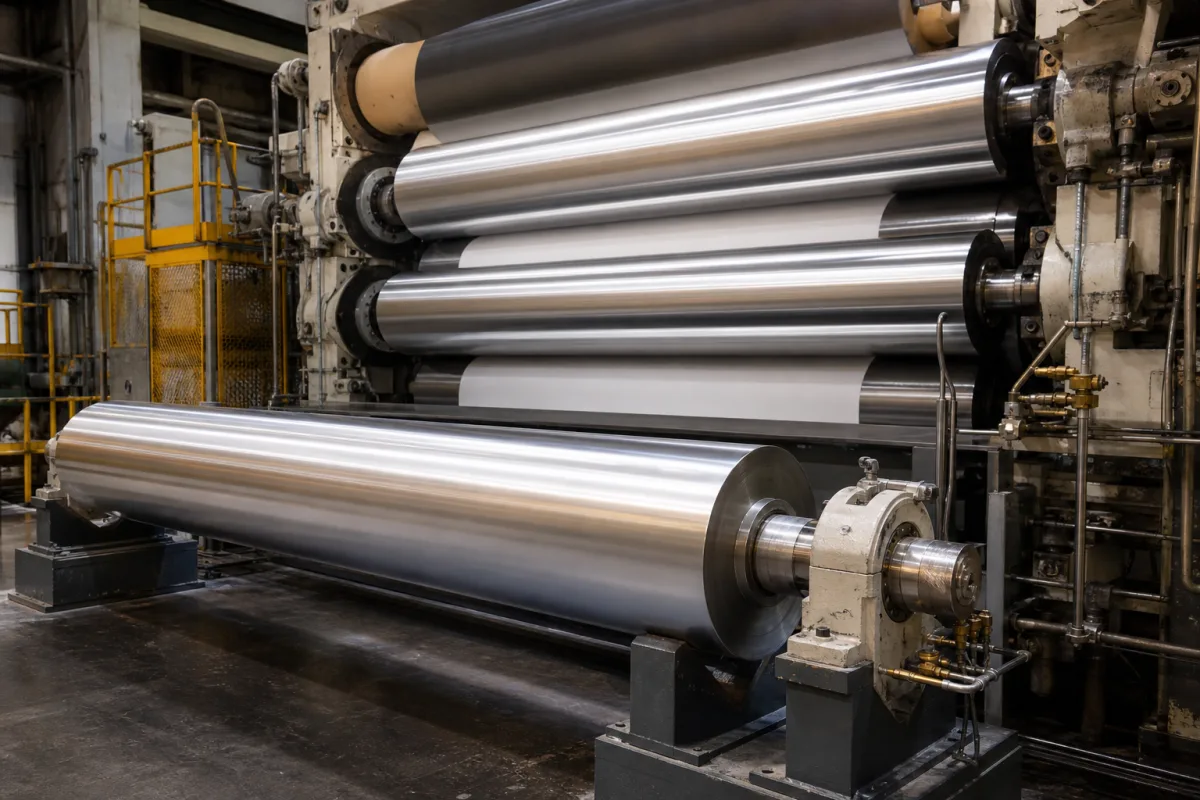
Intermediate rolls for calender and supercalender stacks: chilled and polymer-covered rolls between the top and bottom rolls
Intermediate rolls of supercalender and multi-nip calender stacks · Chilled hard-faced rolls alternating with polymer or fibre-filled soft rolls, bearing-housing relief, crown and edge relief, Shore D cover hardness and grind tolerances
This page covers the intermediate rolls of supercalender and multi-nip calender stacks: the rolls between the loaded top roll and the bottom roll, where hard chilled rolls and soft polymer- or fibre-faced rolls form the nips that glaze the paper web. Ask three things first: which positions in the stack are chilled and which are soft-faced, how the weight of each roll and its bearing housings is relieved, and which cover material, hardness and grinding profile the soft rolls need.
Intermediate rolls of supercalenders and multi-nip calenders, including chilled hard-faced rolls, polymer-covered and fibre-filled soft rolls, their covers, bearing housings and relief or support cylinders, supplied new, recovered or reground. Press rolls, felt rolls and shoe presses of the wet end are covered on the Paper machine press section page. Variable-crown top and bottom rolls, and guide or conveyor rolls for steel mills, are outside this page.
CNFX editorial research · Sources checked October 12, 2026 · 4 sources
Chilled and polymer intermediate rolls alternate down the stack
Metso's patent US 7,017,477 describes a vertical set of rolls with a variable-crown upper roll, a variable-crown lower roll and intermediate rolls on support cylinders between them. In its example of eight intermediate rolls, the first, third, sixth and eighth are hard-faced chilled rolls and the second, fourth, fifth and seventh are soft-coated polymer rolls. The patent states that soft-faced rolls can be conventional paper or fibre rolls, formed by fitting disks of paper or other fibrous material onto the roll axle, and that polymer-faced rolls are used increasingly in their place. [4]
Valmet states that polymer covers withstand higher speeds, temperatures and linear loads than cotton-filled rolls, that roll hardness (modulus of elasticity) sets how far the web is compressed in the nip and the nip width, and recommends rolls of 90–94 ShD. It adds that the maximum temperature of a polymer roll is set by the glass transition temperature of a thermoset matrix or the melt temperature of a thermoplastic one. [1]
Valmet lists its composite CL-EC cover for supercalender polymer positions and for calender intermediate/polymer positions, at 92 ShD, surface roughness Ra below 0.6 µm and 11–20 mm thick, with carbon-fibre or glass-fibre doctor blades and oscillation preferred. It explains that a soft cover generates heat under repeated nip loading, that non-uniform loading causes local heating and hot spots, and that higher cover temperature reduces durability. [2]
Give the supplier the stack layout and the position of each roll, roll diameter and face width, paper grade and web width, speed, linear load, heated-roll temperature, current cover type and running hours, and the doctoring on each soft roll.
02
Bearing-housing weight and the linear load profile along each nip
Valmet's patent US 4,901,637 describes a conventional supercalender stack of 8 to 14 rolls in nip contact, with intermediate rolls between an upper and a lower roll, each mounted in bearing housings that glide on vertical lifting spindles. The masses of the bearing housings and attached auxiliary devices make the linear load higher at the ends of each nip than in the middle, and these errors accumulate down the stack. The patent places pressure-medium lightening devices between each bearing-housing bracket and a spindle nut to lift the housing weight, and notes that lever-type relief used on machine calenders is hard to apply to supercalenders because the diameters of fibre rolls keep changing. [3]
Metso's patent computes the linear load distribution from the rigidity and mass distribution of the chilled and polymer rolls and the nip rigidity, and regulates it through the support cylinders of the intermediate rolls, so that the load can be kept down on the soft-faced rolls in the lower part of the stack. [4]
Valmet's process notes state that raising linear load reduces roughness and increases gloss while reducing bulk and opacity, with about 1 point of Hunter gloss per 28.6 kN/m and 0.01 µm less PPS-10 roughness per 33 kN/m, and that each added nip reduces roughness by 0.04 µm. Editorial calculation: a 50 kN/m load increase, the step Metso's patent uses when comparing calendering variables, corresponds to about 1.7 Hunter gloss points on Valmet's figure. [1][4]
03
Crown at running temperature, edge relief and regrind allowances for polymer rolls
Valmet ties polymer roll failures to profile errors: rolls must be ground to 0.018 mm profile tolerance, crowns checked once the rolls reach operating temperature, and, on stacks with heated rolls, a relief zone machined just outside the sheet run because the uncooled roll edges grow in diameter and overload the ends. [1]
Shore D hardness, cover thickness and grind tolerance to state when ordering a calender intermediate roll
Hardness is the first value to settle, because Valmet ties it to nip width and web compression. The field below is listed in Shore A, but Valmet gives its recommended 90–94 range on the Shore D scale, so ask for Shore D. [1]
Field
Published value or dependency
Ask the supplier for
Hardness (Shore A)
Valmet recommends 90–94 ShD; CL-EC is 92 ShD. [1][2]
Explore company information and manufacturing capabilities, then discuss the scope of your project with a relevant supplier.
Share this page
Compiled and source-reviewed by the CNFX editorial team.
Each manufacturer above links to the page on that company's own website where the product is listed, with the date we checked it. How we source and review
· Page last updated 13 October 2026
Buyer questions
What are the intermediate rolls in a supercalender?
They are the rolls between the upper and lower rolls of the stack. In Metso's example of eight intermediate rolls, hard-faced chilled rolls alternate with soft-coated polymer rolls, with two polymer rolls adjacent in the middle. [4]
What hardness should a polymer calender roll have?
Valmet recommends 90–94 ShD, since hardness sets nip width and web compression; its CL-EC composite cover is 92 ShD. [1][2]
Why is the linear load higher at the ends of a supercalender nip?
Valmet's patent explains that the masses of the bearing housings and attached devices load the nip ends more than the middle, and that these errors accumulate over a stack of 8 to 14 rolls. [3]
Sources and what still needs a direct check
Sources checked 2026-10-12. Valmet describes supercalender process conditions and its own roll cover; the two US patents, assigned to Valmet and Metso, describe roll stacks and their load relief.