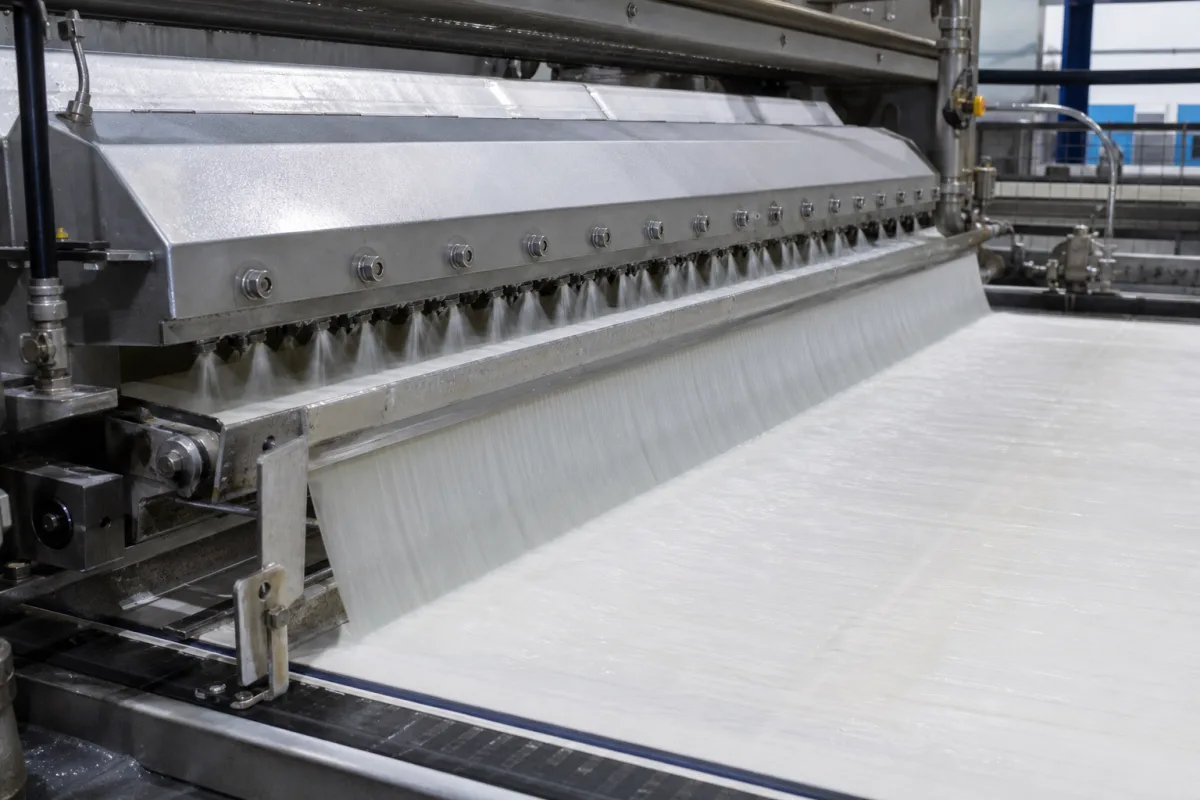
The headbox spreads pulp stock evenly across the machine width and delivers it as a jet onto the forming fabric. Variations in its output show up directly in the paper as basis-weight variation, poor formation and fibre orientation problems, so specify the headbox by the profile and jet control it must deliver, not only by width and speed.
Hydraulic and air-cushion (pressurised) headboxes for paper and board machines, with their cross-direction profile control. The approach-flow system and the forming section are separate purchases that the headbox must match.
CNFX editorial research · Sources checked October 10, 2026 · 6 sources
Parason describes the sequence as pulsation damping, cross-machine distribution in a tapered header, dilution profiling, turbulence generation and finally a converging nozzle that forms the jet at the slice lip. It says the headbox receives diluted stock “typically at 0.5 to 1.2% consistency depending on the paper grade.” [1]
Why the header is tapered
Stock leaves the header through rows of distributor tubes. As flow is drawn off, the header narrows so that pressure, and therefore flow through each tube, stays equal across the width. US Patent 5,196,091 describes the reduction in header area as roughly equal to three times the cross-section of each tier of tubes it feeds. [3]
Pressure pulses from the fan pump still reach the headbox. An attenuator or damping tank upstream reduces them; the patent notes that variations in tube flow are almost impossible to eliminate completely. Pulses that pass through show up as machine-direction basis-weight bands. [3][1]
Why turbulence is needed
Parason describes flocs as “clumps of fibres that stick together”. The turbulence generator, a bank of tubes or channels, breaks them up just before the nozzle so they do not reach the wire as visible formation defects. [1] Ask how the offered design does this for your furnish and consistency.
02
Control the cross-direction profile with dilution, the slice lip or both
Older headboxes correct the basis-weight profile by bending the upper slice lip with actuators along the width. US Patent 5,196,091 notes that changing the opening at one point also changes flow on either side and disturbs fibre orientation; it instead meters white water into individual tubes to dilute the stock locally while flow stays matched to neighbouring tubes. [3]
Method
How it acts
What to specify
Slice-lip profiling
Actuators change the slice opening locally, changing the volume of stock leaving at that point. [4][3]
Actuator spacing, travel and resolution; whether the lip is also used for orientation trimming.
Dilution (consistency) profiling
Valves add dilution water zone by zone, changing local consistency rather than flow; a downstream scanner closes the loop. [3][1]
Zone width, number of valves, dilution water source and quality, control system and scanner interface.
Edge flow and cheek bleeds
The jet-measurement patent says edge flows “give the ability to control fiber angle using extra flows on the sides of the headbox”, and cheek bleed removes stock off the sides. [4]
Edge-flow arrangement and how it is set and recorded.
Because dilution changes basis weight zone by zone, the slice lip can then be used to set the jet velocity profile. A patent on jet measurement notes that this lets basis weight and fibre orientation be optimised independently. [4]
Toscotec and YUELI both list dilution profiling for their hydraulic headboxes; Toscotec also lists actuator packages for slice-lip control. Ask for the number of control zones and the profile achieved at your speed and basis weight, measured on a named machine. [5][6]
03
Set the jet speed against the wire speed
The jet-to-wire ratio is the jet speed divided by the forming-fabric speed. Parason's guide says printing papers target close to 1.0 and packaging grades can run with slight rush for machine-direction strength. Its simple rush/drag table is a supplier rule of thumb; fibre orientation also depends on the headbox and former, so measure it. [1]
Fibre orientation is fixed between the headbox and the dry line on the former. The jet-measurement patent lists the adjustments that affect it: headbox recirculation balance, manifold bellows, edge flows and cheek bleeds, slice hang-down, apron and front-wall position, and rectifier rolls. Cross-flows in an unbalanced headbox misalign fibres. [4]
The same patent notes that orientation measured only on the finished sheet is hard to use for control: running conditions can change the size and sign of the response, and dry-end measurement cannot resolve the middle layers of multi-layer board. Ask whether jet velocity or orientation can be measured across the width at the headbox. [4]
Jet speed comes from the pressure at the slice. As a calculation example only, ignoring losses and jet contraction, a jet of 1,000 m/min (16.7 m/s) needs a head of about ρv²/2 = 1,000 kg/m³ × 16.7² ÷ 2 ≈ 139 kPa. A real headbox needs more; ask the supplier for its pressure-to-speed relationship and the measurement used to set it.
Write the target jet-to-wire ratio, the fibre-orientation measurement and the acceptance values into the order, rather than relying on a general rush or drag rule.
04
Match the headbox type to speed and grade
Parason divides its range into hydraulic headboxes with a pulsation-damping tank, which it rates up to 800 m/min for kraft, packaging and board, and pressurised headboxes with an air cushion and three-roll rectifier for 400–1,200 m/min on writing, printing and tissue. These are one supplier's product ranges, not limits for the type. [2][1]
Toscotec describes its hydraulic headbox as high-turbulence with edge-flow regulation and compatible with its dilution profiler, and lists Voith's MasterJet with a membrane pulsation damper. YUELI lists a hydraulic headbox with dilution profiling, lamella design, pressure-difference indication and a pulsation tank. Compare these on the profile, formation and orientation they will guarantee for your grade. [5][6]
The headbox must also fit the former: Parason names fourdrinier, gap and crescent formers as a selection factor. State the former type and the wire geometry when you request a quotation. [2]
05
Attenuator, tapered header, tube bank, dilution valves and slice lip along the flow path
The rows follow the stock in the order Parason gives, from pulsation damping to the slice lip, with the pressurised-type rolls and instrumentation last; materials and dimensions come from the drawings of the headbox you order. [1]
Assembly
Role in the headbox
Fix in the order
Approach-pipe connection and attenuator
Brings stock from the fan pump; damping reduces pressure pulses before the header. [3][1]
Connection size, damping method (tank, membrane or air cushion) and expected pulsation level.
Distribution header (manifold)
Tapered across the width to keep equal pressure at every tube. [3]
Header geometry, recirculation and the cross-machine flow balance test.
Tube bank and turbulence generator
Divide the flow and create turbulence to break up flocs. [3][1]
Tube or channel design and its range of flow and consistency.
Dilution system
Valves and pipes adding dilution water zone by zone. [3][5]
Number of zones, valve type, water source and control interface.
Nozzle and slice lip
Converges the flow into the jet; the slice opening sets jet thickness. [1][4]
Opening range, lip geometry, hang-down and apron adjustment.
Slice-lip actuators
Adjust the opening locally across the width. [4][5]
Actuator spacing, travel, drive type and control system.
Rectifier rolls or air cushion (pressurised types)
Rotating perforated rolls add turbulence; the air cushion controls pressure in pressurised headboxes. [4][2]
Whether fitted, roll drive and speed, and air-cushion controls.
Instrumentation
Pressure measurement across the headbox; YUELI lists pressure-difference indication by transmitter. [6]
Pressure and level measurement points, and their link to the machine control system.
06
Slice opening, design pressure, jet speed and consistency range for a headbox quotation
Parason's 0.5–1.2% consistency and its 800 m/min hydraulic and 400–1,200 m/min pressurised ratings are the only published figures here; design pressure ties back to the jet-head calculation in the jet-speed section. [1][2]
Field
What it means and published values
Ask the supplier for
Working width (mm)
The width of the jet at the slice, set by the machine's wire and trim.
Slice width, edge allowance and the trim it supports.
Slice opening range (mm)
Sets jet thickness and, with jet speed, the flow. [1]
Opening range, adjustment method and the resolution of the actuators.
Design pressure (kPa)
Determines the jet speed available; see the calculation example above.
Design and operating pressure, and the pressure-to-jet-speed relationship.
Jet velocity (m/min)
Matched to wire speed through the jet-to-wire ratio. Parason rates its hydraulic headbox up to 800 m/min and its pressurised type at 400–1,200 m/min. [2]
Jet speed range and how it is measured.
Consistency range (%)
Parason gives 0.5–1.2% headbox consistency, depending on grade. [1]
Consistency range for each grade and the dilution range at that consistency.
2 companies list this product among what they make. Company figures are quoted from each
company's own website; every card states where the relationship came from.
Jiangsu Huadong Paper Machinery Co.,Ltd.
Manufacturing site to be confirmed for the order
Its website has a product page for paper machine headbox.
Product scope checked 2026-10-12
Product page on own website · profile compiled by CNFX from public sources
Explore company information and manufacturing capabilities, then discuss the scope of your project with a relevant supplier.
Share this page
Compiled and source-reviewed by the CNFX editorial team.
Each manufacturer above links to the page on that company's own website where the product is listed, with the date we checked it. How we source and review
· Page last updated 13 October 2026
Buyer questions
Does dilution profiling replace the slice-lip actuators?
Dilution changes basis weight zone by zone without changing local flow, so the slice lip can be used to trim the jet velocity profile. US Patent 5,196,091 explains why bending the lip to fix basis weight disturbs flow and fibre orientation nearby, which is why a headbox can keep both. [3][4]
Should the jet always run at the same speed as the wire?
Not always. Parason's guide says printing papers aim close to 1.0 while packaging grades can run with slight rush. Orientation also depends on the headbox balance, edge flows and former, so set the ratio from measured orientation and strength. [1][4]
Can a hydraulic headbox run a high-speed printing machine?
Parason rates its hydraulic headbox up to 800 m/min and offers a pressurised type for 400–1,200 m/min. Other makers rate their designs differently; ask for references at your speed and grade. [2]
Sources and what still needs a direct check
Sources checked 2026-10-10. Parason, Toscotec and YUELI are supplier publications: their ranges and claims describe their own products. The patents are used for the mechanisms they describe. No headbox standard was reviewed for this page.