Papermaking · Between the forming section and the first dryer
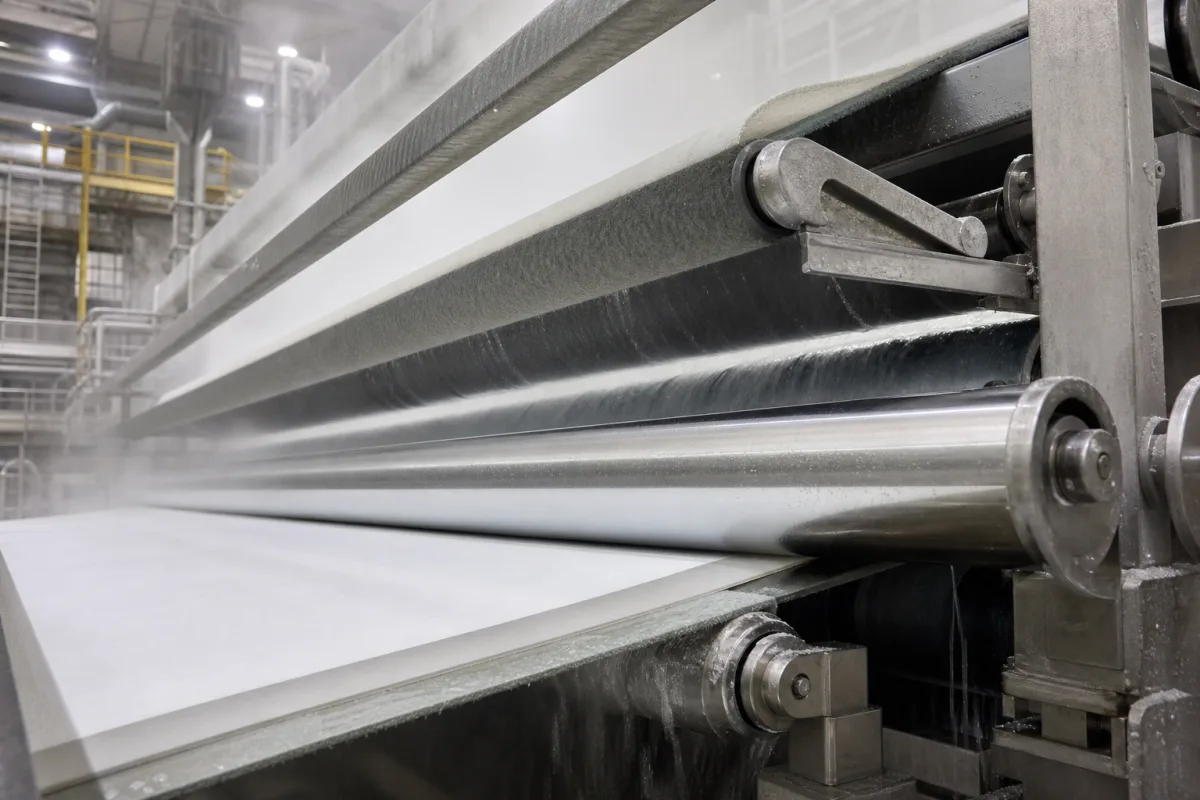
A press section squeezes water out of the wet web through felts before the dryers. Two sections with the same number of nips can deliver very different dryness, bulk and runnability, so define the grade, basis weight, speed and trim first and let the nip and felt design follow.
Wet-end press sections of paper and board machines: roll nips, shoe (extended-nip) presses, press and felt rolls, press felts and their conditioning. Size presses and calender stacks are separate machine sections.
CNFX editorial research · Sources checked October 12, 2026 · 9 sources
In the nip the web is compressed against a felt. Once the web is saturated, hydraulic pressure drives water into the felt; on the outgoing side some water can flow back into the sheet, which is called rewetting. Paulapuro's review lists nip pressure (as a press impulse), residence time, temperature, ingoing moisture and the properties of the incoming web as the main process variables. [2]
Nip dewatering and Uhle box dewatering are different designs
Valmet describes two arrangements. High-speed, low basis-weight machines push water through compressible, light felts onto grooved roll covers, from where savealls and foil doctors take it away. For slower machines running high basis weights, Valmet says felts “mainly remove water with the help of suction boxes (i.e. Uhle box dewatering)”, lower nip loads may be used with higher-void-volume felts, and grooved rolls “do not carry too much water”, so neither saveall pans nor doctors are required. [3]
Ask the supplier which of these routes the offered section relies on at each nip. The answer decides what you must buy and run alongside the rolls: savealls and doctors, or suction capacity and felt conditioning.
Dryness is not the only output
The web leaving the press should be as dry as possible, but it must also have the properties needed for the final grade and run without breaks. Paulapuro writes that quality is now “as important as or even more important than water removal for many paper and board grades”, and that “on most paper machines the first open draw is situated after the third press nip”, which he calls “the most critical point for runnability” because the web solids content is still low there. [2]
Valmet states that a shoe press dewaters more gently than a roll press, which helps even-sidedness and bulk on bulk-sensitive board. Treat this as the maker's design claim to be shown for your grade, not a property of every shoe press. [1]
02
Compare roll and shoe nips on load, length and pressure together
Linear load alone does not describe a nip. Valmet's 2009 white paper compares its roll press, mini shoe press and standard shoe press with three linked figures. These are one maker's published design ranges, not limits for every machine. [1]
1250–1595 mm shoe roll; SymZLC counter roll in the table
Read the columns together. The shoe press reaches its higher load by spreading it over a longer nip, so its maximum pressure is lower than the roll press figure. Valmet says this longer dwell time gives a press impulse up to ten times that of a roll nip and a dryness increase of 5–10% over a conventional roll press; for the smaller mini shoe press it states 2–3%. [1]
Press impulse is the area under the pressure–time curve. For a nip with linear load L running at speed v it equals L ÷ v. As a calculation example only, at an assumed 1,200 m/min (20 m/s), 125 kN/m gives 6.25 kPa·s and 1,000 kN/m gives 50 kPa·s, a ratio of eight. Use the offered nip's actual load range and your machine speed.
Check that a supplier's figures are consistent. Valmet's reported mini shoe press rebuild lists a 400 kN/m maximum load, a 95 mm shoe and a 4 MPa peak pressure; 400 kN/m spread evenly over 95 mm already averages about 4.2 MPa. Those values cannot all describe the same operating point, so ask at which load the pressure figure was stated and for the shoe pressure profile. [1]
Large-diameter roll presses are another route. Shandong Daxing describes its jumbo press rolls (1000–1600 mm diameter) as forming a wider nip for corrugating medium, board and heavy grades, with cooling water circulated through the roll to protect the rubber cover. That is a supplier description; ask for the nip length and load on your machine before comparing it with a shoe press. [5]
Valmet's example rebuild on an Asian fine-paper machine (design speed 1300 m/min, 5800 mm wire) reports dry content up 2.4–3%, steam use down about 8%, wet-web breaks down about 40% and average output rising from 420 to 480 t/day. These are results from one machine, reported by the supplier. [1]
03
Trace the press section assembly
Rolls form the nips, felts carry the water, and suction, doctors and showers keep the felts working. This is a functional assembly reference built from the sources cited; it is not one supplier's manufacturing BOM. Quantities, positions and material grades come from the drawing of the section you order.
Assembly
Role in the section and published construction
Fix in the order
Press rolls (roll nips)
Pairs of rolls form each nip and carry the linear load. Daxing's jumbo press roll specification lists grey cast iron or steel shells, blind-drilled, blind-plus-through-drilled, smooth or grooved surfaces, PU or rubber covers and forged 42CrMo, cast steel or nodular iron journals. [5]
Diameter, face length, shell and journal material, surface type, cover material and hardness, and the crown or deflection compensation for the load range.
Shoe press roll
A flexible polyurethane belt runs around a stationary shoe that hydraulic cylinders press against the counter roll. Valmet writes that “the belt usually has a grooved surface for efficient water handling”; its shoe roll beam is cast iron, and the oil inside must be removed efficiently to keep shoe and belt temperatures down. [1]
Shoe length and profile, load range, belt specification and expected change interval, oil system and evacuation, and the load joint between bearing housings.
Counter roll (centre roll)
Opposes the press or shoe roll. Valmet uses a solid roll with a ceramic cover in its mini rebuild and a deflection-compensated roll for higher speeds and wider machines. Release of the web from the centre roll is a recognised runnability issue. [1][2]
Solid or deflection-compensated roll, cover type and release behaviour, doctor arrangement and lubrication unit.
Suction pick-up roll
Transfers the web from the forming fabric into the press felt. Daxing lists stainless shells (SS304, SS316, SS316L or duplex), a cast steel or QT500-7 shaft, an SS304 suction box, internal spray for flushing perforations and bearing temperature and vibration sensors, 400–1200 mm diameter and 2000–9000 mm face length. [6]
Shell alloy for the white-water chemistry, drilling pattern and open area, suction zone width, seals and sensors.
Press felts
Accept water from the web in the nip, support the sheet and carry the water to the suction or roll covers. AstenJohnson says the fabric must withstand “tremendous crushing forces”, calls the idea that felts are removed for lost porosity a misconception, and finds that returned felts “have lost their uniformity”. [4]
Felt design per position (pick-up, bottom, top), seamed or endless, length, width and the clothing supplier's start-up and conditioning instructions. Construction is specified by the clothing maker; it is not verified on this page.
Felt, guide and tension rolls
Guide the felt loop and keep it tensioned. Daxing describes tensioning rolls with seamless or welded Q235B/Q345B steel shells, rubber or hard-chrome covers, 200–1000 mm diameter and dynamic balancing to ISO 1940 grades G1.0, G1.6 or G2.5. [7]
Balance grade and speed, cover, bearing housings and the stroke of the tensioner and guide for the felt length.
Spread (bow) rolls
Spread the sheet or fabric across the machine so it runs smoothly. Daxing lists fixed or adjustable bow, chromed, rubber or PTFE sleeves, 105–420 mm diameter and up to 10000 mm length. [8]
Bow setting, sleeve material and position in the felt run.
Uhle (suction) boxes and vacuum system
Pull water and fibre out of the felt as it passes over the vacuum zone. Covers may be slotted or perforated; AstenJohnson describes liquid ring pumps as “commonly used for uhle boxes”. [3][4]
Cover type and open area, slot width, vacuum source and capacity per position, and seal-water supply temperature.
Felt conditioning showers
A high-pressure needle shower loosens contaminants and a lubricating shower wets the felt ahead of the Uhle box; chemical showers are sometimes added. [4]
Nozzle type and spacing, pressure, distance from the felt, oscillation drive and extra edge nozzles.
Doctors and savealls
Remove water carried by roll covers and keep roll surfaces clean. Valmet supplies its shoe roll with a saveall and an integrated belt doctor to stop upstream dewatering and reduce misting. [1]
Doctor blade material and loading, saveall drainage and the positions where nip water is taken off the rolls.
Daxing's 'blind drill', 'groove' and 'smoothness' press roll pages repeat the same specification block. Ask which surface and cover the quotation actually applies to, rather than reading the block as three verified products. [5]
04
Keep each felt uniform, not merely open
AstenJohnson reports that 382 used packaging-grade press fabrics returned to its laboratory almost all still had more than 20 cfm of permeability, and rarely more than 5% filler. What AstenJohnson finds in returned felts is lost uniformity: rolls, showers and Uhle boxes create uneven areas, and uneven support in the nip lowers pressing efficiency. [4]
Set up the Uhle box to limit friction wear
AstenJohnson advises keeping vacuum as low as the task allows and reports that wear is almost always an issue above 20 inHg (68 kPa). It sets the box about 3 mm below the fabric line and keeps slot widths below 19 mm. For reference values it quotes TAPPI guidance of 15–25 CFM/in² specific vacuum (660–1100 m³/(m²·min)) and 2–4 ms dwell time over the slots. [4]
Hot seal water reduces liquid-ring pump capacity. In AstenJohnson's example for one pump model, capacity loss at 20 inHg rises from 5% at 90 °F to 73% at 150 °F against an 80 °F baseline. Include the seal-water temperature in the vacuum design, not just the pump size. [4]
Showers clean evenly or create streaks
A high-pressure jet more than about 10 cm from the felt can break up and damage the fabric even at modest pressure; AstenJohnson treats 10 cm or less as the safe distance. Oscillation should be synchronised with felt speed, and edges, where the sheet sheds fibre, may need double nozzle density. Uneven showering leaves wet or dry streaks. [4]
Cover design changes vacuum use
Valmet reports that, on one 350-inch trim machine at 3300 fpm with two shoe presses and four felts, vacuum energy was the third-largest press-section operating cost and Uhle boxes used a third of it. Its perforated cover avoids felt 'diving' into slots; on a 7050 mm fluting machine at 700 m/min it reports pick-up felt dewatering rising from 215 to 283 gpm while vacuum fell from 15 to 11 inHg. These are the supplier's case results. [3]
05
Nip count, linear load, nip length and roll diameter for a press quote
Load, nip length and peak pressure only describe a nip when all three come from the same operating point, so ask for those rows as one set per nip. [1]
Field
What it means and published values
Ask the supplier for
Number of press nips (count)
Set by grade, speed and dewatering route. Paulapuro illustrates a four-nip printing-paper section and notes that “on most paper machines the first open draw is situated after the third press nip”. [2]
The nip sequence, felt runs and where the web runs unsupported.
Linear load per nip (kN/m)
Valmet publishes 120–130 kN/m for its roll press, 250–400 for its mini shoe press and 600–1000 for its standard shoe press. [1]
Minimum, operating and maximum load for each nip.
Nip length (mm)
Needed together with load to judge pressure and impulse; Valmet's ranges are in the nip comparison above. [1]
Nip length at operating load, and the shoe length for a shoe press.
Peak nip pressure (MPa)
Valmet lists 6–9 MPa for its roll press and 4–6 MPa for its shoe presses. [1]
The pressure profile and the load at which the peak value applies.
Roll face width (mm)
Follows the machine trim. Daxing lists press roll face lengths up to 14000 mm and pick-up rolls of 2000–9000 mm. [5][6]
Face length of each roll against wire width and trim.
Roll diameter (mm)
Valmet: roll press 700–900 mm, shoe rolls 1095–1595 mm. Daxing: jumbo press rolls 1000–1600 mm. [1][5]
Diameter of every roll, and the regrind allowance for covered rolls.
Roll shell and cover material
Specify per roll. Published examples include cast iron or steel shells with PU or rubber covers, stainless suction roll shells and ceramic-covered solid counter rolls. [5][6][1]
Shell, journal and cover material and cover hardness for each roll.
Roll balance grade
Daxing quotes ISO 1940 balance grades G1.0–G2.5 for its tensioning rolls. [7]
Balance grade and the speed it is verified at, plus the runout acceptance for press rolls.
Felt type
Specify per position with the clothing supplier. Light compressible felts suit nip dewatering; higher void volume suits Uhle box dewatering. [3]
Felt design, seamed or endless, length and width for each position.
Operating temperature (°C)
Temperature is one of the main wet-pressing variables; an early model cited by Paulapuro relates dryness increase inversely to water viscosity at the prevailing temperature. [2]
The white-water and web temperature the design assumes.
Drive power (kW)
Depends on speed, width, nip loads and felt drag.
A drive list per roll, with motor power and control mode.
Electrical supply and enclosure protection
Set by the mill's supply and where motors and panels are installed.
Supply voltage and frequency, and protection ratings for wet locations, checked against local electrical rules.
Installed mass (t)
Needed for foundations and lifting. Valmet reports a mill whose overhead crane could not carry a standard shoe press. [1]
Mass of each roll and assembly, foundation loads and the heaviest lift.
06
Plan a rebuild around the frame, crane and safe access
Valmet presents its mini shoe press as a rebuild for small and medium lines that needs only limited changes to the existing frame structure; it states that shutdown is about half that of a standard shoe press rebuild and that a separate load joint between the bearing housings avoids extra foundation work. These are the supplier's claims for its design. [1]
Check what the existing machine can carry and lift
Ask for the installed mass of each new roll, the frame modifications, foundation loads and the heaviest lift during installation and roll changes. In Valmet's case the crane limit was the reason for choosing the smaller shoe press. [1]
Also list what changes around the nip: felt runs and lengths, Uhle box positions, savealls, hydraulic and oil units, controls and the transfer to the dryer section.
Include safe access in the scope
For US workplaces, OSHA 29 CFR 1910.261(k) requires paper machines to have emergency stops and lockout devices at the power switch, completely guarded rotating shaft ends, and steps and a removable plank walkway with guardrails along each press. Other jurisdictions apply their own machinery rules; ask the supplier which standards its design and documentation follow. [9]
Felt changes, roll changes and threading bring people close to nips. Ask how each is done with the machine stopped or at a protected crawl speed, and which guards are included in the delivery.
07
Send the grade, speed and dewatering target together
Paste it into your enquiry below or into an email to a maker, then replace every bracket.
Machine and grade: [grade; basis weight range; design and operating speed; wire and trim width]
Incoming web: [dryness entering the press; furnish; white-water temperature and chemistry]
Target: [dryness after press; bulk or smoothness limits; break and runnability problems to solve]
Nip arrangement: [number and type of nips; linear load range; nip length; peak pressure and the load it applies at]
Rolls: [diameter; face length; shell and journal material; surface (smooth/grooved/drilled); cover; crown or deflection compensation; balance grade]
Shoe press (if offered): [shoe length and profile; belt specification; hydraulic and oil system]
Felts and conditioning: [felt positions and lengths; Uhle box cover and open area; vacuum per position; seal-water temperature; showers]
Drives and utilities: [drive list per roll; electrical supply; hydraulic units; cooling water]
Installation: [frame changes; foundation loads; heaviest lift and crane capacity; shutdown time]
Safety and handover: [guards; stop and lockout points; walkways; drawings; manuals; spare roll list]
YUELI lists a complete press section among its paper machine sections; Shandong Daxing publishes press-section rolls.
YUELI MACHINERY
Taichung, Taiwan head office; Wuxi, Jiangsu address — both published
Lists a press section within its paper machine range, with feature claims (high dewatering, high speed, automatic felt tension control) but no published data. Also lists headbox, wire, dryer and size press sections.
Publishes press rolls (blind-drilled, grooved, jumbo), suction pick-up rolls, tensioning and spread rolls with dimension and material ranges. Its press-section pages describe rolls and suction boxes; a complete press section with loading and felt system was not established.
Explore company information and manufacturing capabilities, then discuss the scope of your project with a relevant supplier.
Share this page
Compiled and source-reviewed by the CNFX editorial team.
Each manufacturer above links to the page on that company's own website where the product is listed, with the date we checked it. How we source and review
· Page last updated 13 October 2026
Buyer questions
Is a shoe press always the better choice?
Not automatically. Valmet's own range runs from a mini shoe press at 250–400 kN/m to a standard one at 600–1000 kN/m, and it offered the smaller design where the crane and frame could not take the larger one. On slower, heavy-grade machines much of the water may be removed over Uhle boxes rather than through the nip. Choose from the grade, speed, dryness target and what the existing machine can carry. [1][3]
Does the highest linear load tell me which section removes the largest share of water?
No. Water removal depends on the pressure over time in the nip, which Paulapuro describes as the press impulse, as well as temperature, ingoing moisture and the web itself. Compare load, nip length and speed together. [2][1]
Why replace a press felt that is still permeable?
AstenJohnson found almost all returned used felts still permeable and rarely filled; what they had lost was uniformity, which reduces even support in the nip. Watch moisture profiles and uniform conditioning rather than permeability alone. [4]
Sources and what still needs a direct check
Sources checked 2026-10-12. Valmet and AstenJohnson documents are supplier publications: their ranges and case results describe their own designs and cases. The TAPPI values are as quoted by AstenJohnson; the TAPPI documents themselves were not read. OSHA applies to US workplaces.