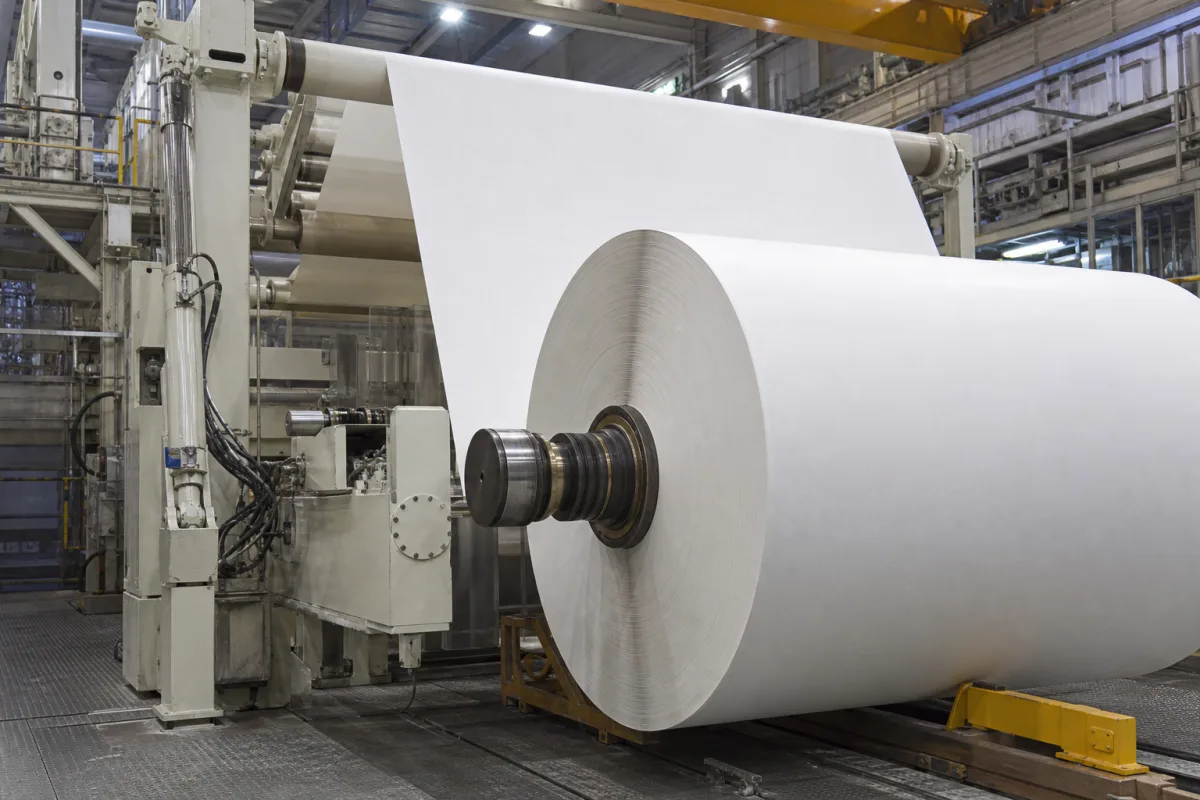
Papermaking · The shaft that carries the parent roll
At the end of the paper machine the sheet is wound onto a reel spool to form the parent (jumbo) roll. The spool turns at full machine speed, carries the growing roll, takes braking loads and is moved on rails and stands between cycles, so its balance, stiffness and journals decide both roll quality and safety.
Reel spools used in Pope-type and similar reels on paper and board machines, and the reel functions around them. Winder shafts and corrugator roll stands are different equipment.
CNFX editorial research · Sources checked October 10, 2026 · 4 sources
In a Pope-type reel the empty spool is brought into contact with the reel drum, the sheet is turned up onto it, and the spool is transferred from primary to secondary arms while the roll builds. Toscotec offers reels with hydraulic control and pivoting or linear secondary arms, and an inclined-rail system that uses gravity to move parent rolls. [3]
YUELI lists automatic spool-roll discharge, a turn-up system to reduce waste during roll change, hydraulic control with a proportional valve, and jumbo-roll storage that transfers rolls directly to the unwind stand. [4]
Toscotec's premium reel adds an electro-mechanical centre-wind assist and load cells for nip control to preserve bulk and softness. Where the spool is driven at its centre, the drive engagement and torque become part of the spool specification. [3]
Name the reel type, how the spool is driven and braked, and how spools travel between storage, reel and unwind stand. The spool design must suit all of these, not only winding.
02
Hold balance and deflection at full speed
Shandong Xinhe describes reel spools and winder carrier rolls as the highest-speed rolls on a paper machine, with dynamic speeds up to 2,800 m/min and dynamic loads up to 60 t, and says deflection demands are very high. It states that wall-thickness variation must be controlled and that the spool must be balanced in three sections to limit deflection. These are the supplier's statements. [2]
Ask for the balance grade and the speed at which balancing is verified, the measured wall-thickness variation, and the calculated deflection with the full roll at maximum speed. A spool balanced as a short rigid rotor may still deflect at speed if wall thickness varies along its length.
As a calculation example only, a spool of 0.6 m diameter on a machine at 1,500 m/min turns at 1,500 ÷ (π × 0.6) ≈ 796 rpm when empty. Because surface speed stays constant, rotational speed falls as the roll grows, but the empty spool and the turn-up are at the highest rpm. Use your machine speed and spool diameter.
03
Inspect the journals for fatigue cracks
TAPPI's TIP 0402-34 (2023) gives guidelines for non-destructive testing of reel-spool journals and for repair or replacement. Its published summary identifies fatigue cracking as the main damage mechanism, driven by high rotational speed, brake-torque reaction stresses and impact loads from rough treatment on stands and rails. Failures are infrequent, but can injure workers and severely damage surrounding equipment. [1]
What the inspection programme should cover
The TIP covers journal materials, failure locations and mechanisms, recommended inspection frequency and NDT methods, and its summary says the guidance applies to reel-spool journals of all sizes. The specific intervals and methods are in the full document, which was not read for this page; obtain it or ask your inspection provider to work to it. [1]
Keep a record for each spool: serial number, journal material, inspection dates, method, findings and any repair. Spools circulate between positions, so the record must follow the spool, not the reel.
Reduce the loads that start cracks
Brake torque and impact are both named in the TIP summary. Ask how the reel brakes the spool, how spools are lowered onto stands and rails, and whether stops and rails are cushioned. [1]
04
Shell, hubs, journals and surface of a reel spool
Xinhe's construction options fill the middle column: seamless-pipe or bent-plate shells, cast iron hubs, cast or alloy steel journals and rubber or electroplated surfaces; the journal row links back to the TAPPI fatigue-cracking guidance above. [2][1]
Part
Role and published construction
Fix in the order
Shell
Carries the roll and sets stiffness. Xinhe lists seamless steel pipe or bent plate. [2]
Shell material, diameter, wall thickness and permitted wall-thickness variation.
Hubs (heads)
Connect shell and journals. Xinhe lists cast iron hubs. [2]
Hub material and the shell-to-hub joint.
Journals
Carry bearing, brake and handling loads; the location of fatigue cracking. Xinhe lists cast steel or alloy steel. [2][1]
Journal material and heat treatment, fillet geometry, and NDT before delivery.
Surface
Contacts the first wraps of paper. Xinhe offers rubber or electroplated surfaces according to the paper. [2]
Bearing type and housing, brake type and the torque the journal is designed for.
Drive interface (centre-wind)
Couples a centre-wind drive where the reel uses one. [3]
Coupling type, torque and engagement method.
Handling interfaces
Contact points for arms, stands, rails and cranes. [1][3]
Rail and stand contact geometry, lifting points and identification marking.
05
Trim, shell diameter, roll weight and speed for a reel-spool order
Xinhe's 2,800 m/min and 60 t figures are the only published bounds in this table; trim, shell diameter, drive and bearings depend on the reel the spool will serve. [2]
Field
What it means and published values
Ask the supplier for
Shaft length and maximum roll width (mm)
Set by the machine trim and the reel frame.
Overall length, face length and bearing centres.
Shell diameter (mm)
Sets rpm at a given speed and the stiffness of the spool; see the calculation example above.
Diameter and wall thickness.
Maximum roll weight (t)
Xinhe cites dynamic loads up to 60 t for this class of roll. [2]
Design roll mass and diameter, and the load case used for journal design.
Surface-driven from the reel drum, or with centre-wind assist. [3]
Drive and brake arrangement on the reel the spool will serve.
Bearing type
Carries rotation and brake loads at the journal. [1]
Bearing type, size and housing.
Shaft material
Xinhe lists steel shells, cast iron hubs and cast or alloy steel journals. [2]
Material standard and heat treatment for shell, hubs and journals.
Balance and deflection
Xinhe describes three-section balancing to limit deflection. [2]
Balance grade, balancing method and speed, and calculated deflection at full roll.
Roundness and runout (mm)
Affect nip uniformity at the reel drum and vibration.
Roundness and runout tolerances and the measurement report.
Surface hardness and roughness
Depend on the surface type chosen for the grade. [2]
Hardness and roughness of the delivered surface.
Operating temperature (°C)
The temperature at the reel environment.
Temperature range the surface and bearings are designed for.
Spool weight (t)
Needed for arms, rails, stands and cranes.
Empty spool mass and centre of gravity.
06
Send the reel, roll and handling data together
Paste it into your enquiry below or into an email to a maker, then replace every bracket.
Machine: [grade; design speed; trim width; reel type and arm arrangement]
Parent roll: [maximum diameter; maximum mass; reel cycle time; turn-up method]
Spool: [shell diameter and wall thickness; face length; bearing centres; surface type]
Materials: [shell; hubs; journals; heat treatment; material certificates]
Dynamics: [balance grade and method; balancing speed; calculated deflection at full roll]
Drive and brake: [surface drive or centre-wind; coupling; brake type and torque]
Handling: [rails, stands and storage; lifting points; cushioning at stops]
Inspection: [NDT of journals before delivery; inspection plan to TAPPI TIP 0402-34; identification marking]
Delivery: [quantity of spools; spares; drawings; inspection and balancing reports]
Shandong Xinhe lists reel spools among its paper machine components.
Shandong Xinhe Paper-Making Engineering Co., Ltd.
Liaocheng, Shandong — published address
Lists paper machine reel spools with seamless-pipe or bent-plate shells, cast iron hubs, cast or alloy steel journals and rubber or electroplated surfaces, and describes three-section balancing. Its page also contains generic marketing text; ask for a drawing and balancing report.
Explore company information and manufacturing capabilities, then discuss the scope of your project with a relevant supplier.
Share this page
Compiled and source-reviewed by the CNFX editorial team.
Each manufacturer above links to the page on that company's own website where the product is listed, with the date we checked it. How we source and review
· Page last updated 13 October 2026
Buyer questions
Why do reel-spool journals crack?
TAPPI's TIP 0402-34 identifies fatigue cracking as the main damage mechanism, driven by high rotational speed, brake-torque reaction stresses and impact loads on stands and rails. [1]
Is a balanced spool enough for a fast machine?
Shandong Xinhe says wall-thickness variation must be controlled and that it balances spools in three sections to limit deflection. Ask for the balance grade, balancing speed and calculated deflection at full roll. [2]
Does the reel type change the spool specification?
Yes. Toscotec's reels range from pivoting or linear secondary arms to a centre-wind-assisted design with load-cell nip control. A centre drive adds a coupling and torque that the spool must carry. [3]
Sources and what still needs a direct check
Sources checked 2026-10-10. Toscotec, YUELI and Shandong Xinhe are supplier publications: their ranges and statements describe their own products. The TAPPI points come from TAPPI's published summary of TIP 0402-34; the full document was not read.