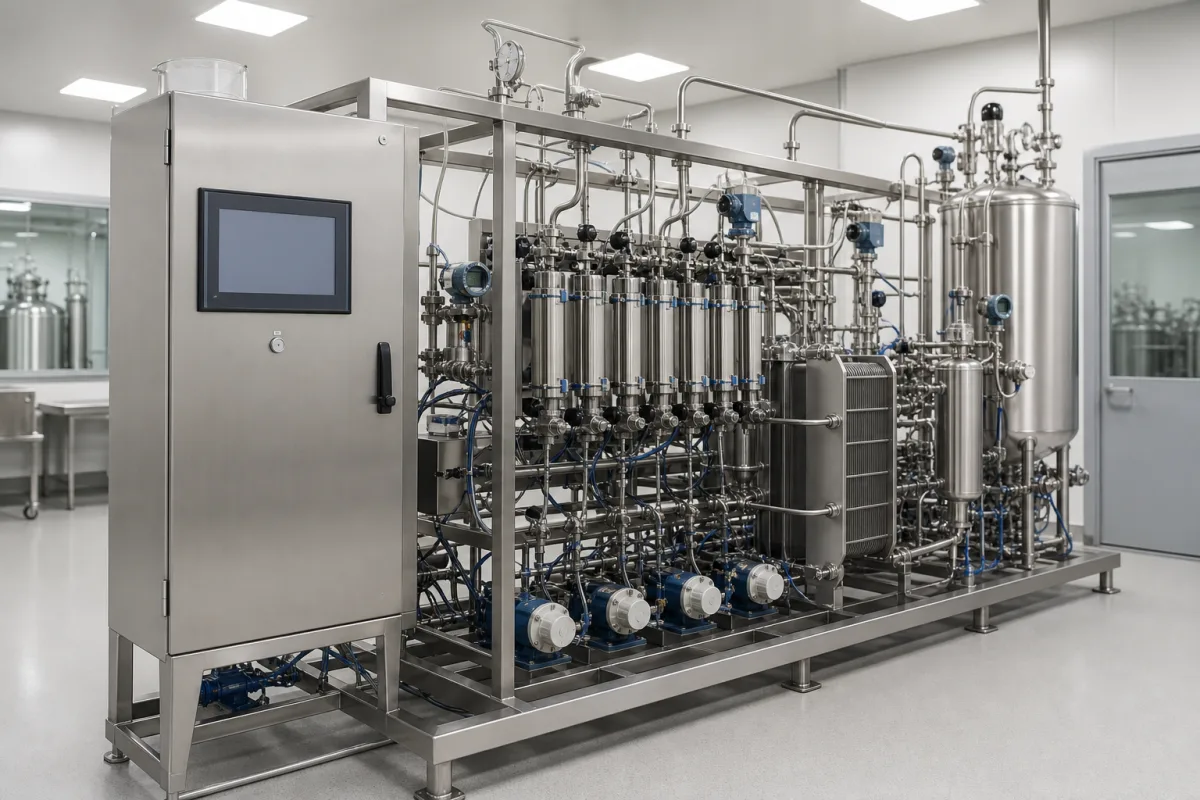
Continuous flow reactor for pharmaceutical synthesis
Continuous flow reactors for APIs · Residence time from volume and flow, pressure and temperature limits, RTD, diversion and batch definition under ICH Q13
A continuous flow reactor for pharmaceutical synthesis pumps reagents through small channels or tubes — plug-flow, microchannel or fixed-bed — so that each element of fluid reacts for a controlled residence time at a controlled temperature and pressure. Ask three things first: what internal volume and flow range give your residence time, what pressure, temperature and chemical compatibility the wetted parts allow, and how the system supports residence time distribution studies, monitoring and material diversion under ICH Q13.
Continuous plug-flow, microchannel and similar flow reactors for drug substance (API) synthesis, from laboratory to production scale, with pumps, heat exchange and controls. Batch stirred reactors, continuous tablet lines (drug product) and bioreactors are outside this page.
CNFX editorial research · Sources checked October 11, 2026 · 4 sources
The University of Liège's FloW4All facility describes its Corning Advanced-Flow Reactor G1 in glass as a pilot-scale continuous flow reactor with 9 mL internal volume per fluidic module, flow rates of 30–200 mL/min, operating conditions from –60 °C to 200 °C up to 18 bar, and wetted parts of glass, perfluorinated polymers and PEEK, designed for simplified scale-up to production with Corning technology. [2]
ICH Q13 notes that plug-flow reactor design — dimension and configuration — allows control of temperature, heat and mass-transfer rates and reaction time, and that in its worked example these parameters were shown to drive the drug substance impurity profile; stoichiometry was controlled by feed concentrations and flow rates, and conversion by reaction temperature and flow rate. [1]
Editorial calculation: mean residence time is internal volume divided by total flow. One 9 mL module gives 9 / 200 ≈ 2.7 s at 200 mL/min and 9 / 30 = 18 s at 30 mL/min; ten modules in series (90 mL) at 30 mL/min give 3 min. Running at 200 mL/min for 24 h passes about 288 L. The module count is an assumed example. [2]
Give the supplier the chemistry (phases, solids, gases, exotherm, corrosives), required residence time and temperature, maximum pressure, total flow and annual output, wetted-material compatibility, mixing and heat-transfer needs, PAT and sampling points, diversion valves, automation and data integrity, and cleaning approach.
02
Build the ICH Q13 control strategy around the reactor
ICH Q13 (Continuous Manufacturing of Drug Substances and Drug Products, adopted November 2022) says process dynamics should be characterised, for example by residence time distribution (RTD), which is specific to the process, material and equipment design, and which supports material tracking, sampling and diversion strategies; changes in RTD can affect conversion, yield and impurity formation. RTD may be studied with tracers that behave like the stream they replace, or by step changes in composition. [1]
The guideline allows batch size to be defined by output quantity, input quantity, or run time at a defined mass flow rate, or as a range of run times. In its drug-substance example, diversion points after each plug-flow reactor remove non-conforming material when conditions fall outside acceptance criteria, online PAT at the second reactor exit feeds back to the addition rate of a reagent, timing and duration of diversion are set from the modelled and tracer-confirmed RTD, and surge tanks decouple upstream and downstream flow rates. [1]
Editorial note: ask the reactor supplier to provide the RTD of the delivered equipment at your planned flow rates, the hold-up volume between each sensor and diversion valve, and how alarms trigger diversion — these define how much material is lost on a disturbance.
03
Read a telescoped three-step API synthesis in tubing reactors
US patent 8,426,630 B2, assigned to the Florida State University Research Foundation (priority 2009), describes a three-step continuous synthesis of ibuprofen in PFA tubing with no intermediate purification. Step one, a Friedel-Crafts acylation of isobutylbenzene with propionic acid in triflic acid (TfOH), runs through a 50 cm PFA segment in an oil bath at about 150 °C; the stream is cooled to about 0 °C at a tee, joined by a PhI(OAc)2/TMOF stream at 131.5 µL/min, and passed through 80 cm of PFA at about 50 °C; a base stream at about 260.0 µL/min then enters 300 cm of PFA at about 65 °C for hydrolysis. The patent states that unions, junctions and tubes must resist TfOH, naming Teflon PFA or metal. [4]
The patent reports about 68% crude yield (average of three trials) at about 96% purity by GC and GC/MS, and states that with under 500 cm of tubing and five syringe pumps the system generates about 9 mg/min of crude ibuprofen, with parallel reactors or longer channels proposed for higher throughput. It notes that at 50 °C with a 5 minute residence time, reagent immiscibility and plug flow gave poor mixing and low conversion in step one, so it raises that temperature to 150 °C. [4]
Editorial calculation: the first-step feeds of 15.1 µL/min and 28.7 µL/min total 43.8 µL/min; after the two later additions, total flow reaches about 435 µL/min, ten times the first-step flow, so later reactors need longer tubing for comparable residence time. About 9 mg/min is 0.54 g/h, about 13 g per 24 h day. [4]
Multiphase, microchannel and photochemical modules on offer
The listing reviewed offers multiphase, microchannel, hydrogenation, Grignard, loop and photochemical continuous flow reactors as skid-mounted modules [3]; ask for internal volume, flow, pressure and temperature ratings and wetted materials for each.
05
Pumps, reactor modules, back-pressure and diversion on a flow skid
Diversion valves and surge tanks come from the ICH Q13 example rather than a reactor maker's list; ask whether they sit inside the supplier's scope. [1]
Explore company information and manufacturing capabilities, then discuss the scope of your project with a relevant supplier.
Share this page
Compiled and source-reviewed by the CNFX editorial team.
Each manufacturer above links to the page on that company's own website where the product is listed, with the date we checked it. How we source and review
· Page last updated 13 October 2026
Buyer questions
How do I calculate residence time in a flow reactor?
Divide internal volume by total flow; a 9 mL Corning G1 module at 200 mL/min gives about 2.7 s. [2]
What pressure and temperature can a glass flow reactor take?
The Corning G1 glass reactor at Liège runs from –60 °C to 200 °C up to 18 bar. [2]
What does ICH Q13 require for continuous reactors?
Characterising process dynamics such as RTD to support material tracking, sampling and diversion. [1]
How is a batch defined in continuous manufacturing?
ICH Q13 allows output quantity, input quantity, or run time at a defined mass flow rate. [1]
What output does a laboratory tubing flow synthesis reach?
Florida State University's US patent 8,426,630 B2 reports about 9 mg/min of crude ibuprofen from under 500 cm of PFA tubing and five syringe pumps, about 68% crude yield at 96% purity; that is about 0.54 g/h (Editorial calculation). [4]
Sources and what still needs a direct check
Sources checked 2026-10-11. ICH Q13 is the international regulatory guideline for continuous manufacturing; the FloW4All page is a university facility describing its Corning reactor; Florida State University's US patent 8,426,630 B2 describes a three-step flow synthesis of ibuprofen; PMG ChemTech is a linked supplier.