Editorial Technical Reference

Process Analytics

This page explains how Process Analytics is classified within Chemical Manufacturing. Technical values and manufacturer relationships are research references; confirm the current specification and supplier evidence for each order.

Technical Definition & Core Assembly

Real-time monitoring and analysis system for pharmaceutical manufacturing processes

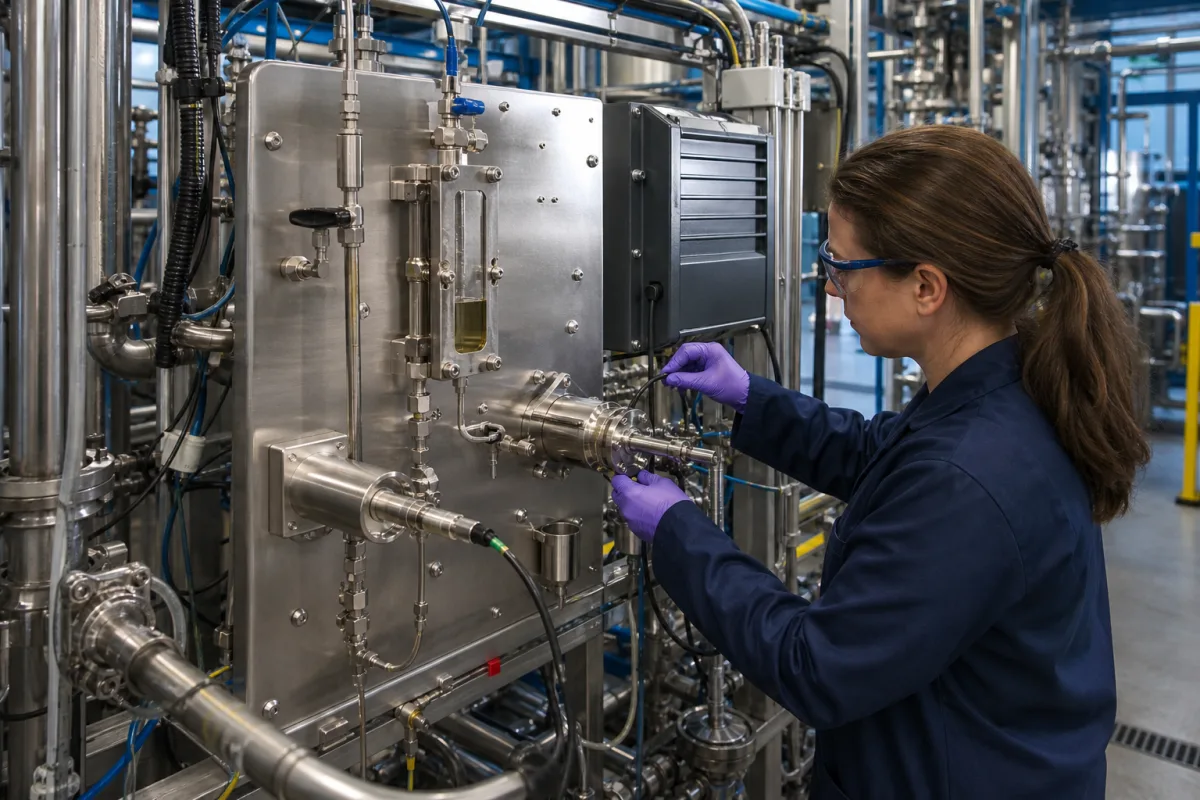
Representative product image. Confirm appearance and specifications with the manufacturer.

Product Specifications

Technical details and manufacturing context for Process Analytics

Definition
Process Analytics in Continuous Flow Pharmaceutical Reactors refers to integrated systems that monitor, analyze, and control critical process parameters in real-time during pharmaceutical synthesis. These systems ensure product quality, optimize reaction conditions, and maintain regulatory compliance by continuously measuring chemical composition, temperature, pressure, flow rates, and other key variables throughout the manufacturing process. The system is designed as a component for integration into continuous flow reactors used in chemical manufacturing, particularly in the pharmaceutical sector. It comprises sensors and analytical instruments deployed at strategic points within the reactor, collecting data on process variables such as temperature, pressure, flow, and chemical composition. The data is transmitted to analytical software that processes it using algorithms to interpret the data, detect anomalies, and provide feedback for automated process control adjustments. This enables real-time optimization of reaction conditions and early detection of deviations, contributing to consistent product quality and operational efficiency. The system is built with materials including Stainless Steel 316L, PTFE, sapphire windows, and quartz glass, ensuring compatibility with a range of chemical environments. Key parameters include measurement accuracy of ±0.1%, response time ≤1 second, operating temperature range -10 to 60 °C, pressure rating 1.0–1.6 bar, sampling rate 10–100 Hz, measurement range 0–100%, input power 24 V DC ±10% (optional 110–240 V AC with adapter), communication interfaces 4–20 mA with HART, Modbus, Profibus available, ingress protection IP54–IP65 (IEC 60529), wetted parts material 316L (Hastelloy C-22 optional), weight 5–15 kg, and dimensions 300×400×200 mm (W×H×D). These values are directory reference ranges and must be confirmed for the specific model and application with the legal manufacturer or supplier. The system is intended for indoor and outdoor installation, with panel-mount or wall-mount options. It is essential to verify model-specific values and standards with the manufacturer before procurement.
Working Principle
Process Analytics systems operate by deploying various sensors and analytical instruments at strategic points within the continuous flow reactor. These instruments collect real-time data on process variables, which is then transmitted to analytical software for processing. The system uses algorithms to interpret the data, detect anomalies, and provide feedback for automated process control adjustments to maintain optimal reaction conditions. The sensors measure parameters such as temperature, pressure, flow rate, and chemical composition, with a response time of ≤1 second and sampling rate adjustable from 10 to 100 Hz. The system operates within a temperature range of -10 to 60 °C and pressure rating of 1.0–1.6 bar. Data is communicated via 4–20 mA analog signals with digital protocols like HART, Modbus, or Profibus available. The system is designed for continuous operation and can be integrated into existing control systems for real-time monitoring and control.
Common Materials
Stainless Steel 316L, PTFE (Polytetrafluoroethylene), Sapphire Windows, Quartz Glass
Technical Parameters
ParameterTypical rangeNotes & selection driver
Measurement AccuracyRequired±0.1 %Accuracy of analytical measurements relative to reference standards
Response TimeRequired≤1 secondsTime delay between process event and analytical result
Operating Temperature RangeRequired-10–60 °CTemperature range within which the analytical system operates reliably
Pressure RatingRequired1.0–1.6 barMaximum operating pressure for analytical componentsISO 5208
Sampling Rate10–100 HzAdjustable for process dynamics
Measurement Range0–100 %For concentration or composition
Input Power24 ±10% V DCOptional 110–240 V AC with adapter
Communication Interface4–20 mAHART, Modbus, Profibus available
Ingress ProtectionIP54–IP65For indoor and outdoor installationIEC 60529
Material of Wetted Parts316LHastelloy C-22 optional for corrosive mediaASTM A240
Weight5–15 kgDepending on configuration
Dimensions (W×H×D)300×400×200 mmPanel-mount or wall-mount

Ranges are indicative industry figures for RFQ preparation, not a supplier commitment. Confirm every value and standard with the legal manufacturer before ordering.

Components / BOM
  • Spectroscopic Analyzer
    Measures chemical composition using spectroscopic techniques (FTIR, Raman, UV-Vis)
    Material: Stainless Steel housing with optical components
  • Flow Sensor
    Monitors flow rates of reactants and products through the reactor
    Material: Corrosion-resistant alloys with PTFE seals
  • Temperature Probe
    Measures temperature at critical points in the reaction pathway
    Material: Stainless Steel with thermocouple or RTD elements
  • Data Acquisition System
    Collects, processes, and transmits sensor data to control systems
    Material: Electronic components with industrial-grade housing
  • pH/Conductivity Sensor
    Monitors acidity/alkalinity and ionic concentration in process streams
    Material: Glass electrodes with reference cells
  • Pressure Sensor
    Measures line pressure at the monitored points.

Industry Taxonomies & Aliases

Commonly used trade names and technical identifiers for Process Analytics.

Industrial Ecosystem & Supply Chain Structure

Complementary Systems
Downstream Applications
Specialized Tooling

Application Fit & Sizing Matrix

Operational Limits
pressure: 0-10 bar (standard), up to 25 bar with high-pressure variant
flow rate: 0.1-100 L/min (liquid), 1-1000 SLPM (gas)
temperature: 0-150°C (standard), up to 200°C with optional cooling
slurry concentration: Up to 40% solids by weight, particle size <500 μm
Media Compatibility
✓ Aqueous solutions (pH 2-12) ✓ Organic solvents (ethanol, acetone, IPA) ✓ High-purity water (WFI/RO/DI)
Unsuitable: Hydrofluoric acid or highly corrosive halogenated compounds
Sizing Data Required
  • Process flow rate range (min/max)
  • Required analytical parameters (pH, conductivity, dissolved oxygen, etc.)
  • Integration requirements with existing control systems (PLC/DCS/SCADA)

Reliability & Engineering Risk Analysis

Failure Mode & Root Cause
Sensor drift
Cause: Long-term exposure to process media causing calibration degradation or electronic component aging
Optical window fouling
Cause: Accumulation of process deposits or scaling on measurement surfaces, blocking signal transmission
Maintenance Indicators
  • Erratic or inconsistent measurement readings compared to process conditions
  • Persistent calibration failure alerts or out-of-spec diagnostic warnings
Engineering Tips
  • Implement regular calibration verification against master instruments and establish drift trend analysis
  • Install appropriate filtration/purge systems to protect optical/measurement surfaces from contamination

Indicative industry ranges for design and RFQ preparation. Confirm the exact figures and applicable standard with the manufacturer before specifying.

Compliance & Manufacturing Standards

Applicable Standards
ANSI/ASME B46.1 Surface Texture ASTM E1256 Standard Test Methods for Radiation Thermometers

Quoted from the published standard.

Manufacturing Precision
  • Dimensional Accuracy: +/-0.05mm
  • Surface Roughness: Ra 0.8μm
Quality Inspection
  • Statistical Process Control (SPC) Analysis
  • Non-Destructive Testing (NDT) - Ultrasonic Testing

Manufacturers of Process Analytics

Manufacturer profiles associated with Process Analytics.

Sourcing Process Analytics from China?
Tell us your specification and target quantity — we will match it against manufacturer records and come back with the factories that fit.
Request manufacturers We manufacture this

Manufacturer listings support early research and capability understanding. They are not certification, ranking, or transaction guarantees.

Technical documentation
Request current drawings, revision history, and a signed specification sheet.
Manufacturing capability
Verify equipment lists, process limits, capacity, and representative production evidence.
Inspection readiness
Confirm test methods, calibrated equipment, sampling plans, and traceable reports.
Supplier transparency
Check the legal entity, factory address, ownership, certifications, and direct contacts.

CNFX does not score or rank suppliers. Buyers must verify all claims and documents with the legal manufacturer before ordering.

Supply Chain Compatible Machinery & Devices

Continuous Flow Reactor System

A modular, automated chemical processing system designed for continuous flow synthesis of chemical products.

Explore Specs →
Automated Batch Crystallization System

Automated system for controlled crystallization of chemical compounds in batch processes.

Explore Specs →
Automated pH Monitoring and Dosing System

Automated system for continuous pH monitoring and chemical dosing in process streams.

Explore Specs →
Automated Powder Dispensing and Blending System

Automated system for precise dispensing and homogeneous blending of powdered chemicals.

Explore Specs →

Frequently Asked Questions

What is the typical response time of the Process Analytics system?

The response time is ≤1 second, meaning the system can detect process changes and provide analytical results within one second. This is a reference value; the actual response time may vary depending on the specific configuration and installation, so it should be confirmed with the manufacturer.

What communication interfaces are available?

The system supports 4–20 mA analog output, with digital protocols such as HART, Modbus, and Profibus available as options. The availability of these interfaces depends on the specific model and configuration, so it is recommended to verify with the supplier.

What is the operating temperature range?

The operating temperature range is -10 to 60 °C. This indicates the ambient temperature range within which the analytical system operates reliably. For extreme conditions, consult the manufacturer for suitability.

What materials are used for wetted parts?

The standard material for wetted parts is Stainless Steel 316L (ASTM A240). Hastelloy C-22 is optional for corrosive media. The choice of material depends on the chemical compatibility required for the specific application, and it is essential to confirm with the manufacturer.

Data Basis

Editorial classification, named public sources where available, and source-reviewed manufacturer records.

Preliminary Technical Classification
This page supports structured research, RFQ preparation, and supplier evaluation. It does not replace buyer-led supplier qualification, standards review, or technical approval.
Buyer enquiry

Request manufacturing insight for Process Analytics

Ask for use case, specification boundaries, supplier type, and RFQ preparation information for this product.

Where it goes
Straight to the CNFX editorial desk, and to the manufacturer if this product is linked to a claimed profile. Nothing is broadcast to a supplier list.
Your details stay here
We do not sell or rent enquiry data, and we do not add you to a mailing list. Used only to answer this request.
No commission, no middleman
CNFX is a directory. We take no cut of any order and never negotiate on a supplier's behalf.
What we don't claim
A listing is not an endorsement. Qualify every supplier and verify every figure yourself before ordering.

Your business information is used only to process this request.

Thank you! Your message has been sent. We'll respond within 1–3 business days.
Sorry, we couldn't send your message. Please try again, or email us at contact@cnfx.com.

Need to Manufacture Process Analytics?

Compare manufacturer profiles with relevant product and process capability.

Previous Product
Twin-Screw Polymer Compounding Extruder
Last Product
Get QuotesChat