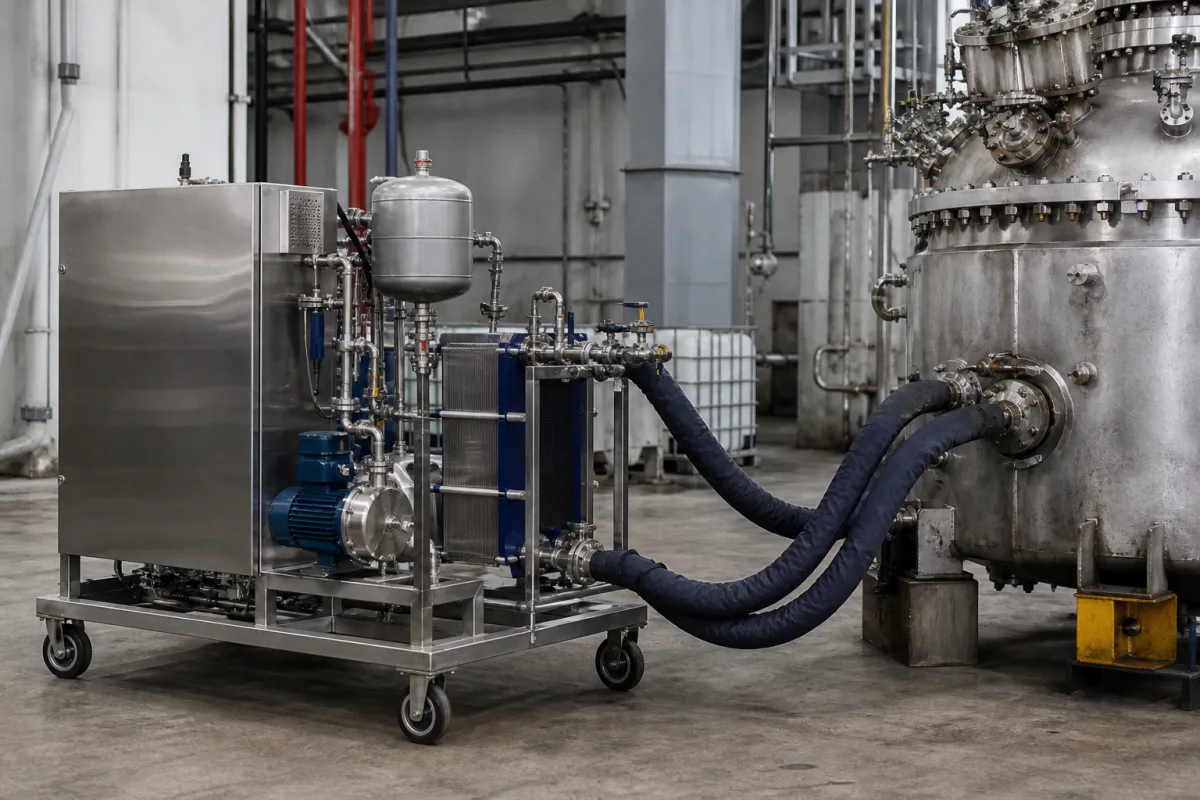
Tempered-water temperature control unit for steel and glass-lined reactor jackets (pressurised hot-water loop)
Reactor jacket TCUs · pressurised tempered-water loops for steel and glass-lined vessels: heat duty per kelvin, thermal-shock limits, saturation pressure
A tempered-water temperature control unit is a pump, heater, plate heat exchanger and pressurised expansion vessel on one skid that circulates water — not thermal oil — through the jacket of a production reactor, heating and cooling it while holding the loop above the pressure at which the water would boil. On glass-lined vessels it also has to keep the jacket inside the lining's thermal-shock limits. Ask three things first: the heat duty the loop must carry per degree of temperature drop, the highest jacket temperature and the pressure needed to keep water liquid there, and the jacket-to-batch temperature difference the vessel maker allows.
Water-based circulating units for the jackets of steel and glass-lined steel production reactors, running pressurised hot water up to the limit where a water loop stops being practical. General circulating units for reactor jackets, including thermal-oil, silicone-oil and glycol units, are covered on the Jacket temperature control system page; water and oil units that heat and cool die-casting and plastics moulds are covered on the Mould temperature controller page; panel-mount electronic temperature controllers are covered on the Temperature controller page. Plant steam and chilled-water systems themselves are outside this page.
CNFX editorial research · Sources checked October 12, 2026 · 4 sources
Size the water loop from the batch heat load and the circulation rate
Thermo Fisher's application note sets the method: the heat load is Q = M·C·ΔT, summed over everything being heated or cooled — the reaction medium, the vessel, the fluid in the jacket, the hoses and the temperature control unit itself — and it warns that an uninsulated vessel or poor heat transfer can stop an otherwise correctly sized unit from reaching its target. [1]
A production-scale example: Hydro-Thermal describes a tempered-water loop for the jacket of a 2000-gallon glass-lined reactor at a contract specialty chemical maker, circulating water at 125 GPM (28 m³/h), with an initial batch temperature of 10–27 °C, a maximum batch temperature of 88 °C, jacket water up to 154 °C and a temperature rise per pass listed as 0–30° (the page does not state the unit for that figure). Steam was supplied at 6.9 barg and 170 °C. [2]
Editorial calculation of the loop's carrying capacity: NIST lists saturated liquid water at 91.5 °C at 964.3 kg/m³ with a heat capacity of 4.207 kJ/kg·K, so 28 m³/h of water carries 28 ÷ 3600 × 964.3 × 4.207 = 31.5 kW for every kelvin the water cools across the jacket — 315 kW at a 10 K drop. [4][2]
Editorial calculation of the batch side, assuming for illustration a full 2000-gallon (7.57 m³) water-like batch: heating it from 27 °C to 88 °C needs 7570 kg × 4.2 kJ/kg·K × 61 K ≈ 1.94 GJ, or about 539 kWh — roughly 1.7 hours at 315 kW before vessel mass, losses and reaction heat are added as Thermo Fisher's method requires. [1][2]
Give the supplier the vessel volume and jacket type, the lining (glass-lined or steel), the batch mass and heat capacity, the heat of reaction and dosing rate, the start and end temperatures and the time allowed, and the steam pressure and cooling-water temperature available on site.
02
Read the allowed jacket temperature from the glass lining's thermal-shock diagram
ISO 28721-3 specifies the thermal-shock resistance of glass-lined apparatus, and the heating and cooling procedures for it, by diagrams. For glass-lined steel it distinguishes a thermal shock on the glass-lined side, produced by charging the vessel, from a thermal shock on the steel side, produced by heating or cooling the apparatus — the side the jacket loop acts on. It covers operating temperatures from −25 °C to +230 °C and applies only to enamelled unalloyed and low-alloy carbon steels. [3]
In Hydro-Thermal's case the customer, because of a previous circumstance, was sensitive to any potential for thermal shock to the glass lining; the tempered-water loop with modulated steam injection was chosen so jacket temperature could be controlled precisely across heating and cooling, and the case lists elimination of steam hammer among the results. [2]
Editorial calculation: the case's limits — jacket water to 154 °C, batch to 88 °C — allow a jacket-to-batch difference of up to 154 − 88 = 66 K at the end of heating and more when the batch is still at 10–27 °C. Whether that difference is acceptable at each batch temperature is read off the vessel maker's ISO 28721-3 diagram for its lining, so the TCU's controller needs that limit as an input rather than a fixed setpoint. [2][3]
Thermo Fisher explains why the controller drives the jacket away from the setpoint at all: with a sensor in the reaction mass the unit can run the jacket hotter or colder than the target, while control on the unit's own fluid temperature slows as the batch approaches setpoint because heat flow follows Q = U·A·LMTD. [1]
03
Hold the loop above saturation pressure so the jacket water stays liquid
Hydro-Thermal notes that keeping a liquid phase in the jacket throughout the batch cycle gives a quick response and simplifies design, installation and tuning. The pressure needed for that rises steeply with temperature. [2]
NIST's saturation table for water gives 1.11 bar (absolute) at 102.5 °C, 5.15 bar at 153.0 °C, 5.52 bar at 155.6 °C and 27.95 bar at 230.0 °C. [4]
Editorial calculation: Hydro-Thermal's 154 °C jacket water sits between NIST's 153.0 °C and 155.6 °C points, so the loop must be held above roughly 5.3 bar absolute (about 4.3 barg) at its hottest point; the 6.9 barg steam supply the case lists is above that, which direct steam injection into the loop needs. [4][2]
Editorial calculation: running a water loop at the 230 °C upper limit of the ISO 28721-3 range would need about 28 bar absolute, against about 5.5 bar near 155 °C — so both the jacket and the skid would need a pressure rating of that order, and the thermal-fluid units on the Circulating TCU page are the alternative to price. [4][3]
04
Direct steam injection into the tempered-water loop, and the jacket pressure limit
Hydro-Thermal's case heats the tempered-water loop by injecting steam directly into the circulating water rather than through a separate heating surface. [2]
Hydro-Thermal's K410AD Hydroheater modulates steam internally into the circulating water, giving complete rangeability without steam hammer or instability, and the tempered loop responds to heating or cooling demand. [2] Editorial note: direct injection adds condensate to the loop, so the skid needs a way to bleed the excess water; ask the supplier how the loop level and pressure are held when steam is injected.
Thermo Fisher's note adds the limit on the other side of the jacket: glass vessels may have pressure limits below what a circulator can deliver, so pressure reducers or reduction valves are needed; for glass-lined steel the jacket's own pressure rating plays the same role against the loop pressure worked out above. [1]
05
Steam injector, pump, pressurised expansion vessel, process sensor and jacket limiter on one skid
Part
Role in a tempered-water loop
Fix in the order
Circulation pump
Sets loop flow; 125 GPM (28 m³/h) on a 2000-gallon glass-lined reactor. [2]
Flow at jacket pressure drop.
Steam injection heater
Modulates steam into the loop; 6.9 barg supply in the case. [2]
Steam pressure and heater model.
Pressurised expansion vessel
Keeps water above saturation pressure, about 5.3 bar abs at 154 °C. [4]
Design pressure and pressurising gas.
Process temperature sensor
Lets the unit drive the jacket above or below setpoint. [1]
Sensor input and location.
Jacket temperature limiter
Keeps jacket-to-batch difference inside the lining's thermal-shock diagram. [3]
Limit values from the vessel maker.
06
Jacket water temperature, loop pressure, flow and thermal-shock limit for the quotation
Explore company information and manufacturing capabilities, then discuss the scope of your project with a relevant supplier.
Share this page
Compiled and source-reviewed by the CNFX editorial team.
Each manufacturer above links to the page on that company's own website where the product is listed, with the date we checked it. How we source and review
· Page last updated 13 October 2026
Buyer questions
What pressure keeps jacket water liquid at about 155 °C?
NIST lists water's saturation pressure as 5.52 bar absolute at 155.6 °C, so the loop has to be held above that. [4]
Which standard sets thermal-shock limits for glass-lined reactors?
ISO 28721-3 gives the limits as diagrams for −25 °C to +230 °C, separating glass-side and steel-side thermal shock. [3]
How much water does a production glass-lined reactor loop circulate?
Hydro-Thermal's case for a 2000-gallon glass-lined reactor circulates 125 GPM (28 m³/h) with jacket water up to 154 °C. [2]
Sources and what still needs a direct check
Sources checked 2026-10-12. ISO 28721-3 (scope page) sets the glass-lining limits; NIST supplies water properties; Hydro-Thermal describes one production loop; Thermo Fisher's note gives the heat-load and control method.