Industry-Verified Manufacturing Data (2026)

Ink Pump

Based on aggregated insights from multiple verified factory profiles within the CNFX directory, the standard Ink Pump used in the Printing and Reproduction of Recorded Media sector typically supports operational capacities ranging from standard industrial configurations to heavy-duty production requirements.

Technical Definition & Core Assembly

A canonical Ink Pump is characterized by the integration of Motor and Pump Head. In industrial production environments, manufacturers listed on CNFX commonly emphasize Stainless steel construction to support stable, high-cycle operation across diverse manufacturing scenarios.

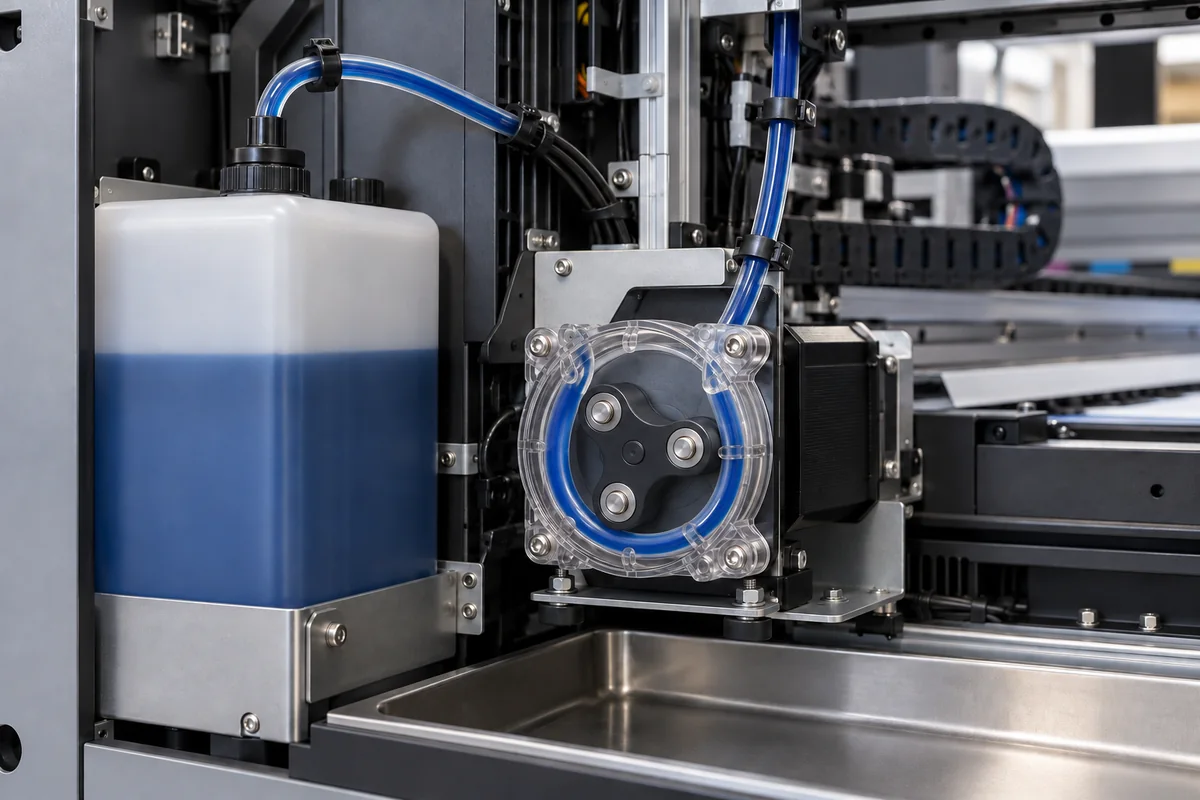
A mechanical device that transfers ink from a reservoir to the printing mechanism.
Product Specifications

Technical details and manufacturing context for Ink Pump

Definition
An ink pump is a critical component within an ink system that precisely controls the flow and pressure of ink from storage containers to the printing heads or application units. It ensures consistent ink delivery for quality printing operations.
Working Principle
Typically operates using positive displacement (such as diaphragm, gear, or peristaltic mechanisms) or centrifugal force to create pressure differentials that move ink through the system. Many modern ink pumps incorporate electronic controls for precise flow regulation.
Common Materials
Stainless steel, Ceramic, PTFE (Teflon), Engineering plastics
Technical Parameters
  • Flow rate capacity (L/min) Per Request
Components / BOM
  • Motor
    Provides rotational power to drive the pumping mechanism
    Material: Steel/Copper
  • Pump Head
    Contains the displacement mechanism that moves the ink
    Material: Stainless steel/Ceramic
  • Seals/Gaskets
    Prevent ink leakage at connection points
    Material: PTFE/Viton
Engineering Reasoning
0.5-3.0 bar (50-300 kPa)
Cavitation occurs at vapor pressure threshold of 0.023 bar (2.3 kPa) at 20°C, mechanical failure at 4.5 bar (450 kPa) due to diaphragm yield stress
Design Rationale: Cavitation-induced erosion from Bernoulli's principle (P = P₀ - ½ρv²) when local pressure drops below ink vapor pressure, causing bubble collapse with microjet impacts exceeding 1000 MPa
Risk Mitigation (FMEA)
Trigger Diaphragm material fatigue from 10⁷ cycles at 2 Hz operating frequency
Mode: Diaphragm rupture causing 0% ink transfer efficiency
Strategy: Replace EPDM diaphragm with FKM compound (fatigue strength 15 MPa vs 8 MPa) and implement cycle counter with 9×10⁶ cycle maintenance threshold
Trigger Particulate contamination exceeding 25 μm diameter in ink supply
Mode: Check valve jamming with 100% backflow coefficient
Strategy: Install 10 μm absolute filtration with differential pressure monitoring (alarm at 0.3 bar ΔP) and ultrasonic cleaning cycle every 500 operating hours

Industry Taxonomies & Aliases

Commonly used trade names and technical identifiers for Ink Pump.

Applied To / Applications

This component is essential for the following industrial systems and equipment:

Industrial Ecosystem & Supply Chain DNA

Complementary Systems
Downstream Applications
Specialized Tooling

Application Fit & Sizing Matrix

Operational Limits
pressure: Up to 100 psi
flow rate: 0.1 to 10 L/min
temperature: 5°C to 60°C
viscosity range: 1 to 5000 cP
Media Compatibility
✓ Water-based inks ✓ Solvent-based inks ✓ UV-curable inks
Unsuitable: Abrasive slurries with high particulate concentration
Sizing Data Required
  • Required flow rate (L/min)
  • System pressure requirements (psi)
  • Ink viscosity (cP)

Reliability & Engineering Risk Analysis

Failure Mode & Root Cause
Cavitation damage
Cause: Insufficient NPSH (Net Positive Suction Head) leading to vapor bubble formation and implosion on impeller surfaces, causing pitting and material loss.
Seal failure and leakage
Cause: Abrasive particle accumulation in seal faces from ink pigments/solids, combined with chemical degradation of seal materials from ink solvents.
Maintenance Indicators
  • Unusual high-frequency vibration or knocking sounds from pump housing indicating cavitation or bearing issues
  • Visible ink leakage around shaft seal or discoloration/dripping at seal housing
Engineering Tips
  • Maintain proper NPSH margins by ensuring adequate suction pressure and minimizing suction line restrictions/air ingress
  • Implement regular seal flush system maintenance with compatible flushing fluid to prevent particle buildup and monitor seal face wear patterns

Compliance & Manufacturing Standards

Reference Standards
ISO 28580:2009 (Diaphragm pumps for general use) ANSI/ASME B73.1 (Specification for horizontal end suction centrifugal pumps) CE marking (EU compliance for machinery safety under Directive 2006/42/EC)
Manufacturing Precision
  • Shaft runout: +/-0.01mm
  • Impeller clearance: +/-0.05mm
Quality Inspection
  • Pressure decay leak test (to verify seal integrity)
  • Material composition verification via XRF analysis

Factories Producing Ink Pump

Verified manufacturers with capability to produce this product in China

✓ 98% Supplier Capability Match Found

S Sourcing Manager from Singapore Feb 09, 2026
★★★★★
"Testing the Ink Pump now; the technical reliability results are within 1% of the laboratory datasheet."
Technical Specifications Verified
P Procurement Specialist from Germany Feb 06, 2026
★★★★☆
"Impressive build quality. Especially the technical reliability is very stable during long-term operation. (Delivery took slightly longer than expected, but technical support was excellent.)"
Technical Specifications Verified
T Technical Director from Brazil Feb 03, 2026
★★★★★
"As a professional in the Printing and Reproduction of Recorded Media sector, I confirm this Ink Pump meets all ISO standards."
Technical Specifications Verified
Verification Protocol

“Feedback is collected from verified sourcing managers during RFQ (Request for Quote) and factory evaluation processes on CNFX. These reports represent historical performance data and technical audit summaries from our B2B manufacturing network.”

13 sourcing managers are analyzing this specification now. Last inquiry for Ink Pump from Poland (1h ago).

Frequently Asked Questions

What materials are used in this ink pump for corrosion resistance?

This ink pump utilizes stainless steel for structural components, ceramic for the pump head, PTFE (Teflon) for seals, and engineering plastics for chemical resistance against various inks.

How does this mechanical ink pump transfer ink in printing systems?

The pump uses a motor to drive the pump head, creating suction to draw ink from a reservoir and pressure to deliver it precisely to the printing mechanism through sealed pathways.

What maintenance is required for the pump's seals and gaskets?

Regular inspection of PTFE seals and gaskets is recommended to prevent leaks; replacement intervals depend on ink type and usage frequency, typically outlined in the product manual.

Can I contact factories directly on CNFX?

CNFX is an open directory, not a transaction platform. Each factory profile provides direct contact information and production details to help you initiate direct inquiries with Chinese suppliers.

Get Quote for Ink Pump

Request technical pricing, lead times, or customized specifications for Ink Pump directly from verified manufacturing units.

Your business information is encrypted and only shared with verified Ink Pump suppliers.

Thank you! Your message has been sent. We'll respond within 1–3 business days.

Need to Manufacture Ink Pump?

Connect with verified factories specializing in this product category

Add Your Factory Contact Us
Previous Product
Ink Channel / Manifold
Next Product
Ink System