Dosing pump head (liquid end) of mechanically actuated and solenoid diaphragm pumps: material combinations, check valves, self-degassing heads and the suction and discharge limits they set
The wetted head of a mechanically or solenoid-driven diaphragm dosing pump · which head, ball, seat, seal and diaphragm materials go together for which chemical, what a self-degassing head costs in output and suction lift, and the pressures the head needs on each side
In a diaphragm dosing pump the drive moves a diaphragm and everything the chemical touches sits in the pump head: the head body, the suction and discharge check valves with their balls and seats, the seals and the wetted face of the diaphragm. Heads are sold as replaceable liquid ends, coded by material, and the choice is made by chemical first, then by what the head does to suction lift, output and the pressures the pump needs to work. The figures below come from one solenoid pump and two motor-driven, mechanically actuated pumps.
Pump heads (liquid ends) of mechanically actuated (motor-driven) and solenoid-driven diaphragm dosing pumps: head bodies, suction and discharge check valves, balls and seats, seals and gaskets, diaphragms, degassing and bleed heads, and their material codes, suction and discharge requirements and capacity effects. Hydraulically actuated diaphragm liquid ends with an oil chamber and drive piston are covered on the Piston and PTFE diaphragm assembly of a hydraulically actuated metering pump page; complete metering pumps with their accuracy, turndown and installation on the Metering pump page; packaged dosing skids on the Chemical dosing pump skid page; hygienic beverage dosing pumps on the Hygienic precision metering pump assembly page; ceramic piston filling pumps on the Precision metering pump for filling and dispensing page.
CNFX editorial research · Sources checked October 13, 2026 · 3 sources
Materials by chemical: PVC heads with ceramic balls for acids and hypochlorite, Hastelloy or 304 balls for alkalis, stainless heads for solvents
Iwaki's LK series are motor-driven, mechanically actuated diaphragm pumps, and its brochure sets out each liquid-end code part by part, with the chemicals it lists for each: [1]
Every LK combination uses a PTFE valve gasket and a PTFE + EPDM diaphragm. [1] Milton Roy's MacRoy D, also mechanically actuated, offers polypropylene, acrylic, PVDF, 316 stainless and PVC heads (PVC with Alloy 20 or with 316 stainless balls and seats), Viton or Aflas seals, a standard PTFE diaphragm, and balls of the valve-body material except on PVC and PVDF heads, which use ceramic. [2] ProMinent's solenoid gamma/ X offers acrylic/PVC, PVT (PVDF) and stainless steel liquid ends, and PVT4 heads for viscosities up to 3000 cP. [3]
Editorial note: in Iwaki's and Milton Roy's tables the ball material changes more than the head material does: ceramic against acids and oxidisers, Hastelloy C276 or stainless steel against alkalis and slurries, with the plastic head kept. [1][2]
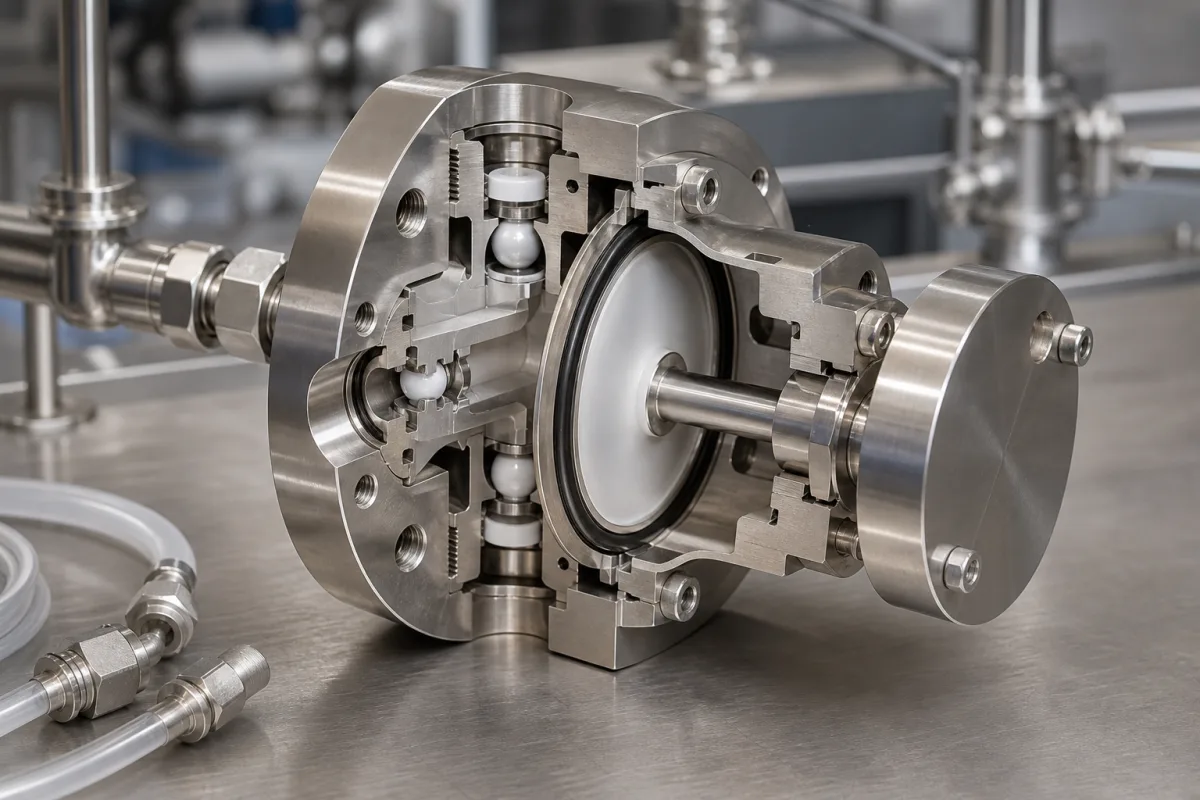
The image above shows a head of the mechanically actuated type in cutaway: a stainless head body with a PTFE-faced diaphragm on a drive rod, and suction and discharge valves each with two white balls in series.
Give the chemical, its concentration and temperature, any solids or gas it releases, and ask for the full liquid-end code: head, ball, seat, seal, gasket and diaphragm materials.
02
Self-degassing heads for gassing chemicals: 27 % less output and 1.8 m instead of 3.0 m suction lift on the same pump
Editorial note: gas collecting in a head is compressed by the diaphragm instead of displacing liquid, which is what degassing heads and bleeds are for. ProMinent lists every gamma/ X size with a standard (non-self-bleeding) head and, for 8 of its 10 sizes, a self-degassing head (dosing head design 7); MacRoy D offers a manual bleed that vents the head at start-up or an automatic bleed that continuously returns a small portion of the fluid to purge gas. [3][2]
ProMinent's suction lift is stated with a filled head and suction line, and for self-bleeding heads with air in the suction line; all figures are at 200 strokes/min with water at 20 °C (the sheet prints '43 °F (20 °C)'; 20 °C is 68 °F). It adds that heads for higher-viscosity media have 10–20 % lower capacity and are not self-priming with all chemicals, and gives metering reproducibility of ±1 % when operated as instructed. [3]
Editorial calculation: on the GMXa 1009 the self-degassing head delivers 6.6 / 9.0 = 73 % of the standard head's output, 27 % less, and lifts 1.2 m less; on the GMXa 1604 it delivers 61 % and the maximum back pressure falls from 232 to 145 psi. [3] A pump sized on standard-head figures and then fitted with a degassing head for a gassing chemical can therefore fall short of its dose.
State whether the chemical releases gas, the suction lift or flooded suction, and whether a degassing head, manual bleed or automatic bleed is wanted; size the pump on the capacity of the head actually fitted.
03
What the head needs on each side: 12 psia NPIP and 2.5 m lift on suction, at least 30 psi on discharge, and the relief valve setting
Milton Roy's MacRoy D specification gives the suction and discharge conditions for its single-ball-check, mechanically actuated head: NPIP (NPSH) required 12 psia (0.82 bar absolute), maximum suction pressure 15 psi (1 bar), maximum lift on water 8.2 ft (2.5 m) (typ.), and a minimum recommended discharge pressure of 30 psi (2.06 bar) or 20 psi (1.4 bar) over suction pressure. For the external relief valve in the piping the specification reads '10% over discharge pressure or 15 psi (1 bar) – whichever is greater'. [2]
Milton Roy calls these viscosity ratings conservative and says viscous applications should be checked with an NPIP calculation; its head works up to 175 psi (12 bar) and its drive has an 11.9 mm stroke. [2]
Iwaki's specification table shows how much of a head's swept volume reaches the discharge. Its LK-A55 has a 100 mm effective diaphragm diameter and 10 mm stroke and delivers 3.3 L/min at 58 strokes/min (60 Hz) at its maximum pressure. [1] Editorial calculation: π/4 × (10 cm)² × 1.0 cm = 78.5 cm³ swept per stroke against 3300 / 58 = 56.9 cm³ delivered, 72 %; the LK-C87 (205 mm, 20 mm stroke, 54.0 L/min at 116 strokes/min) works out at 465.5 of 660 cm³, 71 %. [1]
Give the suction conditions (tank level, lift, line length, viscosity), the discharge pressure at the injection point, and the relief valve setting; ask for the head's NPIP requirement and minimum discharge pressure.
04
Pump head details to send
Paste it into your enquiry below or into an email to a maker, then replace every bracket.
Chemical: [name; concentration; temperature; gassing; solids; viscosity]
Head: [body; ball; seat; seal; gasket; diaphragm]
Valves: [single or double ball; springs]
Degassing: [self-degassing head; manual or automatic bleed]
Suction: [lift or flooded; NPIP available]
Discharge: [pressure; relief setting]
Pump: [make and model the head must fit]
Explore company information and manufacturing capabilities, then discuss the scope of your project with a relevant supplier.
Share this page
Compiled and source-reviewed by the CNFX editorial team.
Each manufacturer above links to the page on that company's own website where the product is listed, with the date we checked it. How we source and review
· Page last updated 13 October 2026
Buyer questions
Which pump head material is used for sodium hypochlorite?
Iwaki lists its VC liquid end, a PVC head with ceramic valve balls, PVC seats, FKM O-rings and a PTFE + EPDM diaphragm, for sodium hypochlorite as well as sulfuric and hydrochloric acid. [1]
Does a self-degassing pump head reduce output?
Yes. ProMinent's GMXa 1009 delivers 9.0 l/h with a standard head and 6.6 l/h with a self-degassing head, and its suction lift falls from 3.0 m to 1.8 m. [3]
What discharge pressure does a diaphragm dosing pump head need?
Milton Roy recommends at least 30 psi (2.06 bar), or 20 psi over suction pressure, for its MacRoy D, with the external relief valve set at '10% over discharge pressure or 15 psi (1 bar) – whichever is greater'. [2]
Sources and what still needs a direct check
Sources checked 2026-10-13. Three sources from three publishers: Iwaki's large LK series brochure (published by Iwaki America / Walchem) for liquid-end material combinations and swept volumes, Milton Roy's MacRoy D product specification for a mechanically actuated head's suction, discharge and viscosity limits, and ProMinent's gamma/ X cut sheet for standard and self-degassing heads.