Industry-Verified Manufacturing Data (2026)

Cutting Rotor

Based on aggregated insights from multiple verified factory profiles within the CNFX directory, the standard Cutting Rotor used in the Rubber and Plastic Product Manufacturing sector typically supports operational capacities ranging from standard industrial configurations to heavy-duty production requirements.

Technical Definition & Core Assembly

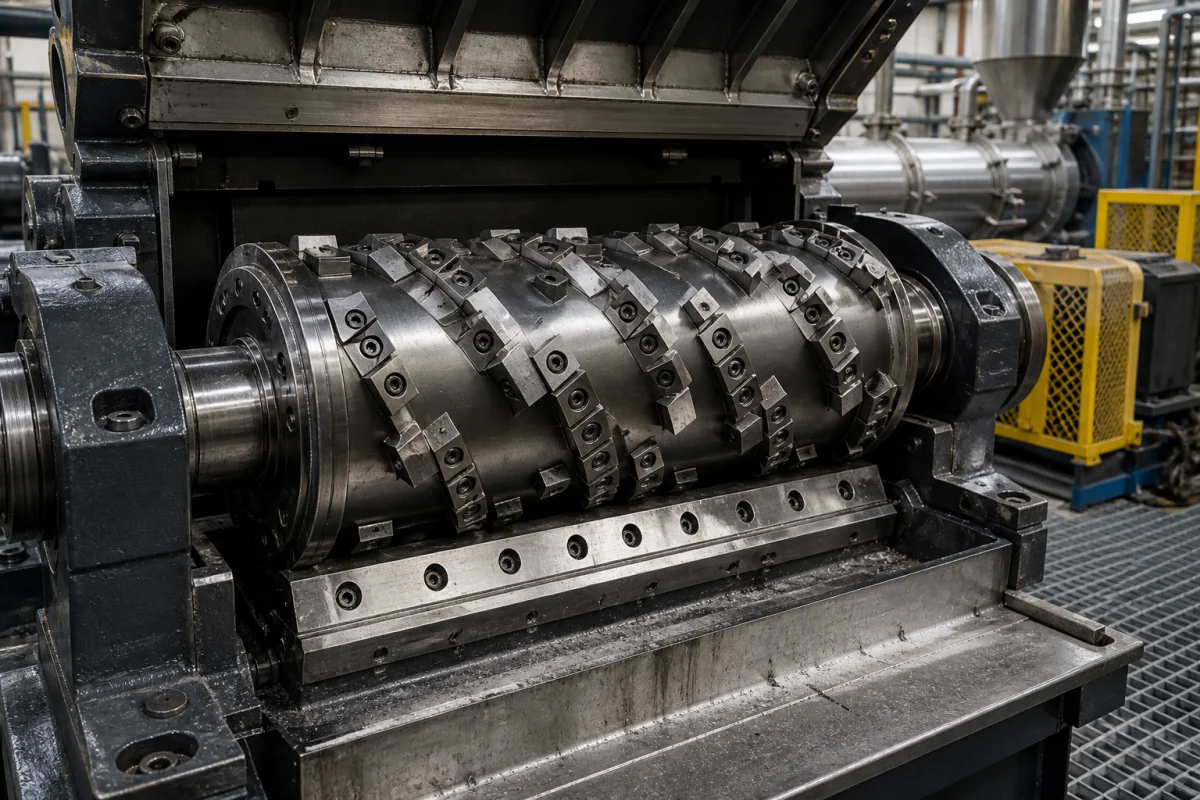
A canonical Cutting Rotor is characterized by the integration of Rotor Shaft and Cutting Blades. In industrial production environments, manufacturers listed on CNFX commonly emphasize Tool Steel construction to support stable, high-cycle operation across diverse manufacturing scenarios.

Rotating blade assembly that cuts polymer strands into uniform pellets in pelletizing equipment.

Product Specifications

Technical details and manufacturing context for Cutting Rotor

Definition
A critical rotating component within a Polymer Pelletizing Strand Cutter that consists of multiple blades mounted on a central shaft. As polymer strands are fed into the cutter, the rotor spins at high speed, precisely cutting the continuous strands into uniform pellets of specified length. The rotor's design, blade configuration, and rotational speed directly determine pellet size, shape consistency, and production efficiency.
Working Principle
The rotor rotates at controlled speeds driven by a motor. Polymer strands are fed tangentially or axially into the cutting chamber where the rotating blades make clean, shearing cuts against stationary bed knives or counter-blades. The centrifugal force helps eject cut pellets from the chamber.
Common Materials
Tool Steel, Stainless Steel, Hardened Alloy Steel
Technical Parameters
  • Rotor diameter and blade length dimensions (mm) Per Request
Components / BOM
  • Rotor Shaft
    Central structural component that transmits torque and supports blades
    Material: Alloy Steel
  • Cutting Blades
    Sharp edges that perform the actual cutting of polymer strands
    Material: Hardened Tool Steel
  • Blade Mounting Brackets
    Secure blades to the rotor shaft at precise angles and positions
    Material: Steel
  • Balance Weights
    Counterweights to ensure smooth rotation at high speeds
    Material: Steel
Engineering Reasoning
3000-12000 RPM rotational speed, 50-200 N·m torque, 20-80°C operating temperature
Material yield strength exceeded at 250 MPa stress, blade tip speed exceeding 150 m/s causing centrifugal failure, temperature exceeding 120°C causing polymer adhesion
Design Rationale: High-cycle fatigue from cyclic loading at blade resonance frequencies (typically 80-200 Hz), abrasive wear from polymer additives (silica, talc), thermal stress from rapid temperature changes during startup/shutdown
Risk Mitigation (FMEA)
Trigger Imbalance exceeding 0.5 g·mm/kg due to uneven blade wear or material buildup
Mode: Excessive vibration exceeding 4.5 mm/s RMS causing bearing premature failure and housing fatigue cracks
Strategy: Dynamic balancing to ISO 1940 G2.5 standard with real-time vibration monitoring using piezoelectric accelerometers
Trigger Polymer melt temperature deviation beyond ±5°C from 220°C setpoint causing viscosity changes
Mode: Strand diameter variation exceeding ±0.3 mm leading to inconsistent pellet size and cutter blade overload
Strategy: Closed-loop PID temperature control with RTD sensors and melt pressure feedback at 100 ms sampling rate

Industry Taxonomies & Aliases

Commonly used trade names and technical identifiers for Cutting Rotor.

Industrial Ecosystem & Supply Chain DNA

Complementary Systems
Downstream Applications
Specialized Tooling

Application Fit & Sizing Matrix

Operational Limits
pressure: Atmospheric to 5 bar (cutting chamber)
flow rate: 100-5000 kg/hr (polymer throughput)
temperature: 50-150°C (typical polymer processing range)
slurry concentration: Up to 70% solids by weight (water-cooled systems)
Media Compatibility
✓ Polyethylene (PE) pellets ✓ Polypropylene (PP) strands ✓ Polyester (PET) melt
Unsuitable: Abrasive-filled polymers with >30% mineral content
Sizing Data Required
  • Polymer melt flow rate (kg/hr)
  • Desired pellet size (mm)
  • Motor power available (kW)

Reliability & Engineering Risk Analysis

Failure Mode & Root Cause
Fatigue cracking
Cause: Cyclic loading from cutting impacts and rotational stresses, often exacerbated by material defects or improper heat treatment
Edge degradation
Cause: Progressive wear from abrasive materials, improper cutting angles, or excessive feed rates leading to loss of cutting efficiency
Maintenance Indicators
  • Unusual vibration patterns or audible knocking during operation
  • Visible cracks, chips, or excessive wear on cutting edges and mounting surfaces
Engineering Tips
  • Implement regular non-destructive testing (NDT) inspections using dye penetrant or magnetic particle methods to detect early-stage cracks
  • Optimize cutting parameters (speed, feed rate, depth) based on material being processed and maintain proper lubrication/cooling systems

Compliance & Manufacturing Standards

Reference Standards
ISO 1940-1:2003 (Balance quality requirements for rotors in a constant state) ANSI/AGMA 2000-A88 (Gear Classification and Inspection Handbook) DIN 3962 (Tolerances for cylindrical gear teeth)
Manufacturing Precision
  • Bore diameter: +/-0.01 mm
  • Surface flatness: 0.05 mm
Quality Inspection
  • Magnetic Particle Inspection (MPI)
  • Coordinate Measuring Machine (CMM) dimensional verification

Factories Producing Cutting Rotor

Verified manufacturers with capability to produce this product in China

✓ 96% Supplier Capability Match Found

P Procurement Specialist from Australia Feb 12, 2026
★★★★★
"Standard OEM quality for Rubber and Plastic Product Manufacturing applications. The Cutting Rotor arrived with full certification."
Technical Specifications Verified
T Technical Director from Singapore Feb 09, 2026
★★★★★
"Great transparency on the Cutting Rotor components. Essential for our Rubber and Plastic Product Manufacturing supply chain."
Technical Specifications Verified
P Project Engineer from Germany Feb 06, 2026
★★★★★
"The Cutting Rotor we sourced perfectly fits our Rubber and Plastic Product Manufacturing production line requirements."
Technical Specifications Verified
Verification Protocol

“Feedback is collected from verified sourcing managers during RFQ (Request for Quote) and factory evaluation processes on CNFX. These reports represent historical performance data and technical audit summaries from our B2B manufacturing network.”

11 sourcing managers are analyzing this specification now. Last inquiry for Cutting Rotor from Turkey (46m ago).

Supply Chain Compatible Machinery & Devices

Modular Injection Molded Plastic Pallet

Interlocking plastic pallet system for logistics and storage.

Explore Specs →
Multi-Layer Co-Extruded Barrier Film

Plastic film with multiple layers for superior barrier properties.

Explore Specs →
High-Precision Silicone Gasket

Custom-molded silicone seal for industrial equipment.

Explore Specs →
High-Density Polyethylene Storage Container

Industrial-grade plastic container for bulk material storage and transport.

Explore Specs →

Frequently Asked Questions

What materials are best for cutting rotors in plastic pelletizing?

Tool steel, stainless steel, and hardened alloy steel offer optimal durability and corrosion resistance for cutting polymer strands in pelletizing applications.

How often should cutting rotors be replaced in pelletizing equipment?

Replacement frequency depends on material abrasiveness and production volume, but regular inspection of cutting blades and rotor balance is recommended every 6-12 months.

Can cutting rotors be customized for specific polymer types?

Yes, cutting rotors can be engineered with specific blade geometries, materials, and balancing weights to optimize performance for different polymer viscosities and strand diameters.

Can I contact factories directly on CNFX?

CNFX is an open directory, not a transaction platform. Each factory profile provides direct contact information and production details to help you initiate direct inquiries with Chinese suppliers.

Get Quote for Cutting Rotor

Request technical pricing, lead times, or customized specifications for Cutting Rotor directly from verified manufacturing units.

Your business information is encrypted and only shared with verified Cutting Rotor suppliers.

Thank you! Your message has been sent. We'll respond within 1–3 business days.

Need to Manufacture Cutting Rotor?

Connect with verified factories specializing in this product category

Add Your Factory Contact Us
Previous Product
Cooling Unit
Next Product
Delivery Manifold & Valves