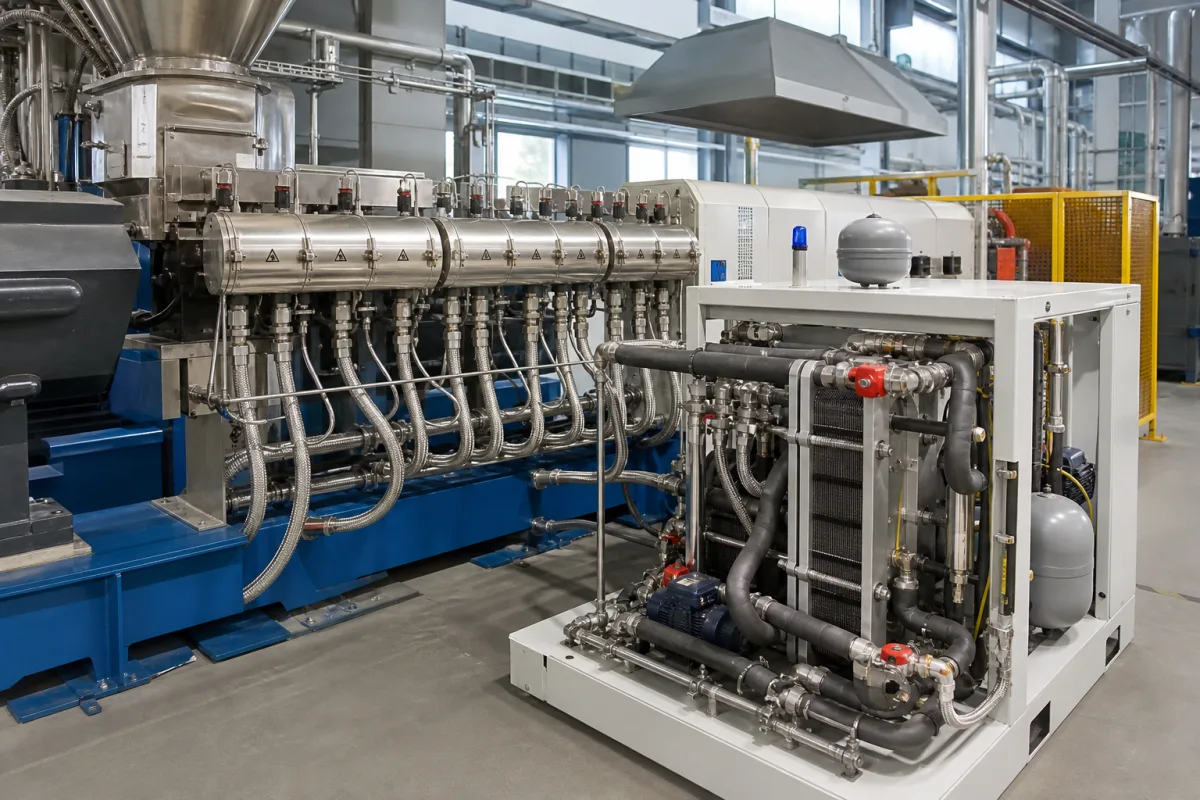
Barrel heating and cooling system for twin-screw extruder zones
Extruder barrel zones · cast-in heaters with cooling tubes, alloy temperature limits, watt density, tube pressure and scale
On a twin-screw extruder each barrel section, or zone, has its own heater, its own cooling path and its own thermocouple, and the controller heats or cools each zone to hold its set point. This page covers the zone hardware: electric heater shells and cast-in heaters with cooling tubes, cooling bores in the barrel, the per-zone water valves, and the closed cooling-water loop that serves them. What decides the order: the alloy and watt density the heater can survive at the zone temperature, whether cooling runs through tubes cast into the heater or channels in the barrel, how the tubes are terminated, and how scale will be kept out.
Barrel-zone heating and cooling equipment for twin-screw (and single-screw) extruders: electric heater shells and cast-in band or L-shaped heaters with or without cast-in cooling tubes, air-cooled finned heaters with blowers, barrel cooling bores and barrel pads, per-zone solenoid or ball valves, and closed cooling-water units with heat exchangers. The extruder itself, its torque, free volume and scale-up, is covered on the Co-rotating twin-screw compounding extruder page. Single-fluid circulating temperature control units for reactor jackets and moulds are covered on the Circulating temperature control unit (TCU) for reactor jackets and moulds page and the Temperature control unit (TCU) for jacketed and flow reactors page. Building HVAC heating and cooling systems are outside this page.
CNFX editorial research · Sources checked October 12, 2026 · 5 sources
Heater alloy sets the zone temperature limit and the watt density
Tempco makes L-shaped cast-in heaters for square and rectangular twin-screw extruder barrels in compounding and resin manufacture, in bronze or brass where high shear drives temperature and watt density up, and in aluminium for lower temperatures, where its higher thermal conductivity and lower weight make installation easier. [2] Its specification page gives the limits that follow from that choice: [1]
Editorial calculation: 35 W/in² is about 5.4 W/cm² and 45 W/in² about 7.0 W/cm² (1 in² = 6.45 cm²). The limit is on the tubular element surface inside the casting, not on the barrel.
The elements themselves run up to 600 V and 40 A per element on the largest .430 in tubular heater (240 V and 15 A on the .260 in element), with resistance tolerance of +10 %/−5 % and wattage tolerance of +5 %/−10 %. Combining a heater and a cooling tube in one casting needs at least 1-1/4 in (31.8 mm) of casting thickness, which then takes a .260 in element with a 3/8 in tube; from 1-1/2 in (38.1 mm) the .430 in element fits with a 1/2 in tube. [1]
Bühler's POLYtwin food and feed extruder shows the other route: each 4D barrel section is water-cooled and heated by oil or by optional electric heating shells, rated at 300 bar and 300 °C. Temperature is controlled separately for each barrel by steam and water, with electric heating shells and oil or pressure-water units as options. [4]
Give the supplier the barrel shape (round, square, rectangular) and dimensions per zone, zone set temperatures, heater power per zone, supply voltage and phase, heater alloy, cooling medium and temperature, cooling tube size and fittings, thermocouple positions, clamping (straps or bolts) and terminal protection.
02
Cooling tube size, wall and working pressure in cast-in heaters
Tempco's liquid-cooled heaters cast a serpentine of 1/4, 3/8 or 1/2 in tubing into the heater body, and its standard tubes are 304 stainless; Incoloy® 840 is an option. Working pressures in the table use Barlow's formula with a safety factor of 4: [3][1]
Editorial calculation: 2,800 psi ≈ 193 bar and 4,875 psi ≈ 336 bar, well above plant cooling-water pressure; the tube wall is chosen for corrosion and stress-cracking life rather than pressure.
The catalogue names two failure causes for liquid-cooled cast-in heaters: stress corrosion cracking where the tube extension leaves the casting, and scale that narrows the tube until it blocks. Its answers are a second, spare set of 3/8 or 1/2 in tubes in the same casting, which it says doubles operating life because the tubes fail before the heating element, and Type RC non-exposed tubes ending in stainless NPT fittings (3/8"-18 or 1/2"-14) cast below the heater surface. [3]
Tempco also points out that a cast-in cooling tube lets the processor change one heater at a time if a line clogs, instead of reworking cooling bores in the barrel. [2] Steer Engineering's European patent EP 2 368 690 describes the same scale problem in barrel casings with drilled cooling channels closed by welded plates, where cleaning means removing the casing, and proposes aluminium, copper or bronze barrel pads with cartridge heaters and screwed-in cover plates so the channels can be opened for descaling. [5]
Bühler's barrel diagrams show each zone with an electric heating shell, a thermocouple and a cooling-water supply and return, switched by a solenoid valve that can be replaced by a ball valve when the zone is controlled by hand; the cooling-water return can be replaced by a cooling unit, or the zone served by a heating/cooling unit instead. [4]
Editorial note: because scale is the failure Tempco and Steer both describe, a closed loop of treated water, cooled through a plate heat exchanger against plant water, keeps hardness out of the small tubes; specify water quality and a strainer for each zone manifold.
Ask the supplier for the cooling capacity of each zone at its set temperature, and for the water flow and inlet temperature that capacity assumes.
04
Send zone data for every barrel section
Paste it into your enquiry below or into an email to a maker, then replace every bracket.
Barrel: [round / square / rectangular; size per zone; number of zones]
Temperatures: [set point per zone; maximum]
Heating: [kW per zone; voltage; phase; heater alloy]
Cooling: [water / oil / air; tube size; tube termination]
Valves: [solenoid or manual per zone; voltage]
Water: [closed loop or plant water; quality; heat exchanger]
Sensors: [thermocouple type and position]
Mounting: [straps or bolts; terminal protection]
1 company lists this product among what they make. Company figures are quoted from each
company's own website; every card states where the relationship came from.
SHANGHAI PAMAENS TECHNOLOGY CO., LTD
Manufacturing site to be confirmed for the order
Lists barrel cooling and heating systems for screw extruders and air-cooled band heaters with fins or blowers, alongside cast aluminium and cast brass band heaters.
Explore company information and manufacturing capabilities, then discuss the scope of your project with a relevant supplier.
Share this page
Compiled and source-reviewed by the CNFX editorial team.
Each manufacturer above links to the page on that company's own website where the product is listed, with the date we checked it. How we source and review
· Page last updated 13 October 2026
Buyer questions
How hot can a cast-in barrel heater run?
Tempco lists maximum surface temperatures of 371 °C for aluminium 319, 399 °C for aluminium 356, 649 °C for yellow brass and 732 °C for bronze. [1]
Why do liquid-cooled barrel heaters fail?
Tempco names stress corrosion cracking where the tube leaves the casting and scale that blocks the tube; it offers spare tube sets and non-exposed fittings. [3]
How are twin-screw barrel zones cooled?
Bühler's POLYtwin cools each 4D barrel with water, switched per zone by a solenoid or manual ball valve, and heats by oil or electric shells. [4]
Sources and what still needs a direct check
Sources checked 2026-10-12. Tempco is a heater maker; its catalogue pages are hosted by Tempco and by its distributor Thermal Devices. Bühler is an extruder maker. Steer Engineering's patent is a granted European patent.