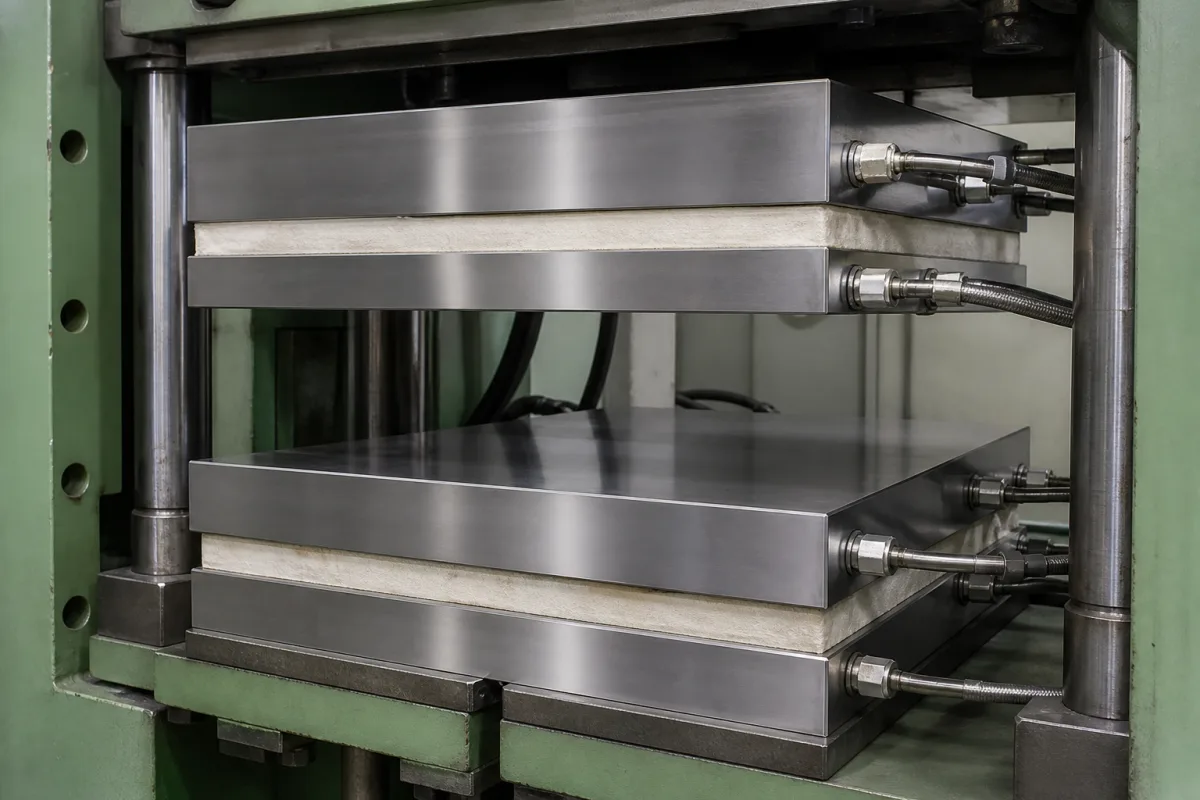
Heating platens fed with steam or thermal oil: the boiler pressure behind each platen temperature, the oil flow behind a small inlet–outlet drop, and the drilled passages between
Press platens heated by steam or thermal oil · saturation pressure per platen temperature, oil limits and circulation rate, drilled passages and steam traps
A fluid-heated platen has no heaters inside it. It is a slab of steel with long drilled passages, and the heat arrives as steam that condenses in those passages or as hot oil that is pumped through them from a heater elsewhere in the plant. That changes what has to be specified: for steam, the boiler pressure that sets the platen temperature and the traps that drain the condensate; for oil, the fluid's temperature limits and the circulation rate that keeps the outlet end of the platen close to the inlet end. This page works through those numbers for rubber and composite compression presses.
Press platens heated by steam or by a circulating thermal oil (hot oil) through drilled internal passages, for rubber, composite and laminating compression presses: steam pressure versus platen temperature, condensate removal, thermal-oil temperature limits and flow rate, passage construction and fouling. Electrically heated platens with cartridge heaters are covered on the Heated press platen (electrically heated surface plate with cartridge heaters, cooling channels and an insulation board) page, including its insulation board. Complete general-purpose presses are covered on the Hydraulic press page, and its other component pages (body panel presses, servo-hydraulic stamping presses, main cylinders with prefill valves) deal with frames and hydraulics, not platen heating. Heated rolls for calenders and film lines are covered on the Fluid-heated roll system page, and thermal-oil circuits for leather press rolls on the Heat transfer assembly for heated leather press rolls page. The boiler and the thermal-oil heater themselves are outside this page.
CNFX editorial research · Sources checked October 13, 2026 · 5 sources
Saturated steam pressure for platen temperatures from 150 °C to 205 °C
Steam gives up its heat in the platen by condensing, and it condenses at a temperature fixed by its pressure. The platen temperature is therefore set at the steam supply: NIST's saturation data for water give 4.76 bar absolute at 150 °C, 7.92 bar at 170 °C and 15.55 bar at 200 °C. [1]
Editorial calculation: latent heat is the vapour enthalpy minus the liquid enthalpy in the NIST table, for example 2,767.9 − 719.1 = 2,048.8 kJ/kg at 170 °C. Subtract about 1 bar from the absolute pressures to get the gauge reading at sea level: a 170 °C platen needs steam at roughly 6.9 bar(g), a 205 °C platen roughly 16.2 bar(g). Between 150 °C and 205 °C the pressure rises 3.6-fold for a 55 K rise in temperature.
Press builders rate steam platens accordingly. French Oil Mill Machinery says its steam-heated platen presses are engineered to match an existing or new steam source for heating up to 400 °F (about 204 °C), are machined from one-piece solid steel with sized flow channels, and are fitted with individual steam traps for each platen or zone. [3] Accudyne Engineering gives the effective range of steam heating as up to about 150–205 °C at practical system pressures, while elsewhere in the same article it places steam's preferred range below 150–175 °C; it lists rubber moulding among steam's applications and notes that the same passages can heat and then cool the platen by switching from steam to cooling water. [4]
State the platen temperature you need and the steam pressure available at the press, as gauge or absolute; if the plant header runs at 7 bar(g), the platens cannot be held much above 170 °C by steam alone.
02
Therminol 66 in a platen circuit: 345 °C bulk, 375 °C film, 2.2 kPa vapour pressure at 200 °C
A thermal oil carries its heat as sensible heat, so it stays liquid at low pressure but cools as it travels along the platen. Eastman's bulletin for Therminol 66, a modified terphenyl fluid, sets a maximum bulk temperature of 345 °C and a maximum film temperature of 375 °C, and lists a vapour pressure of 2.23 kPa at 200 °C. [2]
Editorial comparison: at 200 °C the oil's vapour pressure of 2.23 kPa [2] is about 0.02 bar, against 15.55 bar absolute for saturated steam at the same temperature [1]. French Oil Mill rates its oil-heated platens for controlled heating to 750 °F (about 399 °C), against 400 °F for its steam platens, and offers multi-flow zones on oil platens for large bonding and laminating presses. [3] Accudyne says thermal oils rated for continuous use at 300–400 °C are standard. [4]
Eastman's property table gives, at 170 °C, a density of 907 kg/m³ and a heat capacity of 2.09 kJ/(kg·K). [2] Editorial calculation, assuming a platen that must receive 6 kW at 170 °C (an illustrative load, not a source figure): with a 5 K drop from inlet to outlet the oil flow is 6 ÷ (2.09 × 5) = 0.57 kg/s, about 38 L/min; holding the drop to 2 K needs about 95 L/min. The same 6 kW from 170 °C steam condenses 6 ÷ 2,048.8 = 0.0029 kg/s, about 10.5 kg of steam per hour, with no temperature drop along the passage while the steam stays saturated.
Cold start is slower with oil. Eastman lists the minimum liquid temperature for fully developed turbulent flow (Reynolds number above 10,000) in a 2.54 cm tube at 3.048 m/s as 72 °C, and 35 °C for flow above the transitional Reynolds number of 2,000; its kinematic viscosity is 122 mm²/s at 20 °C against 1.30 mm²/s at 170 °C. [2] Editorial note: those thresholds are for a 2.54 cm tube at 3.048 m/s; the Reynolds number scales with bore diameter and velocity, so in narrower platen bores or at lower flow a cold circuit stays laminar to a higher oil temperature than these figures.
Ask the platen builder for the design flow per zone and the inlet-to-outlet temperature drop it was sized for, and check the oil's film-temperature limit against the heater outlet, not only the platen setpoint.
03
Gun-drilled passages, welded edge cross-channels, a steam trap per zone, and deposits in the bore
French Oil Mill machines its oil-heated platens from one piece of solid steel with interconnecting channels that are milled and welded on the platen's outside edges, a construction it says prevents blockage of the transfer-fluid flow, and it insulates the platens to hold temperature across surfaces and edges. [3]
Accudyne's platen service list shows how such passages are made and kept open: standard and custom platens for electric, steam and thermal-fluid heating, in-house gun-drilling, Blanchard or surface grinding for flatness and parallelism, weld repair, and acid flushing of the serpentine core. [5]
The flush matters because the oil ages in service. Eastman notes that low- and high-boiling compounds form as the fluid ages, that overheating or contamination accelerates decomposition and raises solids, and it recommends an inert-gas blanket against oxidation. [2] Accudyne writes that the oil degrades over time at operating temperature and can leave deposits in the platen channels, and that fluid sampling, flushing at set intervals and replacement belong in the maintenance plan. [4]
For uniformity across the face, Accudyne names channel spacing, flow rate and the fluid temperature drop across the platen as the deciding factors, and says large platens need channel routing that keeps the fluid from cooling significantly between inlet and outlet. [4] On steam platens the equivalent control is condensate removal: French Oil Mill fits a trap to each platen or zone. [3]
04
Data for a steam or thermal-oil heated platen
Paste it into your enquiry below or into an email to a maker, then replace every bracket.
Heating medium: [saturated steam; hot water; thermal oil, name of fluid]
Platen temperature: [setpoint; maximum; allowed variation across the face]
Supply: [steam pressure at the press, bar(g); oil heater outlet temperature and available flow]
Platen: [length × width × thickness; steel grade; number of zones]
Passages: [gun-drilled bore size; edge cross-channel construction; inlet/outlet positions]
Condensate or return: [trap per platen or zone; return line]
Cooling: [same passages with water or oil; target cooling rate]
Finish: [flatness and parallelism; mould mounting holes or T-slots]
Explore company information and manufacturing capabilities, then discuss the scope of your project with a relevant supplier.
Share this page
Compiled and source-reviewed by the CNFX editorial team.
Each manufacturer above links to the page on that company's own website where the product is listed, with the date we checked it. How we source and review
· Page last updated 13 October 2026
Buyer questions
What steam pressure does a 170 °C platen need?
NIST's saturation data give 7.92 bar absolute at 170 °C, about 6.9 bar gauge. [1]
How hot can a steam-heated platen run?
French Oil Mill rates its steam platens for heating up to 400 °F; Accudyne gives about 150–205 °C at practical system pressures. [3][4]
What are the temperature limits of Therminol 66?
Eastman sets 345 °C maximum bulk and 375 °C maximum film temperature. [2]
Why are steam traps fitted to each platen?
French Oil Mill fits individual traps per platen or zone to give overall heating accuracy and uniformity. [3]
Can thermal oil leave deposits in platen passages?
Accudyne says degraded oil can produce deposits in the platen channels and recommends sampling, flushing and replacement; Accudyne also offers acid flushing of serpentine cores. [4][5]
Sources and what still needs a direct check
Sources checked 2026-10-13. NIST saturation data for water, Eastman's Therminol 66 bulletin, French Oil Mill Machinery's heated platen press page, and Accudyne Engineering's article on platen heating methods and its platen services page.