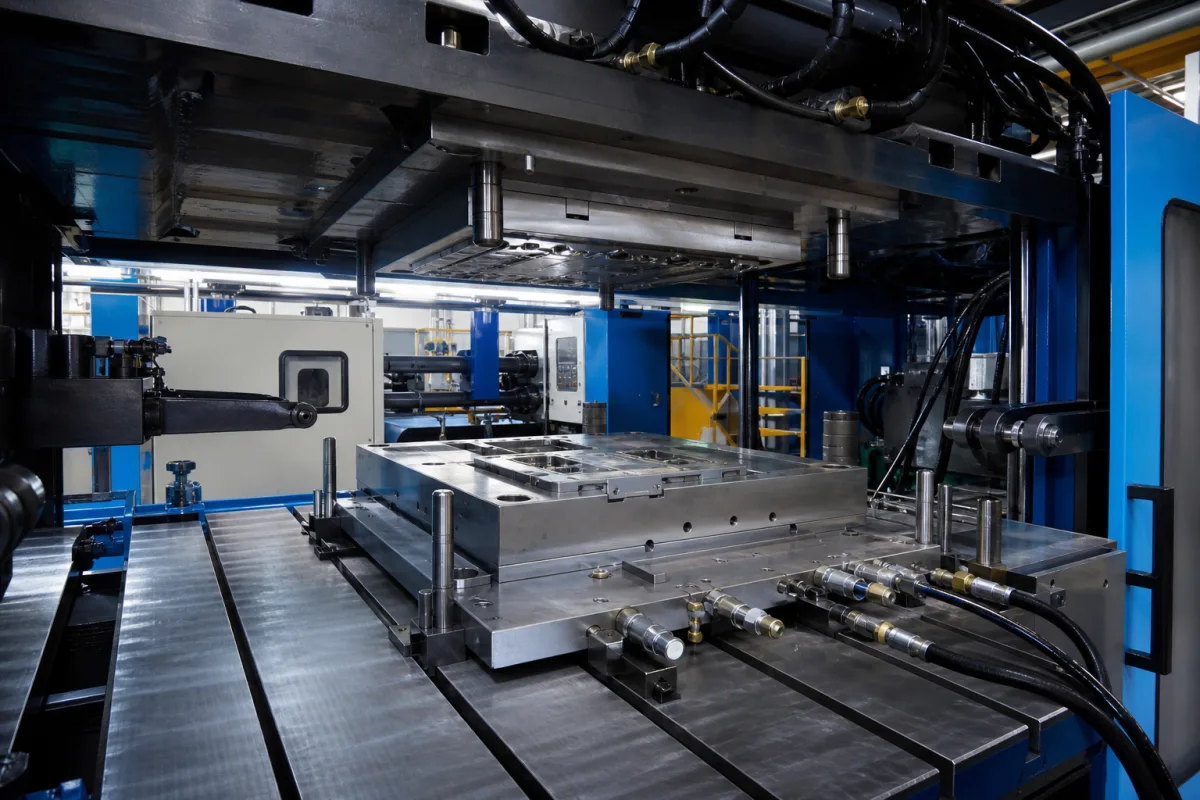
Mould platform of a thermoforming forming station: the table that carries the tool, and the size, weight, force and height it has to take
Thermoformer mould tables · tool footprint against forming area, tool weight per table, closing force, mould height, side loading and tool interface plates
A thermoforming tool is only as usable as the table it is bolted to. Before a mould is ordered for an existing machine, or a machine is bought to run existing moulds, four things on that table have to fit: the tool's outside dimensions against the forming area, the weight the table is allowed to carry and accelerate, the force and stroke it closes with, and the way the tool is brought in and clamped.
The forming-station mould table, also called lower table or platen, of roll-fed and cut-sheet thermoforming machines: the tool footprint and weight it accepts, the closing force and forming height it works against, and how tools are loaded, clamped and adapted between machine makes. The complete vacuum forming machine, draw ratio, sheet gauge and the design of the mould itself are covered on the Industrial vacuum forming machine page. Hydraulic clamping frames that hold welded machine bases are a different product on the Hydraulic clamping frame for heavy weldments page, and the plate stack of an injection mould on the Mold assembly for plastic injection moulds page.
CNFX editorial research · Sources checked October 13, 2026 · 5 sources
Tool footprint and tool weight per table: 780 × 560 mm and 400 kg on a Kiefel KMD 78F, against a 20 mm clamping rim on a Geiss T11
Kiefel's technical data for the KMD 78F roll-fed thermoformer, published with its Chinaplas 2016 launch, separates the forming area from the tool dimensions the table accepts and puts a weight limit on each table: maximum forming area 760 × 540 mm, maximum tool dimensions 780 × 560 mm, maximum tool weight per table 400 kg, maximum height of the formed part 150 mm, at a dry cycle speed of 60 cycles per minute. [1]
Editorial calculation from the Kiefel figures: the tool may be 20 mm larger than the forming area in each direction, about 10 mm per side, and 400 kg spread over the 0.437 m² tool footprint is about 916 kg per square metre of table. At the stated 60 dry cycles per minute, that mass is moved once a second. [1]
On a cut-sheet vacuum forming machine the reference is the sheet, not a web. Geiss states that the nominal dimension of its T11 is the largest sheet the machine can process, that the clamping rim is 20 mm all around, and that the standard tool height is 620 mm, increased on request; the T series is built in sizes from a minimum nominal 1000 × 900 mm up to dimensions such as 4700 × 2400 mm or 3100 × 3100 mm. [2] Editorial calculation: on a 1000 × 900 mm machine, a 20 mm rim on each edge leaves at most 960 × 860 mm of sheet free of the clamp for the tool to draw into.
Chu-Dong publishes a lower limit as well as an upper one for its SLC-1200 roll-fed machine: maximum forming area 1200 × 1000 mm, minimum 840 × 600 mm, maximum forming height 150 mm. [5] Editorial calculation: the smallest accepted tool covers 0.504 m², about 42 % of the 1.2 m² maximum, and a tool smaller than that falls below the published minimum.
Give the tool's outside dimensions and its weight per half, and ask the machine maker for the permitted tool weight per table and the clamping pattern; the forming area alone does not tell you whether the tool fits.
02
Closing force and forming height on the table: 60 t at Geiss, 67 US tons forming and 118 US tons cutting at WM, 84 tons at Chu-Dong
The table does not only carry the tool, it closes it against the sheet and, in form-and-cut machines, against the cutting rule. The force figures makers publish are stated in different units and for different operations, so they have to be read one by one.
Geiss lists high closing forces of up to 60 t with motorized drives as additional equipment for the T11, alongside automatic tool change carts and tool clamping systems for table and upper punch. [2] Editorial calculation: read as tonne-force, 60 t is about 588 kN.
WM gives two forces for the FXL1000: a forming force of 67 US tons from a four-column forming press, and a cutting force of 118 US tons, with a forming depth of 160 mm. [3] Editorial calculation: at 8.896 kN per US ton-force, that is about 596 kN for forming and about 1,050 kN for cutting, and the forming force spread over the 1060 × 940 mm forming area is about 598 kN per m².
Chu-Dong lists a clamping force of 84 tons for the SLC-1200 without stating the ton unit, and describes a servo-driven third movement that can be positioned to suit the mould height. [5] Editorial calculation: 84 metric tonne-force would be about 824 kN; 84 US tons would be about 747 kN, so the unit has to be confirmed before the figure is compared with another machine.
Kiefel's KMD 78F data lists no closing force; it gives the tool weight per table and the formed-part height instead. [1]
Ask which operation the published force belongs to (forming, clamping or cutting), in which unit, and over what stroke and tool height the table delivers it.
03
Bringing the tool onto the table: side loading, change carts and WM adaptation plates for Illig, Kiefel and Sencorp tooling
The makers cited here describe three ways of getting a tool onto the table and fixing it there.
Side loading: WM states the FXL1000 has a lateral mould loading system for easier handling, and Chu-Dong builds a version of the SLC-1200 in which the mould is changed from the side direction. [3][5]
Carts and clamps: Geiss offers automatic tool change carts and proven tool clamping systems for the table and the upper punch, aimed at fast setup times, and the operator enters the tool dimensions so the machine sets end positions and travel paths itself. [2]
Interface plates between machine makes: WM writes that its FX, FLEX and Twist series take tooling built for Illig, Kiefel or Sencorp machines through adaptation plates, and that its plug-and-play system with minor modifications gives mould compatibility with the standard KMD, RDK, RDKP and RDM series. [3][4] An existing tool therefore stays usable only if its mounting and connections can be matched to the new table, which is a drawing-level check before the machine is ordered.
For a tool moving to another machine, send the tool drawing with its mounting holes, clamping edges, vacuum and cooling connections, and ask for the adaptation plate drawing and the remaining forming height after the plate is fitted.
04
Data for a thermoformer mould table or tool interface
Paste it into your enquiry below or into an email to a maker, then replace every bracket.
Machine: [make, model, roll-fed or cut sheet; forming area]
Tool: [outside dimensions; weight per half; height]
Force: [forming, clamping and cutting force needed; unit]
Loading: [front, side, cart or crane; clamping system]
Interface: [existing tool's original machine series; adaptation plate needed]
Connections: [vacuum, pressure air, cooling water to the tool]
Explore company information and manufacturing capabilities, then discuss the scope of your project with a relevant supplier.
Share this page
Compiled and source-reviewed by the CNFX editorial team.
Each manufacturer above links to the page on that company's own website where the product is listed, with the date we checked it. How we source and review
· Page last updated 13 October 2026
Buyer questions
How heavy can a thermoforming tool be?
It is set per table by the machine maker. Kiefel gives a maximum tool weight of 400 kg per table for the KMD 78F, with tool dimensions up to 780 × 560 mm. [1]
Is the tool size the same as the forming area?
No. Kiefel lists a 760 × 540 mm forming area but 780 × 560 mm tool dimensions on the KMD 78F, and Geiss keeps a 20 mm clamping rim around the sheet on the T11. [1][2]
What closing force does a thermoformer table give?
Published figures include up to 60 t on the Geiss T11, 67 US tons forming and 118 US tons cutting on the WM FXL1000, and 84 tons on the Chu-Dong SLC-1200, with the unit not stated there. [2][3][5]
Can a mould from one thermoformer make run on another?
WM states its FX, FLEX and Twist machines accept Illig, Kiefel and Sencorp tooling through adaptation plates, with compatibility for the KMD, RDK, RDKP and RDM series. [3][4]
Sources and what still needs a direct check
Sources checked 2026-10-13. Kiefel's KMD 78F technical data as published by Plastech, Geiss AG's T11 product page, two WM Thermoforming Machines news pages on the FXL1000 and its plug-and-play tooling system, and Chu-Dong Machinery's SLC-1200 specification page.