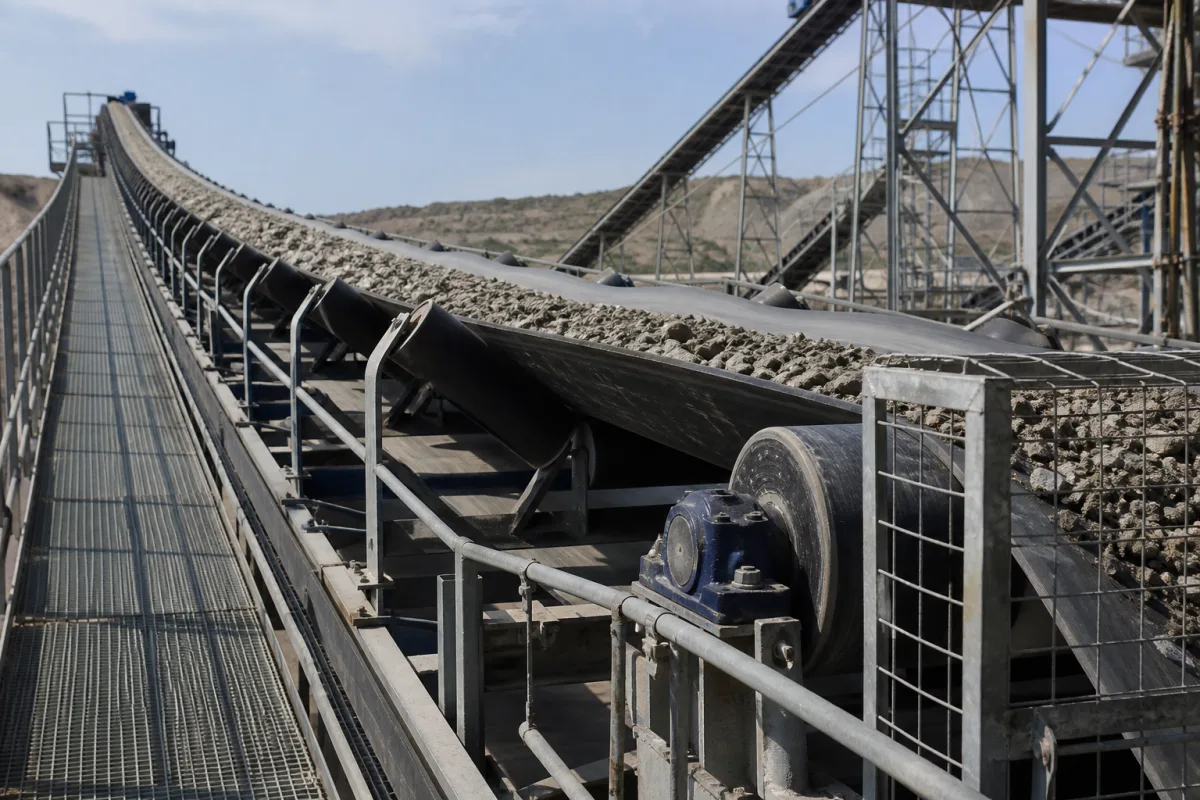
Belting · Carcass for strength, covers for the duty
A conveyor belt is two jobs in one product. The carcass carries the tension that pulls the load; the covers protect it from what is being carried. Specify the carcass from the conveyor's tension calculation and the covers from the material, temperature, oil or fire hazard, and treat light-duty and modular belts as a different family.
Rubber belts with fabric or steel-cord carcasses for bulk handling, special-purpose belts (flame-resistant, heat-, oil- and cold-resistant), and light-duty PVC, PU and modular plastic belts for production lines. The conveyor machine itself is a separate purchase.
CNFX editorial research · Sources checked October 12, 2026 · 8 sources
The carcass is the tension member. Fabric carcasses use plies of polyester and nylon canvas; steel-cord carcasses use embedded steel cords for long-distance, high-capacity conveyors where high strength and low elongation matter. [4][3]
Tiantie rates its steel-cord range from ST630 up to 7,100 N/mm in widths of 400–2,500 mm, with general-purpose, abrasion-resistant, cold-resistant and flame-retardant cover options. Ratings are given as breaking strength per millimetre of belt width. [3]
The rating needed comes from the conveyor's maximum belt tension and the safety factor used by the designer, not from the belt width alone. Ask the conveyor designer for the tension calculation and give it to the belt supplier together with the pulley diameters, which limit how stiff a carcass the conveyor can bend.
Give the belt supplier the conveyor's maximum tension, pulley diameters, transition distances and take-up type. A belt chosen only by width and ply count may be over- or under-rated.
02
Choose the cover grade for the material
Martin Engineering summarises the main grading systems. ISO 10247 has Category H for severe cut and gouge service, Category D for severe abrasion and Category L for moderate service; in the US the Rubber Manufacturers Association has Grade 1 (higher tensile and elongation, better cut and gouge resistance) and Grade 2. Category H is roughly equivalent to RMA Grade 1, and D and L are similar to Grade 2. [1]
Service
Grade to consider
Ask for
Large, sharp lumps falling from height
ISO 10247 Category H / RMA Grade 1 (cut and gouge). [1]
Cover tensile and elongation results and top cover thickness at the loading zone.
Martin Engineering stresses that these grades are laboratory test criteria and do not guarantee performance in a specific application, and that RMA grade does not necessarily indicate overall abrasion resistance. Ask for test results on the actual compound offered. [1]
03
Check special duties: fire, heat, oil and underground use
Belts for hot material, underground mines or oily and chemical service need special compounds. [1] Tiantie, for example, offers flame-retardant belts made from polyester and nylon canvas for coal mines and other flammable or explosive environments, and names MSHA and EN 14973 classes A, B1, B2, C1 and C2 on its page. [4]
Underground coal mines in the US need MSHA-approved belting
30 CFR Part 14 sets the flame-resistance requirements for MSHA approval of conveyor belts used in underground coal mines. Approved belt must be permanently marked with the MSHA approval number in characters at least 1/2 inch (1.27 cm) high, at intervals of no more than 60 ft (18.3 m) and at least once every foot across the width. [2]
Ask for the approval number and check that it appears on the delivered belt. A supplier's statement that a belt 'meets' a standard is not an approval.
Elsewhere, name the standard and class
Where a European standard applies, specify the class required for the installation (EN 14973 classes are listed by suppliers) and ask for the test report for that class. Heat-, oil- and cold-resistant compounds should be specified by the actual material temperature and chemical exposure. The EN standard itself was not read for this page. [4]
04
Treat light-duty and modular belts as a different family
Production and packaging lines use thin PVC and PU belts on polyester fabric, and modular plastic belts. BSBelt describes PU-surfaced belts on polyester fabric for food processing, anti-stick and resistant to oil, acids and alkalis, and offers "more than 60 choices of surface patterns". [5]
Other makers list PE, PVC, TPU, felt and cotton belts (Shun Sheng) and modular and turning belts (Hong's Belt). For these belts specify the item being carried, food-contact requirements, temperature, cleaning chemicals, surface pattern and pulley or sprocket sizes. [6][7]
05
Carcass, top and bottom covers, skim coats, cleats and the splice
Thicknesses and ratings for each layer come from the data sheet of the belt you order; the splice is listed because its rated strength has to be checked against the belt's own.
Element
Role
Fix in the order
Carcass (fabric plies or steel cords)
Carries tension; sets strength and elongation. [3][4]
Carcass type, rating (N/mm) and number of plies.
Top cover
Protects the carcass from the load at the loading zone. [1]
Grade, compound and thickness.
Bottom cover
Protects against pulleys and idlers.
Thickness and compound.
Skim coats and edges
Bond plies and protect edges; skim coat is part of an MSHA approval description. [2]
Joins the belt into a loop; check its rated strength against the belt's.
Splice method (vulcanised or mechanical) and who makes it.
06
Width, carcass rating, cover thickness and pulley diameter for a belting order
Tiantie's steel-cord range, ST630 to 7,100 N/mm in 400–2,500 mm widths, gives the only numeric values here; the rating itself comes from the conveyor's tension calculation, not from the width. [3]
Field
What it means and published values
Ask the supplier for
Belt width (mm)
Steel-cord widths of 400–2,500 mm listed by Tiantie. [3]
Width and tolerance.
Belt length (m)
Endless length or roll length, plus splice allowance.
Rubber compounds by grade, or PVC/PU for light duty. [5]
Compound and any food or flame approval.
Weight (kg/m²)
Needed for conveyor tension and handling.
Mass per square metre.
Minimum pulley diameter (mm)
Limits bending of the carcass.
Minimum pulley diameters for drive, tail and bend pulleys.
07
Send the conveyor data and the duty together
Paste it into your enquiry below or into an email to a maker, then replace every bracket.
Conveyor: [maximum belt tension; pulley diameters; transition distances; take-up type; speed]
Belt: [width; length; endless or roll; carcass type and rating]
Covers: [material conveyed; lump size; drop height; ISO 10247 category or RMA grade; top and bottom thickness]
Special duty: [temperature; oil or chemicals; flame resistance standard and class; underground approval]
Light duty: [items conveyed; food contact; cleaning; surface pattern; cleats or sidewalls]
Splice: [vulcanised or mechanical; who splices; splice length]
Documents: [data sheet; cover test results; approval number or test report; marking on the belt]
The cards below cover three belt families — rubber bulk-handling, flame-, heat- and oil-resistant, and light-duty PVC, PU or modular — so check which family each one lists.
Tiantie Industrial
Xinwu District, Wuxi, Jiangsu — published address
Lists rubber conveyor belts including steel-cord (ST630–7,100 N/mm, 400–2,500 mm), flame-retardant, wear-resistant, sidewall and PVC belts.
Explore company information and manufacturing capabilities, then discuss the scope of your project with a relevant supplier.
Share this page
Compiled and source-reviewed by the CNFX editorial team.
Each manufacturer above links to the page on that company's own website where the product is listed, with the date we checked it. How we source and review
· Page last updated 13 October 2026
Buyer questions
Does a higher cover grade mean better wear life?
Not necessarily. Martin Engineering notes that grades are laboratory criteria, RMA Grade 1 indicates better cut and gouge resistance rather than overall abrasion resistance, and no grade guarantees performance in a specific application. [1]
How do I confirm a belt is approved for underground coal mines in the US?
30 CFR Part 14 requires MSHA-approved belt to carry its approval number at least every 60 ft and once every foot across the width. Check the number on the delivered belt. [2]
When is a steel-cord belt used instead of fabric?
Suppliers offer steel-cord belts for long-distance, high-capacity conveying where high strength and low elongation are needed; Tiantie lists ST630–7,100 N/mm. [3]
Sources and what still needs a direct check
Sources checked 2026-10-12. Martin Engineering summarises grading systems; 30 CFR Part 14 is a US regulation for underground coal mines. Supplier pages describe their own products. ISO 10247, RMA and EN 14973 documents themselves were not read for this page.