Industry-Verified Manufacturing Data (2026)

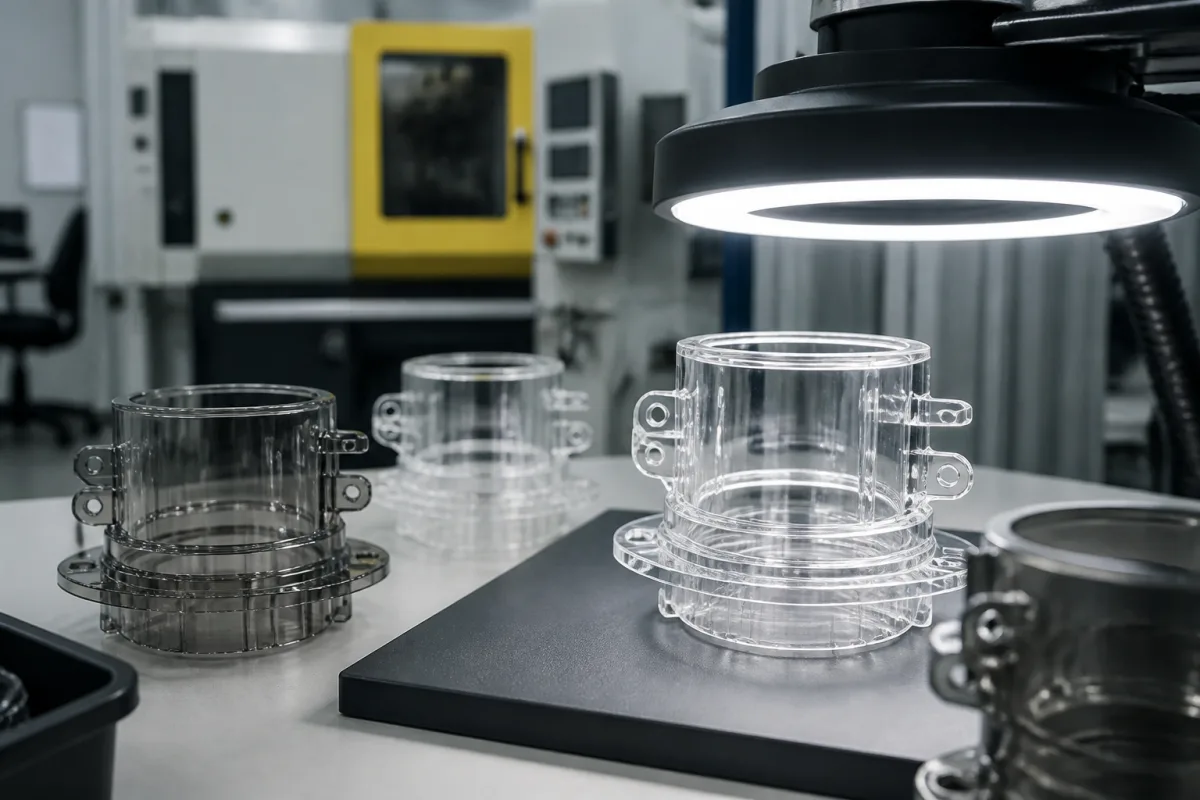
Polycarbonate Injection Molded Lens Housing

Based on aggregated insights from multiple verified factory profiles within the CNFX directory, the standard Polycarbonate Injection Molded Lens Housing used in the Rubber and Plastic Product Manufacturing sector typically supports operational capacities ranging from standard industrial configurations to heavy-duty production requirements.

Technical Definition & Core Assembly

A canonical Polycarbonate Injection Molded Lens Housing is characterized by the integration of Optical Window and Mounting Flange. In industrial production environments, manufacturers listed on CNFX commonly emphasize Polycarbonate (PC) construction to support stable, high-cycle operation across diverse manufacturing scenarios.

Optical-grade plastic housing for LED lighting and sensor protection.

Product Specifications

Technical details and manufacturing context for Polycarbonate Injection Molded Lens Housing

Definition
A precision injection molded component designed to house and protect optical elements in industrial applications. This housing provides environmental sealing while maintaining optical clarity for light transmission or sensor operation. It serves as a critical interface component in B2B supply chains for lighting manufacturers, automotive suppliers, and industrial equipment producers. The component enables modular assembly while protecting sensitive optical components from dust, moisture, and mechanical damage.
Working Principle
Provides structural support and environmental protection for optical elements while allowing controlled light transmission through precision-molded optical surfaces.
Common Materials
Polycarbonate (PC), Optical-grade PMMA
Technical Parameters
  • Energy absorption before fracture (J) Per Request
  • Light transmission efficiency at specified wavelength (%) Per Request
Components / BOM
  • Optical Window
    Primary light transmission surface with controlled optical properties
    Material: Optical-grade polycarbonate
  • Mounting Flange
    Provides mechanical attachment points and sealing surface
    Material: Polycarbonate
  • Gasket Groove Optional
    Channel for environmental sealing gasket installation
    Material: Polycarbonate
  • Heat Sink Interface Optional
    Surface for thermal management component attachment
    Material: Polycarbonate
Engineering Reasoning
0-120°C ambient temperature, 0-85% relative humidity, 300-700 nm wavelength transmission
Glass transition temperature (Tg) of 147°C for polycarbonate, 0.5% total light transmission loss, 5 MPa tensile stress at mounting points
Design Rationale: Thermal degradation above Tg causing polymer chain scission and yellowing, UV-induced photo-oxidation at wavelengths below 300 nm, stress cracking from differential thermal expansion (CTE mismatch of 65×10⁻⁶/°C polycarbonate vs 23×10⁻⁶/°C aluminum)
Risk Mitigation (FMEA)
Trigger Continuous UV exposure at 280 nm wavelength
Mode: Polymer chain scission causing 15% haze increase and yellowing (b* value >5)
Strategy: Add 0.3% UV stabilizer (benzotriazole) and 0.1% HALS (hindered amine light stabilizer) to polymer formulation
Trigger Thermal cycling between -40°C and 100°C at 10 cycles/hour
Mode: Thermal fatigue cracking at gate locations with crack propagation rate of 0.1 mm/1000 cycles
Strategy: Implement radiused gate design (R≥1.5 mm) and post-mold annealing at 120°C for 2 hours to relieve residual stresses

Industry Taxonomies & Aliases

Commonly used trade names and technical identifiers for Polycarbonate Injection Molded Lens Housing.

Industrial Ecosystem & Supply Chain DNA

Complementary Systems
Downstream Applications
Specialized Tooling

Application Fit & Sizing Matrix

Operational Limits
pressure: Atmospheric to 2 bar (29 psi) max, typical for LED/sensor housings
other spec: UV exposure: 5000+ hours at 0.35 W/m² @ 340nm with <5% transmittance loss; Flow rate: N/A (static housing); Slurry concentration: N/A (non-flow application)
temperature: -40°C to +125°C continuous, up to +140°C intermittent
Media Compatibility
✓ Indoor/outdoor LED lighting assemblies ✓ Industrial sensor protection (photoelectric, proximity) ✓ Automotive lighting/indicator housings
Unsuitable: Continuous exposure to strong solvents (ketones, esters, chlorinated hydrocarbons) or high-pressure water jets (>100 psi)
Sizing Data Required
  • Lens diameter/optical aperture required (mm)
  • Mounting interface specifications (thread type, flange, snap-fit)
  • Required IP rating (ingress protection) for environmental sealing

Reliability & Engineering Risk Analysis

Failure Mode & Root Cause
Stress Cracking
Cause: Exposure to incompatible chemicals (e.g., certain solvents, cleaning agents) or residual molding stresses combined with environmental stress, leading to micro-crack initiation and propagation.
UV Degradation and Yellowing
Cause: Prolonged exposure to ultraviolet light, causing polymer chain scission, loss of optical clarity, and embrittlement, especially in outdoor or high-UV environments.
Maintenance Indicators
  • Visible surface crazing or fine cracks under inspection light
  • Noticeable discoloration (yellowing) or cloudiness affecting light transmission
Engineering Tips
  • Implement regular cleaning with only approved, non-aggressive solvents (e.g., isopropyl alcohol) and avoid abrasive materials to prevent surface damage and chemical attack.
  • Apply a UV-protective coating or specify UV-stabilized polycarbonate grade during design, and ensure proper mounting to minimize thermal cycling stresses.

Compliance & Manufacturing Standards

Reference Standards
ISO 13468-1:2019 (Plastics - Determination of total luminous transmittance and reflectance) ASTM D1003-21 (Standard Test Method for Haze and Luminous Transmittance of Transparent Plastics) CE Marking (EU Directive 2014/35/EU for electrical equipment safety)
Manufacturing Precision
  • Wall Thickness: +/-0.1mm
  • Optical Surface Flatness: 0.05mm
Quality Inspection
  • Dimensional Verification with Coordinate Measuring Machine (CMM)
  • Optical Clarity and Haze Measurement per ASTM D1003

Factories Producing Polycarbonate Injection Molded Lens Housing

Verified manufacturers with capability to produce this product in China

✓ 96% Supplier Capability Match Found

T Technical Director from Australia Feb 27, 2026
★★★★★
"Testing the Polycarbonate Injection Molded Lens Housing now; the Wall Thickness (mm) results are within 1% of the laboratory datasheet."
Technical Specifications Verified
P Project Engineer from Singapore Feb 24, 2026
★★★★☆
"Impressive build quality. Especially the Wall Thickness (mm) is very stable during long-term operation. (Delivery took slightly longer than expected, but technical support was excellent.)"
Technical Specifications Verified
S Sourcing Manager from Germany Feb 21, 2026
★★★★★
"As a professional in the Rubber and Plastic Product Manufacturing sector, I confirm this Polycarbonate Injection Molded Lens Housing meets all ISO standards."
Technical Specifications Verified
Verification Protocol

“Feedback is collected from verified sourcing managers during RFQ (Request for Quote) and factory evaluation processes on CNFX. These reports represent historical performance data and technical audit summaries from our B2B manufacturing network.”

15 sourcing managers are analyzing this specification now. Last inquiry for Polycarbonate Injection Molded Lens Housing from Germany (1h ago).

Supply Chain Commonly Integrated Components

Mold Conveyor System

A mechanical system that transports molds through the automated preheating and coating process

Explore Specs →
Spray Manipulator

A robotic arm component within an automated mold spraying system that precisely positions and moves spray nozzles to apply release agents or cooling fluids onto mold surfaces.

Explore Specs →
Cooling Unit

A component within an Automated Mold Spraying and Cooling System responsible for rapidly reducing mold temperature after spraying operations.

Explore Specs →
Temperature Sensor Array

A multi-sensor assembly for distributed temperature monitoring in mold processing systems

Explore Specs →

Frequently Asked Questions

What are the advantages of using polycarbonate for optical lens housings?

Polycarbonate offers excellent impact resistance, high light transmission up to 90%, good thermal stability, and UL94 flammability ratings, making it ideal for demanding LED lighting and sensor applications.

What optical specifications are available for these lens housings?

Our housings achieve light transmission of 88-92%, haze levels below 2%, surface roughness under 0.8μm, and maintain performance across operating temperatures from -40°C to 120°C.

Can these housings be customized for specific applications?

Yes, we offer complete customization including wall thickness (1.5-5mm), mounting flange designs, gasket groove configurations, heat sink interfaces, and optical window specifications to match your exact requirements.

Can I contact factories directly on CNFX?

CNFX is an open directory, not a transaction platform. Each factory profile provides direct contact information and production details to help you initiate direct inquiries with Chinese suppliers.

Get Quote for Polycarbonate Injection Molded Lens Housing

Request technical pricing, lead times, or customized specifications for Polycarbonate Injection Molded Lens Housing directly from verified manufacturing units.

Your business information is encrypted and only shared with verified Polycarbonate Injection Molded Lens Housing suppliers.

Thank you! Your message has been sent. We'll respond within 1–3 business days.

Need to Manufacture Polycarbonate Injection Molded Lens Housing?

Connect with verified factories specializing in this product category

Add Your Factory Contact Us
Previous Product
Plastic Film Blowing Machine
Next Product
Polypropylene Injection Molded Gear Wheel