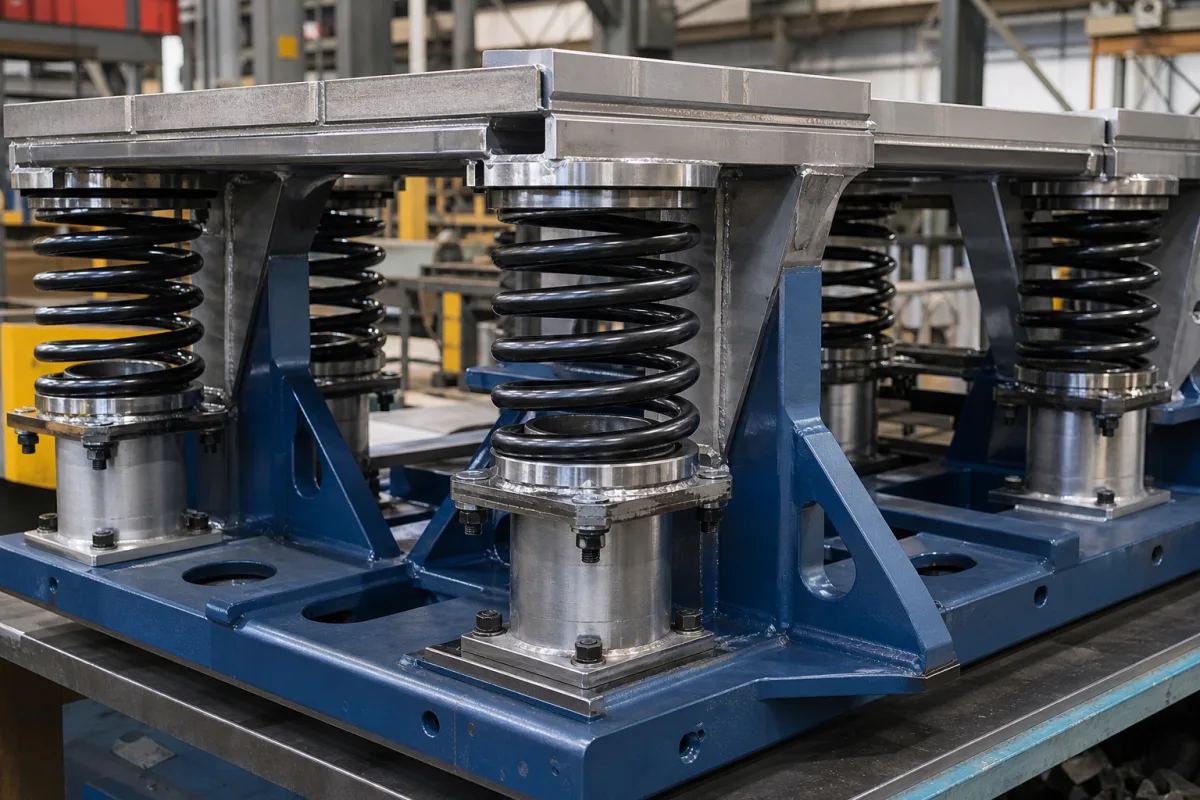
Spring assembly for hygienic relief-valve actuators
Spring and matched hardware within a hygienic relief-valve actuator
A relief-valve spring assembly supplies the spring force within a matched valve actuator. Identify the valve, actuator variant and approved replacement unit before ordering by spring dimensions or attempting to transfer an existing valve setting.
Spring units and their matched support/adjustment hardware within hygienic spring-loaded relief-valve actuators, including the boundary between an approved spring replacement and complete actuator replacement. Complete sanitary/process safety valves, disc-and-seat trim, machinery vibration mounts, press die springs and general-purpose compression springs are outside this page.
CNFX editorial research · Sources checked October 18, 2026 · 3 sources
Identify the valve and actuator before ordering the spring unit
The spring unit belongs to a particular relief-valve actuator and adjustment arrangement. SPX FLOW describes adjustable-spring actuators for its WR60/WR80 relief valves; the valve designation and actuator configuration therefore belong with a replacement enquiry. A loose compression spring with a similar outline does not establish an interchangeable assembly. [1]
Request the original valve/actuator identification, approved spring or actuator part number, permitted adjustment range and the mating seats, guides or retainers included. Where the manufacturer supplies the actuator as a unit, do not assume an individual internal spring is an approved service part.
The photograph shows large machinery spring supports rather than the small spring unit of a hygienic relief-valve actuator. It cannot be used to identify the valve part or its material.
02
Keep spring characteristics separate from the complete valve setting
Alfa Laval describes its hygienic PRV opening against spring force when the set threshold is exceeded. The spring and its adjustment are part of that assembled mechanism; a spring-rate figure alone is not a verified cracking-pressure setting for an unspecified valve. [2]
Keep the ordered spring/actuator variant with the valve size, plug/seat arrangement and manufacturer’s setting and verification documents. This page gives no spring-rate-to-pressure calculation, generic opening-pressure range or replacement calibration claim.
SPX FLOW separately describes pneumatic opening for cleaning that bypasses the relief setting. That function must not be confused with identifying the spring’s normal relief duty or proving the complete valve’s relieving capacity. [1]
03
Confirm service scope and the actual spring material
Alfa Laval’s leaflet lists a maintainable actuator as an option and separates product-wetted from non-product-wetted materials. Its valve material statement does not identify every internal actuator spring’s alloy or make every actuator field-serviceable. Obtain the part-specific drawing and approved service scope. [3]
For replacement, require the manufacturer’s matched assembly designation and the verification required after installation. Do not assign the valve’s hygienic surface finish, wetted-material grade, pressure rating or process-temperature limit to an unverified loose spring. [3]
Complete sanitary relief valves and their process application are covered separately; this page concerns the spring/actuator replacement boundary. Disc/seat repair trim is also a separate component set.
04
Identify the original relief-valve spring or actuator unit
Paste it into your enquiry below or into an email to a maker, then replace every bracket.
Identification: [valve maker/model; size; actuator designation]
Replacement: [approved part number; spring/complete actuator; included hardware]
Application: [original setting requirement; duty; process conditions]
Documents: [matched drawing; actual material; approved service procedure]
Verification: [manufacturer-required checks for the assembled valve]
Explore company information and manufacturing capabilities, then discuss the scope of your project with a relevant supplier.
Share this page
Compiled and source-reviewed by the CNFX editorial team.
Each manufacturer above links to the page on that company's own website where the product is listed, with the date we checked it. How we source and review
· Page last updated 18 October 2026
Buyer questions
Does a spring rate establish the cracking pressure of any relief valve?
No. The published working principle describes spring force within a particular assembled valve. Obtain the matched spring/actuator designation and the manufacturer’s setting verification. [2]
Can the valve’s wetted steel grade be assigned to its actuator spring?
Not from that statement alone. The leaflet separates wetted and non-wetted materials and identifies a maintainable-actuator option. Obtain the actual spring material and permitted service scope. [3]
Sources and evidence scope
Sources checked 2026-10-18. Two valve manufacturers explain the spring-actuator function and configuration boundaries. The cited documents do not provide a generic loose-spring specification or establish cross-brand replacement compatibility.