Editorial Technical Reference

Controller (PLC/Drive)

This page explains how Controller (PLC/Drive) is classified within Textile Manufacturing. Technical values and manufacturer relationships are research references; confirm the current specification and supplier evidence for each order.

Technical Definition & Core Assembly

A programmable logic controller or drive unit that regulates and maintains fabric tension in textile manufacturing processes.
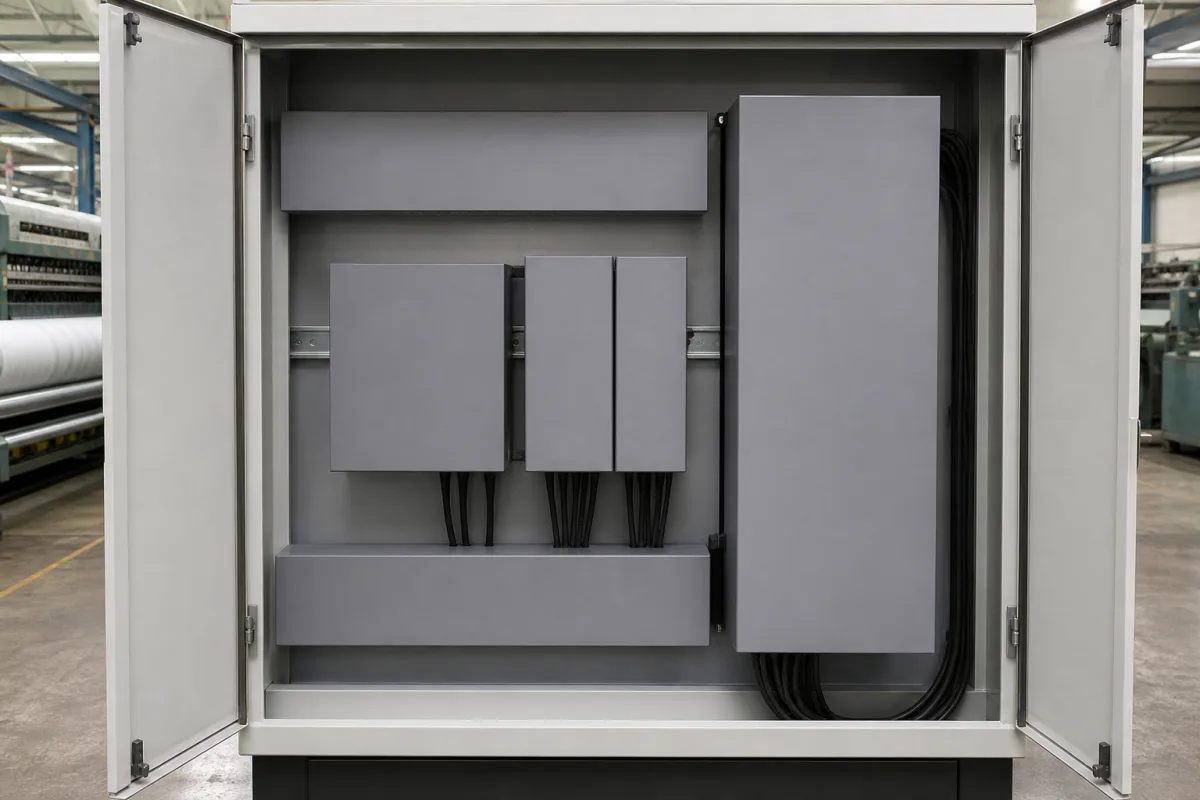
Representative product image. Confirm appearance and specifications with the manufacturer.

Product Specifications

Technical details and manufacturing context for Controller (PLC/Drive)

Definition
Within fabric tension control systems, this controller (typically a PLC or specialized drive) serves as the central processing unit that receives tension feedback from sensors, executes control algorithms, and outputs commands to actuators (such as brakes or motors) to maintain consistent fabric tension throughout production lines such as weaving, knitting, dyeing, or finishing. The controller continuously monitors tension sensor signals, compares them to setpoint values, and adjusts output signals to tensioning devices using PID or other control algorithms to maintain desired tension levels despite variations in fabric speed, material properties, or environmental conditions. This component is designed for integration into textile manufacturing machinery and is available with a range of technical specifications that must be verified for the specific model and application. Key parameters include rated power from 0.75 to 7.5 kW, supply voltage of 380–480 V AC (three-phase, 50/60 Hz, per IEC 60038), control accuracy of ±0.1%, tension range of 10–500 N, response time of ≤5 ms, operating temperature of 0–50 °C (derate above 40 °C, per IEC 60068-2-1), storage temperature of -40–85 °C (per IEC 60068-2-2), humidity of 5–95% RH non-condensing (per IEC 60068-2-78), protection class IP54–IP65 (per IEC 60529), communication interfaces including Ethernet/IP, Profinet, and Modbus TCP (per IEC 61158), weight of 2.5–15 kg, and dimensions ranging from 100×200×150 mm to 250×400×300 mm. These values are directory reference ranges; the actual model must be confirmed with the legal manufacturer or supplier. The controller is typically housed in a plastic enclosure with metal connectors and contains electronic components. It is intended for use in dusty textile environments, and its communication interfaces allow integration with manufacturing execution systems (MES). Always verify model-specific values and standards with the manufacturer or supplier before procurement.
Working Principle
The controller continuously monitors tension sensor signals, compares them to setpoint values, and adjusts output signals to tensioning devices using PID or other control algorithms to maintain desired tension levels despite variations in fabric speed, material properties, or environmental conditions. It receives feedback from sensors, processes the data, and sends commands to actuators such as brakes or motors. The control loop operates with a response time of ≤5 ms, ensuring rapid correction of tension deviations. The controller's parameters, such as tension range (10–500 N) and control accuracy (±0.1%), are adjustable via an HMI. The system is designed to operate within specified temperature and humidity ranges, and its protection class (IP54–IP65) suits dusty textile environments.
Common Materials
Electronic components, Plastic housing, Metal connectors
Technical Parameters
ParameterTypical rangeNotes & selection driver
Rated Power0.75–7.5 kWSelect based on motor size and load
Supply Voltage380–480 V ACThree-phase, 50/60 HzIEC 60038
Control Accuracy±0.1 %Tension regulation accuracy
Tension Range10–500 NAdjustable via HMI
Response Time≤5 msFor dynamic tension changes
Operating Temperature0–50 °CDerate above 40°CIEC 60068-2-1
Storage Temperature-40–85 °CIEC 60068-2-2
Humidity5–95 % RHNon-condensingIEC 60068-2-78
Protection ClassIP54–IP65For dusty textile environmentsIEC 60529
Communication InterfaceEthernet/IP, Profinet, Modbus TCPFor integration with MESIEC 61158
Weight2.5–15 kgDepending on power rating
Dimensions (W×H×D)100×200×150 – 250×400×300 mmVaries with model

Ranges are indicative industry figures for RFQ preparation, not a supplier commitment. Confirm every value and standard with the legal manufacturer before ordering.

Components / BOM
  • Processor Unit
    Executes control algorithms and processes sensor data
    Material: Semiconductor
  • I/O Modules
    Handles input from sensors and output to actuators
    Material: Electronic components
  • Power Supply
    Provides regulated power to controller components
    Material: Electronic components
  • HMI
    Where the operator sets the tension range and control accuracy, and reads back the running values.

Applied To / Applications

This component is essential for the following industrial systems and equipment:

Industrial Ecosystem & Supply Chain Structure

Complementary Systems
Downstream Applications
Specialized Tooling

Application Fit & Sizing Matrix

Operational Limits
pressure: Not applicable (electronic control device)
other spec: Humidity: 10-95% non-condensing, Vibration: 5-200 Hz at 0.5g max, IP rating: IP20/IP65 depending on enclosure
temperature: 0°C to +50°C (operating), -40°C to +85°C (storage)
Media Compatibility
✓ Cotton yarn tension control ✓ Synthetic fiber web tension regulation ✓ Woven fabric tension maintenance
Unsuitable: High-voltage arc welding environments with severe EMI/RFI interference
Sizing Data Required
  • Maximum tension force requirement (N)
  • Web/fabric width and speed (mm & m/min)
  • Required control accuracy and response time (±% & ms)

Reliability & Engineering Risk Analysis

Failure Mode & Root Cause
Overheating
Cause: Inadequate cooling, high ambient temperatures, or excessive load causing thermal stress on components like processors, power supplies, and I/O modules.
Electrical Surge Damage
Cause: Power supply fluctuations, lightning strikes, or electrostatic discharge (ESD) corrupting firmware, damaging sensitive electronic circuits, or causing memory corruption.
Maintenance Indicators
  • Unusual audible buzzing, clicking, or humming from the unit, indicating potential power supply or fan issues.
  • Visible warning indicators (e.g., flashing error LEDs, abnormal status lights) or overheating signs like discoloration or burnt smells.
Engineering Tips
  • Implement regular preventive maintenance, including cleaning air filters and vents to prevent dust buildup, ensuring proper ventilation, and verifying stable power supply with surge protection.
  • Perform periodic firmware updates and backups, and monitor operating temperatures and voltage levels using diagnostic tools to detect early anomalies.

Indicative industry ranges for design and RFQ preparation. Confirm the exact figures and applicable standard with the manufacturer before specifying.

Compliance & Manufacturing Standards

Applicable Standards
IEC 61131-2:2017 (Programmable controllers - Part 2: Equipment requirements and tests) ISO 13849-1:2015 (Safety of machinery - Safety-related parts of control systems) EN 60204-1:2018 (Safety of machinery - Electrical equipment of machines)

Quoted from the published standard.

Manufacturing Precision
  • Enclosure IP rating: IP65 (dust-tight and protected against water jets)
  • Mounting hole alignment: +/-0.5mm for DIN rail or panel mounting
Quality Inspection
  • Environmental stress testing (temperature, humidity, vibration per IEC 60068-2 series)
  • Functional safety validation (diagnostic coverage and performance level verification per ISO 13849)

Manufacturers of Controller (PLC/Drive)

Manufacturer profiles associated with Controller (PLC/Drive).

Sourcing Controller (PLC/Drive) from China?
Tell us your specification and target quantity — we will match it against manufacturer records and come back with the factories that fit.
Request manufacturers We manufacture this

Manufacturer listings support early research and capability understanding. They are not certification, ranking, or transaction guarantees.

Technical documentation
Request current drawings, revision history, and a signed specification sheet.
Manufacturing capability
Verify equipment lists, process limits, capacity, and representative production evidence.
Inspection readiness
Confirm test methods, calibrated equipment, sampling plans, and traceable reports.
Supplier transparency
Check the legal entity, factory address, ownership, certifications, and direct contacts.

CNFX does not score or rank suppliers. Buyers must verify all claims and documents with the legal manufacturer before ordering.

Supply Chain Compatible Machinery & Devices

Automatic Fabric Cutting Machine

This automatic fabric cutting machine is an industrial-grade system designed for apparel manufacturing.

Explore Specs →

Frequently Asked Questions

What is the role of this controller in textile manufacturing?

It acts as the central processing unit in fabric tension control systems, receiving feedback from tension sensors, executing control algorithms, and outputting commands to actuators to maintain consistent fabric tension across processes like weaving, knitting, dyeing, or finishing.

What are the key electrical specifications?

The controller has a rated power range of 0.75–7.5 kW and requires a three-phase supply voltage of 380–480 V AC at 50/60 Hz, per IEC 60038. Always verify these values for the specific model.

How does the controller handle dynamic tension changes?

It uses PID or other control algorithms with a response time of ≤5 ms, allowing rapid adjustments to maintain tension within ±0.1% accuracy, even when fabric speed or material properties vary.

What communication interfaces are available for integration?

The controller supports Ethernet/IP, Profinet, and Modbus TCP (per IEC 61158), enabling integration with MES or other automation systems. Confirm compatibility with your existing network.

Data Basis

Editorial classification, named public sources where available, and source-reviewed manufacturer records.

Preliminary Technical Classification
This page supports structured research, RFQ preparation, and supplier evaluation. It does not replace buyer-led supplier qualification, standards review, or technical approval.
Buyer enquiry

Request manufacturing insight for Controller (PLC/Drive)

Ask for use case, specification boundaries, supplier type, and RFQ preparation information for this product.

Where it goes
Straight to the CNFX editorial desk, and to the manufacturer if this product is linked to a claimed profile. Nothing is broadcast to a supplier list.
Your details stay here
We do not sell or rent enquiry data, and we do not add you to a mailing list. Used only to answer this request.
No commission, no middleman
CNFX is a directory. We take no cut of any order and never negotiate on a supplier's behalf.
What we don't claim
A listing is not an endorsement. Qualify every supplier and verify every figure yourself before ordering.

Your business information is used only to process this request.

Thank you! Your message has been sent. We'll respond within 1–3 business days.
Sorry, we couldn't send your message. Please try again, or email us at contact@cnfx.com.

Need to Manufacture Controller (PLC/Drive)?

Compare manufacturer profiles with relevant product and process capability.

Previous Product
X-Y Gantry System
Last Product
Get QuotesChat