Industry-Verified Manufacturing Data (2026)

I/O Modules

Based on aggregated insights from multiple verified factory profiles within the CNFX directory, the standard I/O Modules used in the Machinery and Equipment Manufacturing sector typically supports operational capacities ranging from standard industrial configurations to heavy-duty production requirements.

Technical Definition & Core Assembly

A canonical I/O Modules is characterized by the integration of Terminal Block and Signal Conditioning Circuit. In industrial production environments, manufacturers listed on CNFX commonly emphasize PCB (Printed Circuit Board) construction to support stable, high-cycle operation across diverse manufacturing scenarios.

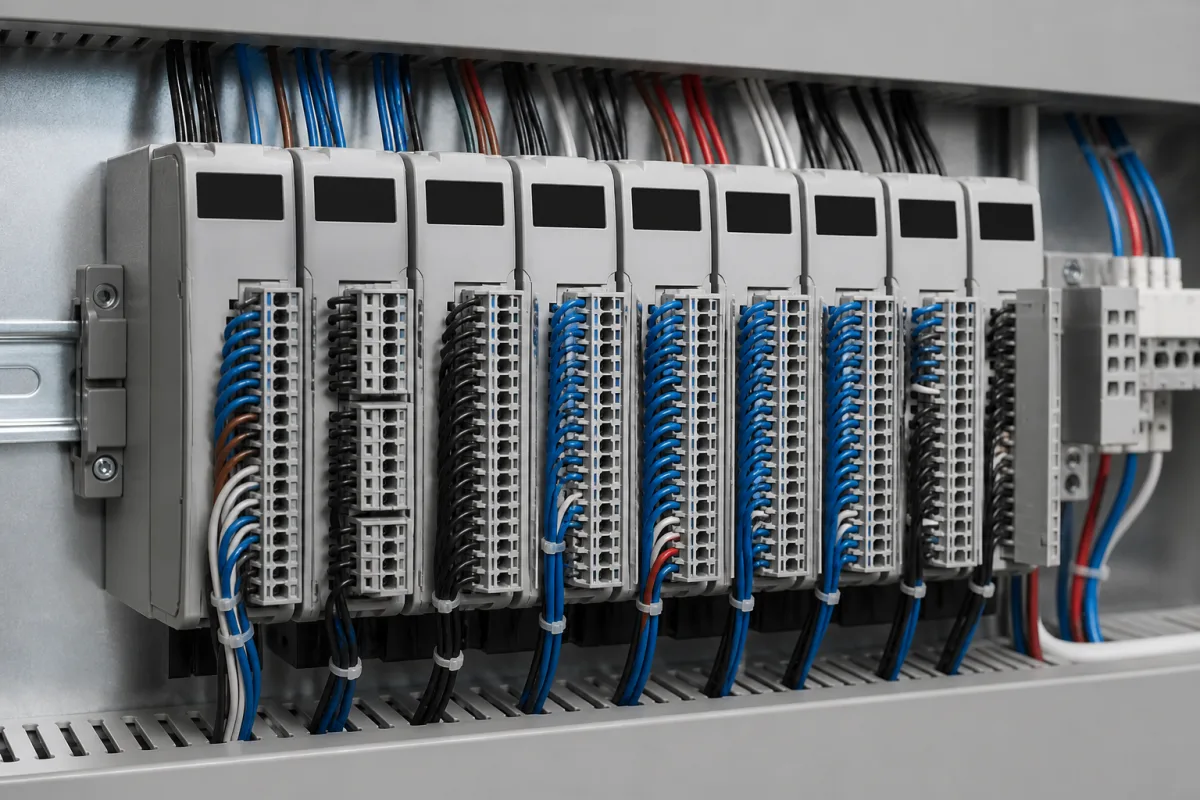
Electronic interface units that connect field devices to PLC systems, converting signals between digital/analog formats.
Product Specifications

Technical details and manufacturing context for I/O Modules

Definition
I/O modules are essential components within PLC control panels that serve as the communication bridge between the central processing unit and external field devices. They handle signal conversion, isolation, and conditioning for inputs (sensors, switches) and outputs (actuators, indicators), enabling the PLC to monitor and control industrial processes.
Working Principle
Input modules receive signals from field devices (e.g., 4-20mA, 0-10V, digital contacts), condition them through filtering and isolation circuits, and convert them to digital signals readable by the PLC CPU. Output modules receive digital commands from the CPU, convert them to appropriate signal formats, and drive connected actuators or indicators while providing electrical isolation and protection.
Common Materials
PCB (Printed Circuit Board), Electronic components (ICs, resistors, capacitors), Plastic/polycarbonate housing, Copper connectors
Technical Parameters
  • Number of input/output channels per module (channels) Customizable
Components / BOM
  • Terminal Block
    Provides secure electrical connections for field wiring
    Material: Plastic with copper alloy contacts
  • Signal Conditioning Circuit
    Filters, amplifies, and isolates incoming/outgoing signals
    Material: PCB with electronic components
  • Status Indicators
    LEDs showing module status and channel activity
    Material: Plastic housing with LED components
  • Communication Interface
    Connects module to PLC backplane or network
    Material: PCB with connector pins/sockets
Engineering Reasoning
0-60°C ambient temperature, 85-264 VAC input voltage, 24 VDC power supply ±10% tolerance
Component failure at 70°C junction temperature (TJmax), 300 VAC dielectric breakdown, 30 VDC reverse polarity
Design Rationale: Thermal runaway in semiconductor junctions (Arrhenius equation: failure rate doubles per 10°C increase above TJmax), dielectric breakdown in isolation transformers (Paschen's law: breakdown voltage ~7.5 kV/mm at STP)
Risk Mitigation (FMEA)
Trigger Electrostatic discharge (ESD) exceeding 8 kV HBM (Human Body Model)
Mode: Gate oxide rupture in input protection MOSFETs, creating permanent short circuit
Strategy: Integrated TVS diodes with 5 ns response time, 15 kV ESD protection on all field connections
Trigger Galvanic corrosion from dissimilar metals (copper-aluminum interfaces) with moisture ingress
Mode: Increased contact resistance from 50 mΩ to >500 mΩ, causing signal attenuation
Strategy: Gold-plated contacts (0.8 μm thickness), conformal coating (IPC-CC-830B Class 3), hermetic sealing to IP67 standard

Industry Taxonomies & Aliases

Commonly used trade names and technical identifiers for I/O Modules.

Applied To / Applications

This component is essential for the following industrial systems and equipment:

Industrial Ecosystem & Supply Chain DNA

Complementary Systems
Downstream Applications
Specialized Tooling

Application Fit & Sizing Matrix

Operational Limits
pressure: Not applicable (electronic component)
other spec: Signal types: 0-10V, 0-20mA, 4-20mA, 24VDC digital; Isolation: 500V AC typical; Response time: <1ms digital, <10ms analog
temperature: -20°C to +70°C (operating), -40°C to +85°C (storage)
Media Compatibility
✓ Industrial control cabinets (IP20 rated) ✓ Process control panels with DIN rail mounting ✓ Factory automation environments with EMC protection
Unsuitable: Outdoor/wet locations without proper IP67+ enclosures
Sizing Data Required
  • Number of I/O points required (digital/analog mix)
  • Communication protocol compatibility (Profibus, Ethernet/IP, Modbus, etc.)
  • Power supply requirements (voltage, current, isolation needs)

Reliability & Engineering Risk Analysis

Failure Mode & Root Cause
Corrosion-induced contact degradation
Cause: Exposure to moisture, corrosive atmospheres, or chemical contaminants leading to oxidation or pitting of electrical contacts and terminals, increasing resistance and causing intermittent or complete signal loss.
Electrostatic discharge (ESD) or overvoltage damage
Cause: Inadequate grounding, improper handling during installation/maintenance, or voltage transients from connected equipment (e.g., motors, solenoids) damaging sensitive semiconductor components, resulting in module failure or erratic behavior.
Maintenance Indicators
  • Intermittent or flickering status LEDs on the module, indicating unstable power or communication issues.
  • Audible buzzing or crackling sounds from the module, suggesting arcing, loose connections, or component failure.
Engineering Tips
  • Implement environmental controls such as sealed enclosures, desiccants, or climate control to maintain stable temperature and humidity, preventing condensation and corrosion.
  • Use surge protectors, proper grounding, and shielded cables to protect against electrical transients, and follow ESD-safe handling procedures during all maintenance activities.

Compliance & Manufacturing Standards

Reference Standards
ISO 13849-1: Safety of machinery - Safety-related parts of control systems ANSI/ISA-12.12.01: Electrical Equipment for Use in Class I, Division 2 Hazardous (Classified) Locations CE Marking: Compliance with EU directives (e.g., EMC Directive 2014/30/EU, Low Voltage Directive 2014/35/EU)
Manufacturing Precision
  • Connector Pin Alignment: +/-0.1mm
  • Mounting Hole Position: +/-0.2mm
Quality Inspection
  • Functional Safety Test (verifying input/output response accuracy and timing)
  • Environmental Stress Screening (temperature cycling, vibration, humidity testing)

Factories Producing I/O Modules

Verified manufacturers with capability to produce this product in China

✓ 98% Supplier Capability Match Found

P Project Engineer from Singapore Feb 02, 2026
★★★★★
"As a professional in the Machinery and Equipment Manufacturing sector, I confirm this I/O Modules meets all ISO standards."
Technical Specifications Verified
S Sourcing Manager from Germany Jan 30, 2026
★★★★★
"Standard OEM quality for Machinery and Equipment Manufacturing applications. The I/O Modules arrived with full certification."
Technical Specifications Verified
P Procurement Specialist from Brazil Jan 27, 2026
★★★★★
"Great transparency on the I/O Modules components. Essential for our Machinery and Equipment Manufacturing supply chain."
Technical Specifications Verified
Verification Protocol

“Feedback is collected from verified sourcing managers during RFQ (Request for Quote) and factory evaluation processes on CNFX. These reports represent historical performance data and technical audit summaries from our B2B manufacturing network.”

5 sourcing managers are analyzing this specification now. Last inquiry for I/O Modules from Turkey (1h ago).

Supply Chain Compatible Machinery & Devices

Hydraulic Press

Industrial machine using hydraulic pressure to compress, form, or assemble materials

Explore Specs →
Heavy-Duty CNC Plasma Cutting Machine

Industrial machine for precision metal cutting using plasma arc technology

Explore Specs →
Automated Assembly Line System

Integrated production system for sequential component assembly operations

Explore Specs →
Automated Powder Coating System

Integrated industrial system for applying dry powder coatings to metal substrates.

Explore Specs →

Frequently Asked Questions

What are the main applications of I/O modules in machinery manufacturing?

I/O modules serve as critical interface units that connect sensors, switches, and actuators to PLC control systems in machinery manufacturing. They enable signal conversion between field devices and controllers for precise equipment monitoring and automation control.

How do I/O modules handle different signal types in industrial environments?

Our I/O modules feature specialized signal conditioning circuits that convert between digital and analog formats. They process various input signals (4-20mA, 0-10V, discrete) from field devices and output compatible signals to PLC systems, ensuring reliable communication in harsh industrial conditions.

What makes these I/O modules suitable for machinery manufacturing environments?

These modules are built with industrial-grade materials including durable PCB construction, polycarbonate housing for impact resistance, and copper connectors for reliable connectivity. They feature status indicators for easy monitoring and terminal blocks for secure wiring in vibration-prone machinery applications.

Can I contact factories directly on CNFX?

CNFX is an open directory, not a transaction platform. Each factory profile provides direct contact information and production details to help you initiate direct inquiries with Chinese suppliers.

Get Quote for I/O Modules

Request technical pricing, lead times, or customized specifications for I/O Modules directly from verified manufacturing units.

Your business information is encrypted and only shared with verified I/O Modules suppliers.

Thank you! Your message has been sent. We'll respond within 1–3 business days.

Need to Manufacture I/O Modules?

Connect with verified factories specializing in this product category

Add Your Factory Contact Us
Previous Product
I/O Module
Next Product
I/P Converter