Industry-Verified Manufacturing Data (2026)

Tilt Mechanism

Based on aggregated insights from multiple verified factory profiles within the CNFX directory, the standard Tilt Mechanism used in the Furniture Manufacturing sector typically supports operational capacities ranging from standard industrial configurations to heavy-duty production requirements.

Technical Definition & Core Assembly

A canonical Tilt Mechanism is characterized by the integration of Tilt Pivot Axle and Tension Spring Assembly. In industrial production environments, manufacturers listed on CNFX commonly emphasize Steel construction to support stable, high-cycle operation across diverse manufacturing scenarios.

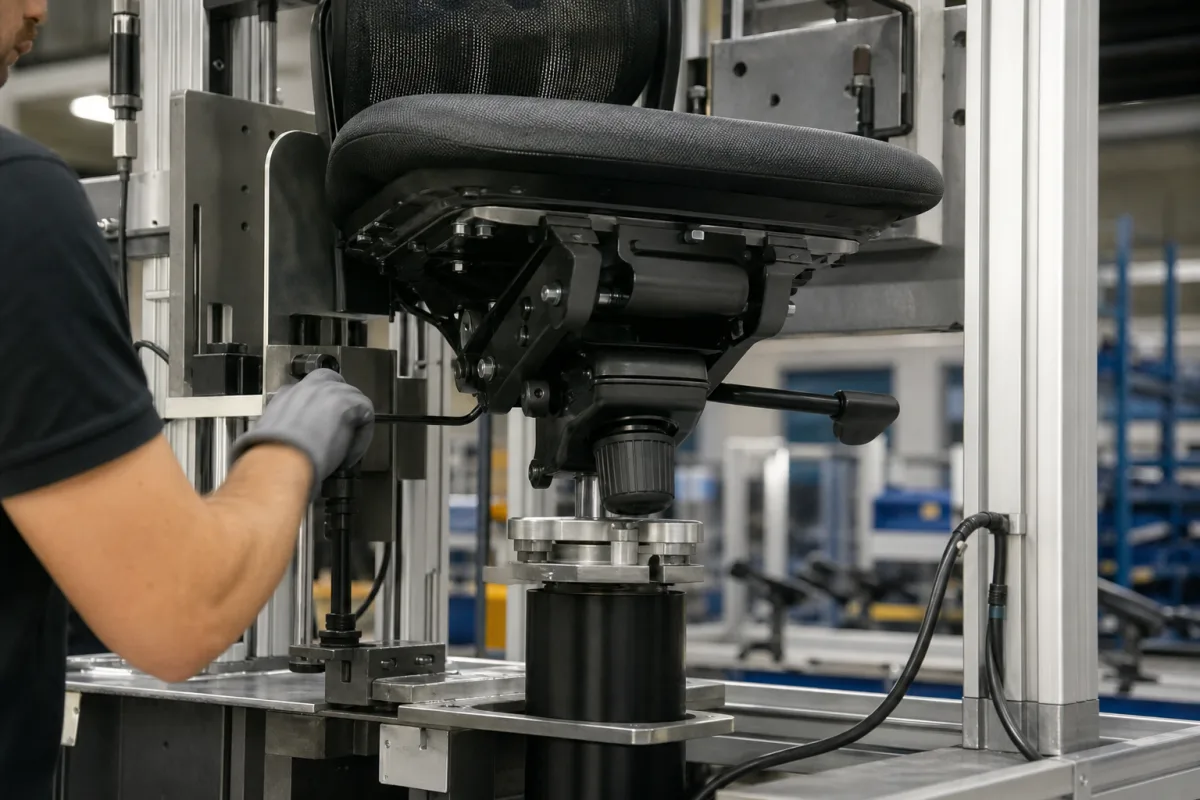
A mechanical component in an ergonomic office chair that allows the seat and backrest to tilt backward while maintaining user support and stability.
Product Specifications

Technical details and manufacturing context for Tilt Mechanism

Definition
The tilt mechanism is a critical component of ergonomic office chairs that enables controlled backward tilting of the seat and backrest assembly. It provides adjustable resistance to accommodate different user weights and preferences, often incorporating tension control knobs or levers. This mechanism works in conjunction with the chair's base and gas lift to create a dynamic seating experience that promotes movement and reduces static posture fatigue.
Working Principle
The tilt mechanism typically consists of a pivot point or axle that allows rotational movement, combined with a tension spring or hydraulic cylinder that provides adjustable resistance. When the user leans back, the mechanism engages, allowing controlled backward movement while maintaining contact with the chair base. Some advanced mechanisms include synchronous tilt features that coordinate seat and backrest movement, as well as tilt locks that prevent movement in certain positions.
Common Materials
Steel, Polymer composites, Aluminum alloy
Technical Parameters
  • Maximum tilt angle range, typically between 10-30 degrees from vertical (degrees) Per Request
Components / BOM
  • Tilt Pivot Axle
    Provides the central rotational point for the tilt movement
    Material: Steel
  • Tension Spring Assembly
    Creates adjustable resistance against backward tilting motion
    Material: Steel with polymer coating
  • Control Knob/Lever
    Allows user to adjust tilt tension and lock positions
    Material: Polymer or aluminum
  • Mounting Plate
    Secures the mechanism to the chair base and seat assembly
    Material: Steel
Engineering Reasoning
0-15° tilt angle, 50-150 N·m torque resistance, 100-5000 cycles fatigue life
Torsional yield at 180 N·m, fatigue fracture at 6000 cycles, plastic deformation at 20° tilt angle
Design Rationale: High-cycle fatigue from cyclic bending stress exceeding 250 MPa, torsional shear failure at 0.003 rad/mm strain, stress concentration at 0.5 mm radius fillets
Risk Mitigation (FMEA)
Trigger Lubricant degradation from polymer oxidation at 80°C
Mode: Increased friction coefficient from 0.15 to 0.45 causing mechanism seizure
Strategy: PTFE-coated bearing surfaces with 0.08 friction coefficient, temperature monitoring at 70°C threshold
Trigger Stress corrosion cracking from chloride ion concentration exceeding 50 ppm
Mode: Crack propagation at 0.1 mm/cycle rate leading to torsional spring fracture
Strategy: 316L stainless steel construction with 0.03% max carbon content, protective epoxy coating of 50 μm thickness

Industry Taxonomies & Aliases

Commonly used trade names and technical identifiers for Tilt Mechanism.

Applied To / Applications

This component is essential for the following industrial systems and equipment:

Industrial Ecosystem & Supply Chain DNA

Complementary Systems
Downstream Applications
Specialized Tooling

Application Fit & Sizing Matrix

Operational Limits
pressure: N/A (mechanical component, not fluid system)
other spec: Max user weight: 150 kg, Tilt angle range: 0° to 20°, Cycle life: 50,000 cycles
temperature: 0°C to 40°C (operational), -10°C to 50°C (storage)
Media Compatibility
✓ Office environments ✓ Conference room seating ✓ Home office furniture
Unsuitable: Outdoor or high-vibration industrial environments
Sizing Data Required
  • User weight capacity requirement
  • Chair base diameter compatibility
  • Desired tilt angle range

Reliability & Engineering Risk Analysis

Failure Mode & Root Cause
Wear and tear on pivot points
Cause: Inadequate lubrication leading to metal-on-metal contact, or misalignment causing uneven load distribution.
Hydraulic system failure
Cause: Contamination in hydraulic fluid, seal degradation, or pressure fluctuations causing component fatigue.
Maintenance Indicators
  • Unusual grinding or squeaking noises during operation
  • Visible fluid leaks around hydraulic cylinders or connections
Engineering Tips
  • Implement a strict lubrication schedule using manufacturer-recommended greases and monitor pivot points for early wear signs.
  • Install filtration systems for hydraulic fluid and conduct regular fluid analysis to detect contamination before system damage occurs.

Compliance & Manufacturing Standards

Reference Standards
ISO 12100:2010 - Safety of machinery ANSI B11.19 - Performance criteria for safeguarding DIN EN 1090-1 - Execution of steel structures
Manufacturing Precision
  • Angular alignment: +/-0.5 degrees
  • Surface flatness: 0.2mm per 100mm
Quality Inspection
  • Load cycle fatigue test
  • Dimensional verification with CMM

Factories Producing Tilt Mechanism

Verified manufacturers with capability to produce this product in China

✓ 95% Supplier Capability Match Found

T Technical Director from Brazil Feb 27, 2026
★★★★★
"Found 22+ suppliers for Tilt Mechanism on CNFX, but this spec remains the most cost-effective."
Technical Specifications Verified
P Project Engineer from Canada Feb 24, 2026
★★★★☆
"The technical documentation for this Tilt Mechanism is very thorough, especially regarding technical reliability. (Delivery took slightly longer than expected, but technical support was excellent.)"
Technical Specifications Verified
S Sourcing Manager from United States Feb 21, 2026
★★★★★
"Reliable performance in harsh Furniture Manufacturing environments. No issues with the Tilt Mechanism so far."
Technical Specifications Verified
Verification Protocol

“Feedback is collected from verified sourcing managers during RFQ (Request for Quote) and factory evaluation processes on CNFX. These reports represent historical performance data and technical audit summaries from our B2B manufacturing network.”

12 sourcing managers are analyzing this specification now. Last inquiry for Tilt Mechanism from Germany (1h ago).

Supply Chain Compatible Machinery & Devices

Furniture Assembly Line

Integrated production system for furniture assembly operations

Explore Specs →
Furniture Caster

Swiveling wheel assembly for furniture mobility

Explore Specs →
Furniture Hinge

Mechanical joint enabling door/cabinet opening and closing

Explore Specs →
Ergonomic Office Chair

Industrial-scale manufactured seating solution for workplace ergonomics and comfort.

Explore Specs →

Frequently Asked Questions

What materials are used in this tilt mechanism?

This tilt mechanism is constructed from high-strength steel, durable polymer composites, and lightweight aluminum alloy for optimal performance and longevity.

How does the tilt mechanism maintain stability during reclining?

The mechanism uses a tension spring assembly and precision tilt pivot axle to provide controlled, smooth reclining while maintaining user support and preventing sudden movements.

Can this tilt mechanism be installed on existing office chairs?

Yes, with proper mounting plates and compatible hardware, this tilt mechanism can be retrofitted to many ergonomic office chair models for enhanced functionality.

Can I contact factories directly on CNFX?

CNFX is an open directory, not a transaction platform. Each factory profile provides direct contact information and production details to help you initiate direct inquiries with Chinese suppliers.

Get Quote for Tilt Mechanism

Request technical pricing, lead times, or customized specifications for Tilt Mechanism directly from verified manufacturing units.

Your business information is encrypted and only shared with verified Tilt Mechanism suppliers.

Thank you! Your message has been sent. We'll respond within 1–3 business days.

Need to Manufacture Tilt Mechanism?

Connect with verified factories specializing in this product category

Add Your Factory Contact Us
Previous Product
Soft-Close Damper
Last Product