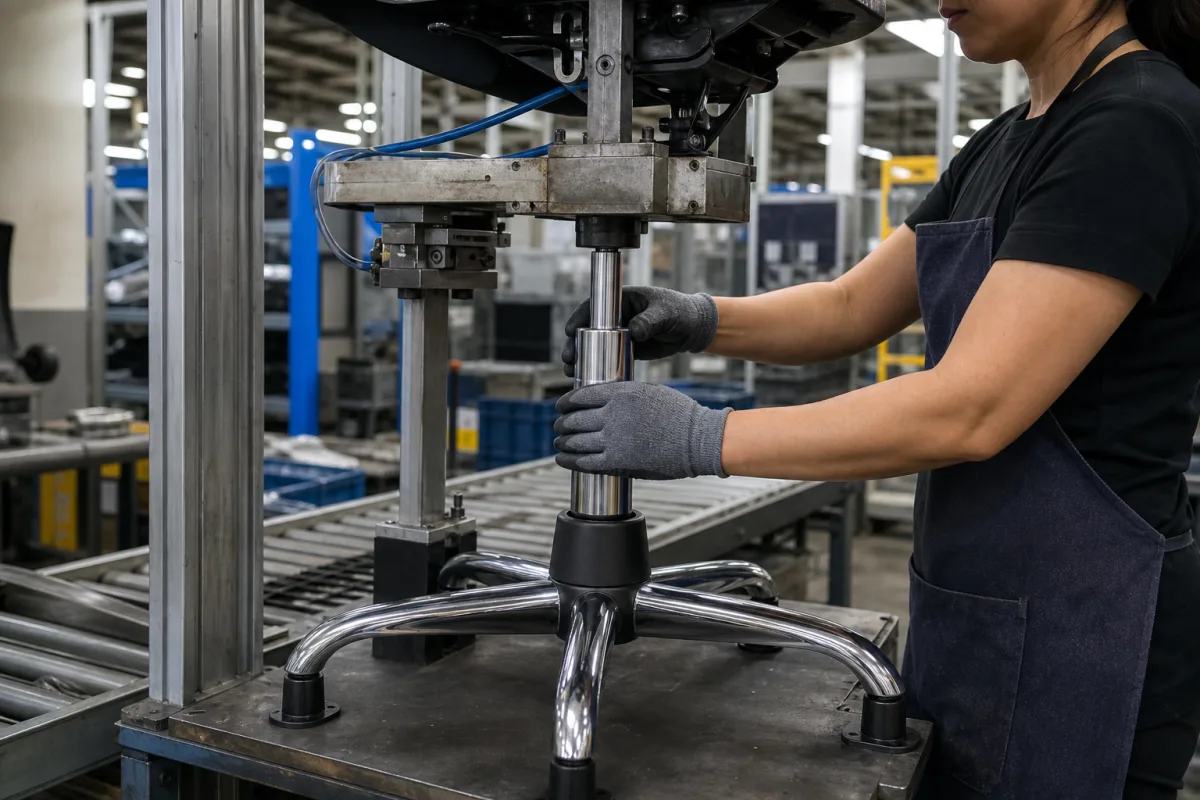
Gas lift cylinder (the self-supporting gas spring column that sets an office chair's seat height)
Gas lift columns for office and task chair seat height · EN 16955 strength and durability of the tapered pressure tube, what a Class 3 or Class 4 claim means, stroke and extended length, tube diameter, and the tapered friction fits into base and seat mechanism
The gas lift is a sealed gas spring with a release valve, pushed into the centre of the chair base at the bottom and into the seat mechanism at the top through tapered friction joints. Buying it means fixing three things: the strength class of the pressure tube and the evidence behind it, the stroke and lengths that give the seat height range, and the taper and tube sizes that fit the base and mechanism the chair already uses.
Self-supporting gas spring columns (gas lifts) for the seat height adjustment of office, task and gaming chairs, with their tapered pressure tubes, strokes, lengths and strength classes. Complete task chairs are covered on the Ergonomic office chair (task chair) page; lumbar modules on the Adjustable lumbar support module for office-chair backrests page; chair castors on the Furniture caster page; drawer dampers on the Soft-close damper for drawers page.
CNFX editorial research · Sources checked October 12, 2026 · 4 sources
Strength class: what EN 16955 tests and what a Class claim needs behind it
DIN Media describes EN 16955:2017 as specifying "test methods and requirements for the strength and durability of tapered pressure tubes for self-supporting gas springs for the height adjustment in seating"; it was prepared by CEN/TC 207 "Furniture" and replaces DIN 4550:2004-12. [1] Intertek, which applies "test requirements from EN 16955, to ensure the cylinder continues to function correctly after endurance testing" for its durable gas lift mark, writes that lifts "are often classified by Class (e.g., Class 3 or Class 4)", which "denotes the thickness of the steel walls and the quality of the internal valves". [2]
Colewell lists Class 4 columns as "Certified highest safety class (BIFMA/TUV)" and rated up to 450 lbs (204 kg) on one listing, and 450 lbs (200 kg) on another; its replacement guide names thick-wall steel of 1.2-1.5 mm and SGS, BIFMA or TÜV certificates as quality indicators. [3][4]
Ask for the EN 16955 test report naming the strength class and the column model, not a class word in a listing; the two Colewell load figures (204 kg and 200 kg for 450 lbs) show why the report, not the listing, should set the rating.
02
Stroke, lengths and tube diameter
Colewell's listings give extended lengths of 350-550 mm for standard models and 300-600 mm for computer and gaming chair lifts, strokes from 80 to 200 mm (with 60-260 mm offered to OEMs), and compressed lengths of 200-300 mm. [3]
The diameters do not agree between the pages: the Class 3 listing calls 35 mm "the most common diameter for medium-duty chairs", other listings call a 2" (50 mm) column a fit for "99% of office chairs", and the replacement guide lists 38, 45 and 50 mm as standard. The pages do not say which tube each figure refers to; ask the maker for a drawing with the outer tube diameter and the taper dimensions. [3][4]
Editorial calculation: the stroke is the seat height range the column gives; a 100 mm stroke with a 350 mm extended length leaves a 250 mm compressed length, inside the 200-300 mm Colewell quotes. [3]
Pressing the column into the base and the seat mechanism
Colewell's guide says the column "connects the wheeled base to the seat mechanism through tapered friction-fit connections", runs on compressed nitrogen in a sealed steel cylinder, and fails when seal wear lets gas escape so the seat sinks; the column cannot be repaired, only replaced. Fitting means cleaning the base bore and seat bracket, checking the tapered surfaces, aligning the taper straight into the base column and seating it firmly. [4]
DIN Media's listing places EN 16955 under the tapered pressure tube itself, so the taper on the column and the bore in the base and mechanism are part of what the test relies on. [1]
Give the column maker the base and mechanism taper drawings, the seat height range wanted, the user weight rating, the strength class and test report required, and the release-valve actuation the mechanism uses.
04
Gas lift order details
Paste it into your enquiry below or into an email to a maker, then replace every bracket.
1 company lists this product among what they make. Company figures are quoted from each
company's own website; every card states where the relationship came from.
Changzhou Colewell Machinery Co., Ltd.
Manufacturing site to be confirmed for the order
Lists Class 3, Class 4, small and gaming-chair gas lift cylinders with strokes, lengths and load ratings, and custom strokes for OEMs.
Explore company information and manufacturing capabilities, then discuss the scope of your project with a relevant supplier.
Share this page
Compiled and source-reviewed by the CNFX editorial team.
Each manufacturer above links to the page on that company's own website where the product is listed, with the date we checked it. How we source and review
· Page last updated 13 October 2026
Buyer questions
What does EN 16955 cover?
Test methods and requirements for the strength and durability of tapered pressure tubes for self-supporting gas springs used for seat height adjustment; it replaced DIN 4550. [1]
What does Class 3 or Class 4 mean?
Intertek says the class denotes steel wall thickness and internal valve quality; ask for the EN 16955 report that states it. [2]
Can a sinking gas lift be repaired?
Colewell says the units are sealed and pressurised, so replacement is the only fix. [4]
How is the column held in the chair?
By tapered friction fits into the base and the seat mechanism. [4]
Sources and what still needs a direct check
Sources checked 2026-10-12. DIN Media lists EN 16955:2017; Intertek describes its durable gas lift mark; Colewell publishes gas lift listings and a replacement guide.