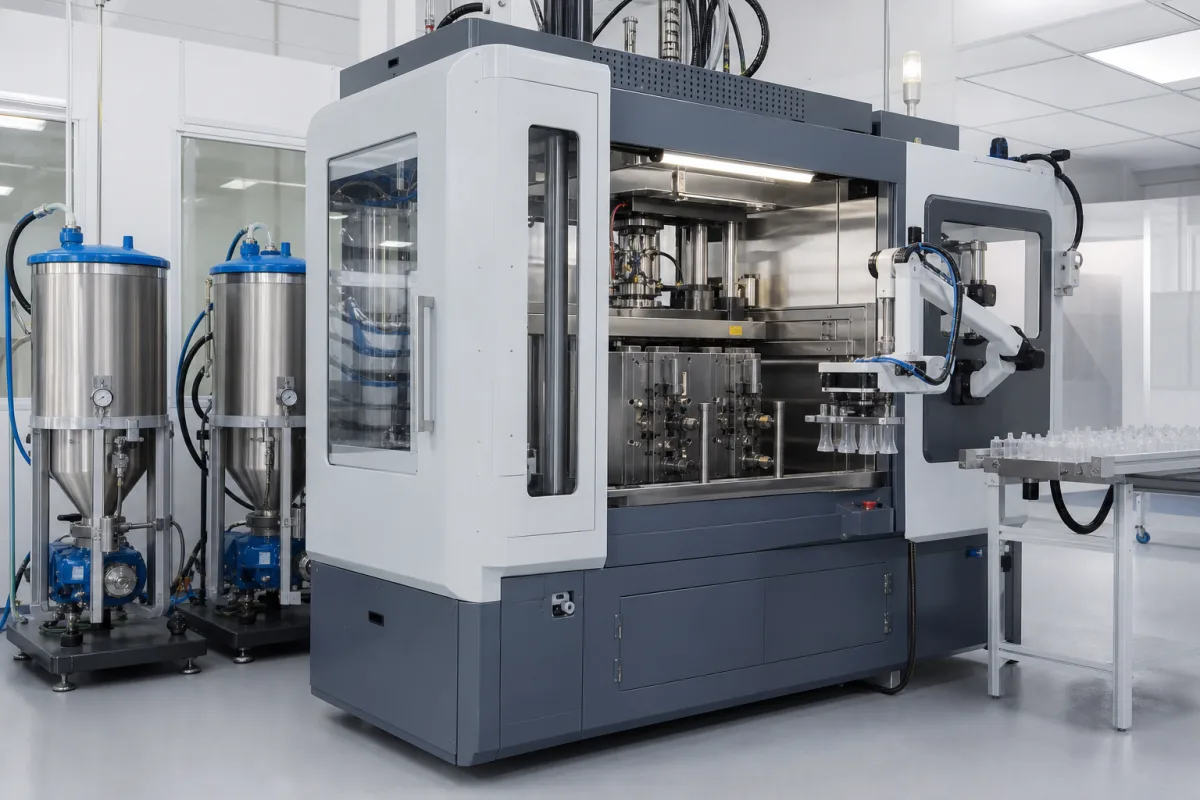
Liquid silicone rubber (LSR) injection moulding · Two-part A/B metering and static mixing, drum pumps and dosing precision, cold runners and heated moulds, cure temperature and cycle time, vacuum or vented injection, automated part removal
A silicone molding machine for liquid silicone rubber is an injection moulding cell in which a dosing system pumps the two LSR components from drums in a fixed ratio, with pigment, through a static mixer to a screw injection unit, which injects the cool material through a cold runner into a heated mould where it cures in seconds before the parts are removed by hand or by automation. Ask three things first: what parts, shot weight and cavity count the mould needs, which LSR grade and cure behaviour it uses, and what dosing precision, cleanliness and automation the application requires.
Machines and cells for moulding silicone parts from two-part liquid silicone rubber: LSR dosing and mixing systems, injection units adapted for LSR, clamping units, heated moulds with cold runners, and part-removal automation. General thermoplastic injection moulding machines (see injection molding machine), silicone raw materials (see liquid silicone rubber), curing ovens and moulds as separate purchases are outside this page except where compared; compression presses for solid silicone are noted only as an alternative to ask suppliers about.
CNFX editorial research · Sources checked October 11, 2026 · 4 sources
US patent 8,198,357 describes the conventional two-part LSR process: component A carries vinyl siloxane polymers, treated fumed silica and the platinum catalyst, component B adds the hydride crosslinker and a cure inhibitor; the two are pumped and metered separately through a static mixer, mixed further in the machine's screw, injected, heat-cured for a time and temperature set by part size, and ejected automatically. It names the weaknesses as off-ratio metering — unbalanced crosslinker giving erratic cure rates and variable part properties — and the cost of pumping and metering equipment. [1]
Elmet describes LSR dosing systems for 20 and 200 litre drums: its TOP 3100 delivers over 5 litres per minute, doses additives and colours from 1, 4 and 20 litre containers, and has a measuring cell resolution of 15.6 µl/l (64,000 pulses per litre) with a volumetric colour meter resolving below 0.1 µl/l; its TOP 700 occupies 799 × 600 mm and leaves about 40 ml of residue at a 20 litre drum change, up to 99.8% utilisation; a new pump unit reaches 230 bar and handles viscosities from 0.001 to 3,000 Pa·s, including filled, self-adhesive and abrasive grades; and pneumatic drive draws 50 Wh idle and 150–400 Wh on average depending on the process. [2]
Simtec, an LSR part moulder, lists the cell's elements as injector, metering unit, supply drum, mixer, nozzle and mould clamp, notes that LSR is supplied in barrels and is pumped through lines thanks to its low viscosity, and that the mixture may be temperature-stabilised before injection. [3]
Editorial calculation: 64,000 pulses per litre means one pulse is 1 ÷ 64,000 L ≈ 15.6 µL, the resolution Elmet quotes. [2]
Give the supplier the part drawings and shot weight, cavity count, LSR grade and supplier (viscosity, cure data, self-adhesive or filled), colours and additives, drum size, required dosing precision, cleanroom or food and medical requirements, mould (cold runner, valve gates, heating), cycle-time target, automation for part removal and inspection, and power and air supply.
02
Set the mould, cure temperature and cycle
Simtec explains that the mould is heated by water or electric heaters, that a cold runner keeps the silicone from curing early in the runners, that injection can be under atmospheric pressure with good venting or under vacuum, and that once the cavity is full the mould heat cross-links the rubber from liquid to solid, with cure time specific to the grade and part and with exothermic heat and thermal expansion raising cavity temperature and pressure. [3]
The patent's moulding trials give working points for two-part LSR: a 96-well pad cured for 35 seconds at 270 °F in the standard process, and a 15.7 g breast-pump diaphragm in an eight-cavity cold-runner mould with automatic removal of eight parts per cycle at a total cycle of 50.7 seconds at 325 °F; with the patent's own single-base inhibitor and catalyst system the pad cured in 4 seconds at 375 °F and the diaphragm cycle fell to 30.7 seconds. [1]
Editorial calculation: eight cavities every 50.7 s is about 3,600 ÷ 50.7 × 8 ≈ 568 parts per hour, and every 30.7 s about 938 parts per hour; ask for the cycle the offered cell achieves with your part, grade and mould. [1]
03
Ask how a quoted cycle time was simulated
A 2025 open-access paper in Polymers from the Polymer Competence Center Leoben and Austrian and Slovenian university partners characterised a 70 Shore A, 1:1 LSR injection grade with about 32 wt% filler for moulding simulations. Its curing exotherm appeared above 90 °C in calorimetry, and its gel temperature was around 100 °C in the rheometer. [4]
The simulated cell was a four-cavity cold-runner mould with 161.3 × 110.6 × 6.3 mm cavities, LSR injected at 25 °C into mould walls held at 180 °C, a 10 s fill, and a generic machine with 1,600 kN clamping force, 1,300 bar maximum injection pressure and 510.51 cm³ maximum dosage volume. At 55 s one material dataset showed full cure and another an uncured core. Viscosity data drove predicted injection pressure, while heat capacity and curing kinetics drove curing profiles and cycle times. [4]
Editorial calculation: 161.3 × 110.6 × 6.3 mm is about 112 cm³ per cavity, about 450 cm³ for four, within that dosage volume. Ask which material data sit behind any simulated cycle and confirm it with a trial on your part. [4]
Ask for the material data source, mould temperature, fill time and the cure level assumed at ejection behind any simulated cycle time.
Machine figures set by your part drawing and LSR grade
The cycle time, dosing pressure, cure temperature and dosing resolution rows quote one patent trial or one Elmet range; clamp force, shot volume and heating power have to come from your mould.
Field
What it means and published values
Ask the supplier for
Clamping force
Force holding the mould closed.
kN for your mould area.
Injection volume
Shot volume of the screw unit.
cm³ for your shot weight.
Heating power
Mould and runner heating.
kW and zones.
Cycle time
50.7 s for an eight-cavity diaphragm mould in one trial. [1]
Explore company information and manufacturing capabilities, then discuss the scope of your project with a relevant supplier.
Share this page
Compiled and source-reviewed by the CNFX editorial team.
Ask Juchuan whether its silicone molding machine is an LSR injection or a compression machine before comparing it with the cell described here. How we source and review
· Page last updated 13 October 2026
Buyer questions
Why does LSR need a dosing system?
LSR comes as two components that must be pumped and metered in ratio through a static mixer; off-ratio metering gives erratic cure and variable parts. [1]
Why use a cold runner for silicone?
The runner is kept cool so silicone does not cure before it reaches the heated cavity. [3]
How fast does LSR cure in the mould?
It depends on grade and part; one patent reports a 35 s cure at 270 °F and an eight-cavity cycle of 50.7 s at 325 °F. [1]
What mould temperature is used to simulate LSR injection moulding?
In a 2025 Polymers study from the Polymer Competence Center Leoben and partners, mould walls were held at 180 °C with LSR injected at 25 °C and a 10 s fill; curing exotherms appeared above 90 °C in calorimetry. [4]
Sources and what still needs a direct check
Sources checked 2026-10-11. The patent describes its applicant's material process with trial data, the Elmet article describes one maker's dosing systems and the Simtec page a moulder's overview; values for your parts must come from the supplier offered.