Industry-Verified Manufacturing Data (2026)

Hydraulic System

Based on aggregated insights from multiple verified factory profiles within the CNFX directory, the standard Hydraulic System used in the Machinery and Equipment Manufacturing sector typically supports operational capacities ranging from standard industrial configurations to heavy-duty production requirements.

Technical Definition & Core Assembly

A canonical Hydraulic System is characterized by the integration of Hydraulic Pump and Hydraulic Cylinder. In industrial production environments, manufacturers listed on CNFX commonly emphasize Hydraulic oil construction to support stable, high-cycle operation across diverse manufacturing scenarios.

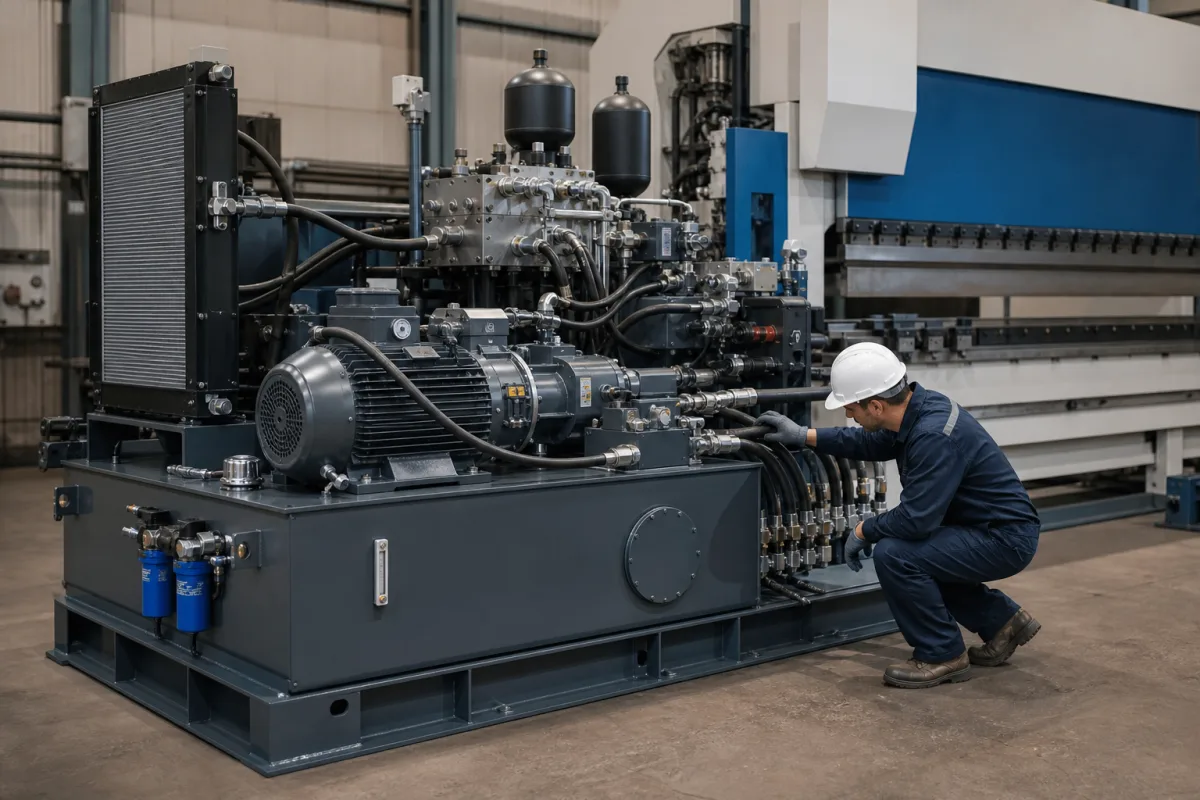
A power transmission system that uses pressurized hydraulic fluid to generate and control mechanical force and motion.
Product Specifications

Technical details and manufacturing context for Hydraulic System

Definition
The hydraulic system in a Sheet Metal Guillotine Shear is the core power unit responsible for driving the cutting blade with controlled force and precision. It converts electrical or mechanical energy into hydraulic pressure to execute the shearing action through cylinders and valves.
Working Principle
An electric motor drives a hydraulic pump that pressurizes hydraulic fluid (typically oil). This pressurized fluid is directed through control valves to hydraulic cylinders, which convert the fluid pressure into linear mechanical force to move the cutting blade. Pressure relief valves and flow control valves regulate force and speed for precise cutting operations.
Common Materials
Hydraulic oil, Steel (for cylinders and pipes), Seals (rubber/polyurethane), Aluminum/steel (for pump housing)
Technical Parameters
  • Maximum working pressure of the hydraulic system (MPa) Per Request
Components / BOM
  • Hydraulic Pump
    Generates hydraulic pressure by converting mechanical energy into fluid flow
  • Hydraulic Cylinder
    Converts hydraulic pressure into linear mechanical force to drive the cutting blade
  • Control Valves
    Regulate direction, pressure, and flow rate of hydraulic fluid
  • Hydraulic Reservoir
    Stores hydraulic fluid and helps dissipate heat
  • Hydraulic Hoses/Pipes
    Transmit pressurized hydraulic fluid between components
Engineering Reasoning
5-350 bar
420 bar (burst pressure for SAE 100R2AT hose at 25°C)
Design Rationale: Cavitation occurs when local pressure drops below fluid vapor pressure (0.024 bar for HLP 46 at 40°C), causing vapor bubble formation and implosion damage
Risk Mitigation (FMEA)
Trigger Particulate contamination exceeding ISO 4406 18/16/13 cleanliness level
Mode: Servo valve spool seizure
Strategy: Install 3 μm absolute beta₃≥200 filters with differential pressure monitoring
Trigger Fluid temperature sustained above 82°C
Mode: Seal hardening and leakage at O-ring interfaces
Strategy: Integrate plate heat exchanger maintaining fluid at 45-55°C with PID control

Industry Taxonomies & Aliases

Commonly used trade names and technical identifiers for Hydraulic System.

Applied To / Applications

This component is essential for the following industrial systems and equipment:

Industrial Ecosystem & Supply Chain DNA

Complementary Systems
Downstream Applications
Specialized Tooling

Application Fit & Sizing Matrix

Operational Limits
pressure: Up to 300 bar (4350 psi)
flow rate: 5-500 L/min
temperature: -20°C to 80°C
slurry concentration: Not recommended for slurries >5% solids by volume
Media Compatibility
✓ Mineral-based hydraulic oils ✓ Synthetic ester fluids ✓ Water-glycol fire-resistant fluids
Unsuitable: Highly corrosive chemical environments (e.g., strong acids, chlorinated solvents)
Sizing Data Required
  • Required force output (kN)
  • Operating cycle frequency (cycles/min)
  • Available power source capacity (kW)

Reliability & Engineering Risk Analysis

Failure Mode & Root Cause
Cavitation
Cause: Low fluid pressure at pump inlet causing vapor bubble formation and implosion, damaging pump components and seals.
Internal leakage
Cause: Worn seals, valve spools, or cylinder components due to contamination, thermal degradation, or improper assembly.
Maintenance Indicators
  • Unusual whining or knocking noises from pump or actuators
  • Visible fluid leaks at connections, seals, or cylinder rods
Engineering Tips
  • Implement strict contamination control with regular fluid analysis and filtration maintenance
  • Maintain proper fluid temperature and pressure ranges through cooling system monitoring and relief valve calibration

Compliance & Manufacturing Standards

Reference Standards
ISO 4413: Hydraulic fluid power - General rules and safety requirements for systems and their components ANSI/B93.5M: Hydraulic fluid power - Cylinders - Bore and rod area ratios DIN 24342: Hydraulic fluid power - Cylinders - Mounting dimensions
Manufacturing Precision
  • Cylinder bore diameter: +/-0.02mm
  • Sealing surface flatness: 0.1mm per 100mm diameter
Quality Inspection
  • Pressure test: 1.5x maximum operating pressure for 30 minutes
  • Dimensional verification using CMM (Coordinate Measuring Machine)

Factories Producing Hydraulic System

Verified manufacturers with capability to produce this product in China

✓ 97% Supplier Capability Match Found

P Project Engineer from Canada Feb 18, 2026
★★★★★
"Standard OEM quality for Machinery and Equipment Manufacturing applications. The Hydraulic System arrived with full certification."
Technical Specifications Verified
S Sourcing Manager from United States Feb 15, 2026
★★★★★
"Great transparency on the Hydraulic System components. Essential for our Machinery and Equipment Manufacturing supply chain."
Technical Specifications Verified
P Procurement Specialist from United Arab Emirates Feb 12, 2026
★★★★★
"The Hydraulic System we sourced perfectly fits our Machinery and Equipment Manufacturing production line requirements."
Technical Specifications Verified
Verification Protocol

“Feedback is collected from verified sourcing managers during RFQ (Request for Quote) and factory evaluation processes on CNFX. These reports represent historical performance data and technical audit summaries from our B2B manufacturing network.”

5 sourcing managers are analyzing this specification now. Last inquiry for Hydraulic System from USA (30m ago).

Supply Chain Compatible Machinery & Devices

Automated Assembly Line System

Integrated production system for sequential component assembly operations

Explore Specs →
Automated Powder Coating System

Integrated industrial system for applying dry powder coatings to metal substrates.

Explore Specs →
Centrifugal Pump Impeller

Rotating component that transfers energy to fluid in centrifugal pumps.

Explore Specs →
High-Precision CNC Laser Cutting Machine

Computer-controlled industrial machine using focused laser beams to cut sheet metal with micron-level accuracy.

Explore Specs →

Frequently Asked Questions

What maintenance is required for hydraulic systems in machinery manufacturing?

Regular maintenance includes hydraulic oil changes every 1,000-2,000 operating hours, inspection of seals and hoses for wear, monitoring fluid contamination levels, and checking pump pressure performance to ensure optimal system efficiency and prevent downtime.

How do I select the right hydraulic pump for my equipment?

Consider flow rate requirements (GPM), operating pressure (PSI), pump type (gear, vane, or piston), compatibility with your hydraulic oil viscosity, and the specific application demands of your machinery. Consult with our engineers for custom solutions.

What are the advantages of hydraulic systems over mechanical power transmission?

Hydraulic systems offer superior power density, precise control of force and speed, smooth operation under varying loads, overload protection capabilities, and flexible component placement through hydraulic hoses, making them ideal for complex machinery applications.

Can I contact factories directly on CNFX?

CNFX is an open directory, not a transaction platform. Each factory profile provides direct contact information and production details to help you initiate direct inquiries with Chinese suppliers.

Get Quote for Hydraulic System

Request technical pricing, lead times, or customized specifications for Hydraulic System directly from verified manufacturing units.

Your business information is encrypted and only shared with verified Hydraulic System suppliers.

Thank you! Your message has been sent. We'll respond within 1–3 business days.

Need to Manufacture Hydraulic System?

Connect with verified factories specializing in this product category

Add Your Factory Contact Us
Previous Product
Hydraulic Stoppering System
Next Product
Hydraulic Tilt Mechanism