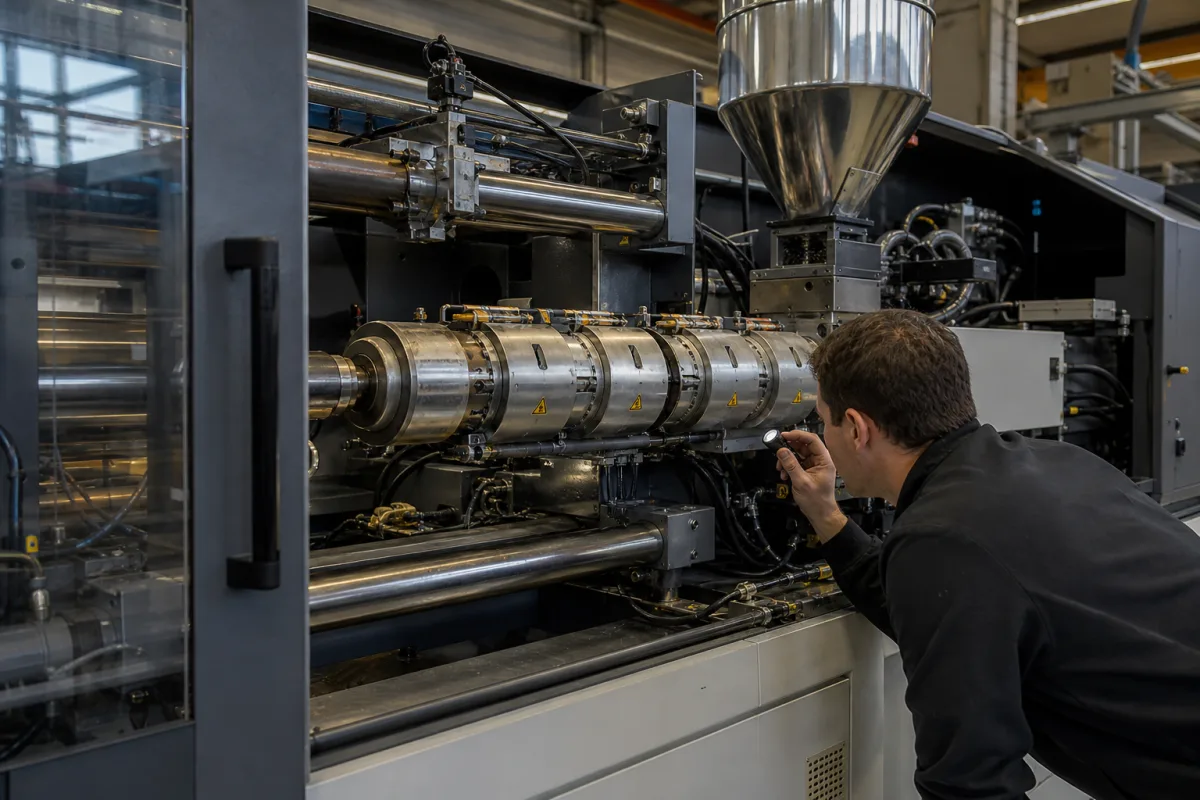
Injection unit barrel and screw for thermoplastics: bimetallic wear protection and pressure rating
Thermoplastic injection unit barrel and screw · Nitrided versus bimetallic barrels, inlay alloys and hardness, backing steel and pressure rating
The injection unit of a thermoplastic injection moulding machine melts resin in a heated barrel and pushes it into the mould with a reciprocating screw and check ring. As the barrel bore and screw wear, melt leaks back past the check ring and the unit can no longer build injection pressure, so the barrel's wear protection and strength decide how long the unit holds its shot. Buyers should check three things first: whether the bore is nitrided or carries a bimetallic inlay suited to the resin and fillers, what pressure the barrel's backing steel is built to carry, and whether the screw material is matched to the barrel alloy.
Injection units for thermoplastic injection moulding machines as components: plasticising barrels with nitrided or bimetallic bores, reciprocating screws and check rings, and their heating and feed zones. Complete injection moulding machines, with clamp-force and injection-unit sizing, are covered on the Injection molding machine page; cooled injection and metering units for liquid silicone rubber are covered on the Silicone injection molding machine page. Extrusion barrels and screws are outside this page except where a source compares them.
CNFX editorial research · Sources checked October 12, 2026 · 3 sources
Choose the barrel wear protection: nitrided bore or bimetallic inlay
A Xaloy patent explains why bore wear matters: if the bore is enlarged by wear or corrosion, plastic leaks back through the increased clearance between screw and bore, and the proper pressure and injection action cannot be maintained. It compares two constructions. A nitrided bore gives a hardened layer only 0.005 to 0.020 inches deep, with nitride concentration falling rapidly with depth; a centrifugally cast inlay is about 0.060 to 0.125 inches thick, with uniform composition, corrosion resistance, hardness and wear resistance through its thickness, and makes the cylinder last 5 to 10 times as long as a nitrided barrel. [1]
Reifenhäuser Reiloy lists four bimetallic inlay alloys for injection moulding and extrusion barrels. Smart R121 is a martensitic iron-based alloy with chromium carbides, 1.5 mm layer, min. 65 HRC, for plastics with up to 30% glass fibre. Advanced R131 is iron-based with vanadium carbides, 1.5 mm layer, min. 60–64 HRC, for up to 40% glass fibre. Premium R241 is a nickel matrix with tungsten carbides, layer min. 1.0 mm, min. 59 HRC, for maximum wear and corrosion resistance. Select R115 is a nickel-cobalt alloy, min. 55 HRC (min. 47 HRC above 60 mm inner diameter), for maximum corrosion resistance. [3]
For PA, PBT, PEEK and PPS, Reiloy's barrel matrix recommends Smart or Advanced up to 30% filler, Advanced or Premium below 40% and Premium above 40%; for PTFE it lists Select. [3]
Editorial calculation: 0.060 to 0.125 in equals about 1.5 to 3.2 mm, so Reiloy's 1.5 mm layer sits at the thin end of the cast inlay range in the Xaloy patent, and both are roughly 3 to 25 times the 0.005 to 0.020 in (0.13 to 0.51 mm) depth of a nitrided layer. [1][3]
Give the supplier the machine model and injection unit size, screw diameter and L/D, the resins and fillers (type and percentage), processing temperatures, any corrosive additives or flame retardants, maximum injection pressure, the current barrel and screw materials and the wear measured, and whether you need a new unit or a replacement barrel and screw.
02
Check the barrel's pressure rating and backing steel
Another Xaloy patent describes injection pressures of 20,000 psi and above at the high-pressure end of the cylinder. Its process heat-treats the backing steel to a bainitic structure of 30–50 Rockwell C while the hard ferrous liner transforms to martensite of 58–65 Rc. In its example the backing steel reached 50 Rc, 247,000 psi yield strength and 271,000 psi tensile strength, and the 64 Rc liner did not crack until 55,000 psi internal pressure; without the heat treatment the backing steel was only 18–20 Rc and 60,000 psi yield, so the liner would crack below 30,000 psi. [2]
The later Xaloy patent sets discharge-end pressure as high as 30,000 psi during the forward stroke of screw and check ring, and notes that casting heat causes grain growth in the cylinder steel while nickel or cobalt inlays need slow cooling to avoid cracking. Its example cylinder, 1.650 in bore × 5.078 in outside diameter × 24 in long with a tungsten-nickel inlay in ASTM 193B-16 steel, failed at 60,000 psi internal pressure; the inlay fractured but the crack did not extend into the steel. [1]
Reiloy lists the strength of its barrel base materials as Rm 980 MPa and Rp0.2 at 300 °C of 580 MPa for Reiloy Standard, 800 and 360 MPa for C60, and 630 and 300 MPa for NiCr22Mo9Nb; it specifies Reiloy Standard backing for its injection moulding barrels, with NiCr22Mo9Nb as an option for Select R115. [3]
Editorial calculation: 20,000 psi ≈ 138 MPa (about 1,380 bar) and 30,000 psi ≈ 207 MPa (about 2,070 bar); the 55,000 psi crack pressure in the first example is about 379 MPa, roughly 1.8 times 30,000 psi. [2][1]
03
Compare barrel inlay alloys
Reiloy's datasheet lists these inlays; ranges apply to the stated alloy only.
Alloy
What the source lists
Ask about
R121 Smart (Fe)
1.5 mm layer; min. 65 HRC; Ra 0.2–0.8; ID 14–400 mm; length up to 9,000 mm; up to 30% glass fibre. [3]
Bore size and length.
R131 Advanced (Fe, V carbides)
1.5 mm layer; min. 60–64 HRC; ID 14–90 mm; length up to 3,000 mm; up to 40% glass fibre. [3]
Where wear and pressure act in the barrel, screw and check ring
In the Xaloy patents the bore inlay and the check ring decide whether the unit still builds pressure, while the backing steel decides how much pressure it can hold.
Part
Role
Fix in the order
Barrel backing steel
Carries injection pressure; heat-treated to 30–50 Rc in one patent. [2]
Plasticises and injects; Reiloy pairs barrels with nitrided, through-hardened or PM-HIP tool steel screws. [3]
Screw material and flight protection.
Check ring
Stops melt flowing back during injection; bore wear opens leak-back clearance. [2]
Ring design and clearance.
Heater bands
Heat the barrel zones.
Zone count, wattage, voltage.
Feed throat and hopper
Feed resin into the screw.
Cooling and hopper capacity.
Nozzle
Seals against the mould sprue bushing.
Radius, orifice and tip material.
05
State pressure, bore size and alloy for a barrel and screw quotation
Pressure, bore diameter, barrel temperature and the inlay and backing materials are the values the reviewed sources give numbers for; the remaining rows depend on the machine maker.
Field
What it means and published values
Ask the supplier for
Injection volume (cm³)
Swept volume of screw diameter times stroke.
Volume for each screw option.
Injection pressure (MPa)
Discharge-end pressure as high as 30,000 psi (≈207 MPa) in one patent. [1]
Maximum melt pressure and barrel rating.
Screw diameter (mm)
Barrel inlays offered from 14 mm inner diameter. [3]
Powerjet sells injection units as modules matched to its all-electric clamping units rather than as standalone barrels.
Powerjet Plastic Machinery Co., Ltd.
Manufacturing site to be confirmed for the order
Lists all-electric injection units in modular sizes matched to its clamping units, with screw diameters from 18 to 95 mm and injection volumes from 20 to 2270 g.
Explore company information and manufacturing capabilities, then discuss the scope of your project with a relevant supplier.
Share this page
Compiled and source-reviewed by the CNFX editorial team.
Each manufacturer above links to the page on that company's own website where the product is listed, with the date we checked it. How we source and review
· Page last updated 13 October 2026
Buyer questions
How much longer does a bimetallic barrel last than a nitrided one?
A Xaloy patent states a cast inlay makes the cylinder last 5 to 10 times as long as a nitrided barrel. [1]
Which inlay alloy suits glass-filled resins?
Reiloy lists R121 for up to 30% glass fibre and R131 for up to 40%, with R241 recommended above 40% filler. [3]
What pressure must the barrel carry?
Xaloy patents describe injection pressures of 20,000 psi and above, and discharge-end pressure as high as 30,000 psi. [2][1]
Sources and what still needs a direct check
Sources checked 2026-10-12. Xaloy, a barrel maker, describes barrel construction and pressure tests in its patents; Reifenhäuser Reiloy publishes a datasheet for its own bimetallic barrels.