Industry-Verified Manufacturing Data (2026)

Precision Casting Gating System

Based on aggregated insights from multiple verified factory profiles within the CNFX directory, the standard Precision Casting Gating System used in the Basic Metal Manufacturing sector typically supports operational capacities ranging from standard industrial configurations to heavy-duty production requirements.

Technical Definition & Core Assembly

A canonical Precision Casting Gating System is characterized by the integration of Sprue and Runner. In industrial production environments, manufacturers listed on CNFX commonly emphasize Refractory Ceramic construction to support stable, high-cycle operation across diverse manufacturing scenarios.

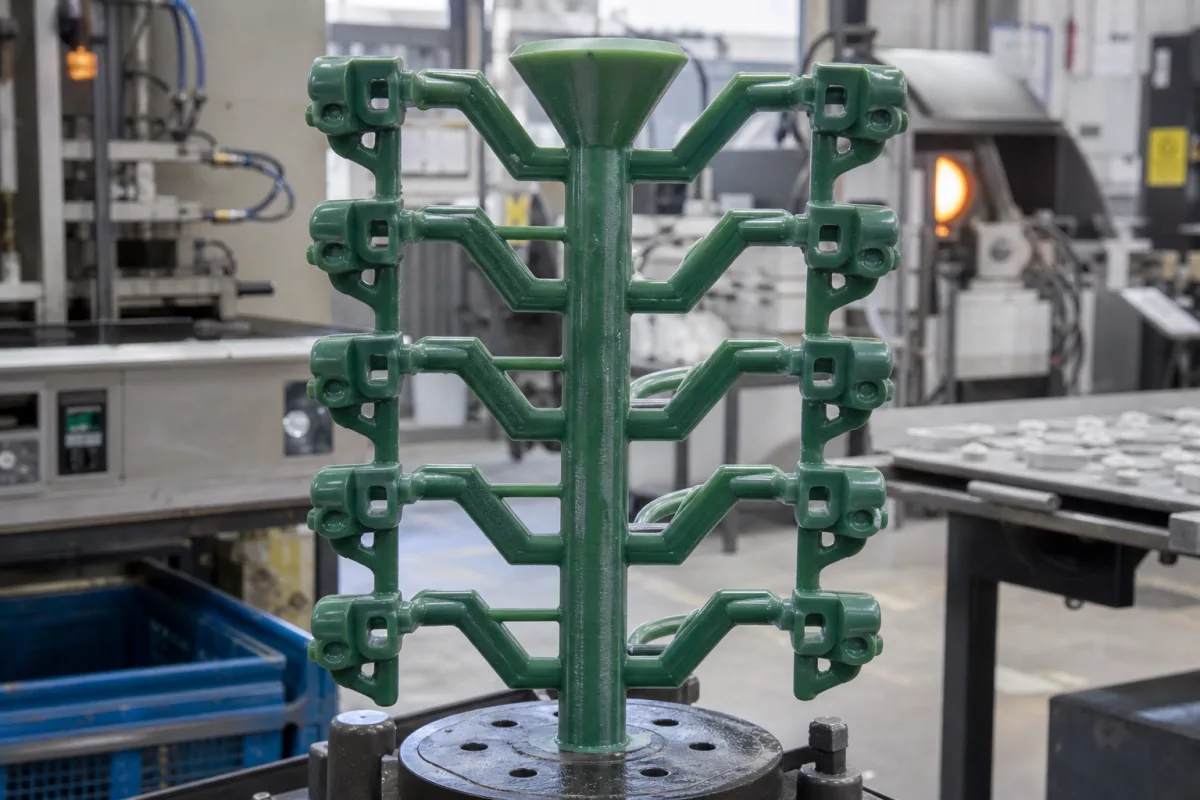
Network of channels delivering molten metal to mold cavities in foundry casting.
Product Specifications

Technical details and manufacturing context for Precision Casting Gating System

Definition
A precision casting gating system is a critical component in metal casting processes that controls the flow of molten metal from the pouring basin into the mold cavity. It consists of carefully designed channels including sprue, runners, and gates that regulate metal velocity, temperature, and turbulence to ensure proper mold filling and minimize defects. In industrial foundry operations, optimized gating systems directly impact casting quality, yield rates, and production efficiency by reducing scrap and improving metallurgical properties. These components are essential in B2B supply chains for automotive, aerospace, and machinery manufacturing where consistent casting quality is paramount.
Working Principle
Utilizes fluid dynamics principles to guide molten metal through progressively smaller channels, controlling flow rate and minimizing turbulence while preventing premature solidification.
Common Materials
Refractory Ceramic, Silica Sand, Zircon Sand
Technical Parameters
  • Runner diameter controlling metal flow rate (mm) Customizable
  • Total cross-sectional area of gating channels (mm²) Customizable
Components / BOM
  • Sprue
    Vertical channel receiving molten metal from pouring basin
    Material: Refractory ceramic or sand
  • Runner
    Horizontal distribution channels directing metal to multiple gates
    Material: Silica sand or zircon sand
  • Gate
    Final entry point controlling metal flow into mold cavity
    Material: Refractory ceramic
  • Pouring Basin Optional
    Initial reservoir that receives molten metal from ladle
    Material: Refractory ceramic
Engineering Reasoning
0.1-0.5 bar (10-50 kPa) pressure differential between sprue base and mold cavity
0.8 bar (80 kPa) pressure differential causing mold erosion or 0.05 bar (5 kPa) causing incomplete filling
Design Rationale: Bernoulli's principle (P + ½ρv² + ρgh = constant) - excessive velocity (v > 2.5 m/s) at constrictions causes turbulent flow and mold erosion, while insufficient pressure (ΔP < 5 kPa) fails to overcome surface tension (γ = 0.8-1.2 N/m for molten aluminum)
Risk Mitigation (FMEA)
Trigger Thermal expansion mismatch between gating material (steel, α = 11.5×10⁻⁶/K) and mold material (sand, α = 0.5×10⁻⁶/K)
Mode: Channel constriction from compressive stresses exceeding yield strength (σ_y > 250 MPa)
Strategy: Expansion joints with 0.5 mm clearance per 100 mm length at 700°C casting temperature
Trigger Solidification shrinkage (6-7% volume reduction for aluminum alloys) creating vacuum pockets
Mode: Air aspiration through permeable mold walls (Darcy's law: Q = -kA(ΔP/μL) with k = 1×10⁻¹² m²)
Strategy: Pressurized risers maintaining 0.3 bar overpressure until complete solidification

Industry Taxonomies & Aliases

Commonly used trade names and technical identifiers for Precision Casting Gating System.

Industrial Ecosystem & Supply Chain DNA

Complementary Systems
Downstream Applications
Specialized Tooling

Application Fit & Sizing Matrix

Operational Limits
pressure: 0.1-0.5 MPa (gravity/pressure-assisted systems)
flow rate: 0.5-5.0 kg/s (depends on gating ratio)
temperature: 1400-1700°C (typical ferrous alloys)
slurry concentration: N/A (solid ceramic systems)
Media Compatibility
✓ Molten steel alloys ✓ Aluminum alloys ✓ Copper-based alloys
Unsuitable: Highly reactive metals (e.g., titanium, magnesium) requiring inert atmosphere gating
Sizing Data Required
  • Casting weight and volume (kg/cm³)
  • Number of cavities in mold
  • Solidification characteristics of alloy

Reliability & Engineering Risk Analysis

Failure Mode & Root Cause
Thermal fatigue cracking
Cause: Repeated thermal cycling from molten metal contact and cooling cycles, leading to stress concentration at sharp corners and material embrittlement
Erosion wear
Cause: High-velocity molten metal flow causing gradual material removal, particularly at gate entries and runner bends, exacerbated by abrasive inclusions in the melt
Maintenance Indicators
  • Visible cracks or discoloration (blue/brown temper colors) on gating surfaces indicating overheating and material degradation
  • Abnormal casting defects in products such as incomplete fills, cold shuts, or increased porosity suggesting flow restriction or temperature loss in the gating system
Engineering Tips
  • Implement regular thermal imaging inspections to identify hot spots and uneven temperature distribution before cracking initiates
  • Apply specialized refractory coatings to critical wear areas and optimize gating geometry using fluid dynamics simulation to reduce turbulence and erosion

Compliance & Manufacturing Standards

Reference Standards
ISO 8062:2020 (Geometrical product specifications (GPS) - Dimensional and geometrical tolerances for moulded parts) ASTM A703/A703M-22 (Standard Specification for Steel Castings, General Requirements, for Pressure-Containing Parts) DIN EN 1559-1:2011 (Founding - Technical conditions of delivery - Part 1: General)
Manufacturing Precision
  • Wall thickness: +/-0.5mm (for typical sections)
  • Surface finish: Ra 3.2 μm (as-cast condition)
Quality Inspection
  • Radiographic Testing (RT) for internal defects
  • Coordinate Measuring Machine (CMM) for dimensional verification

Factories Producing Precision Casting Gating System

Verified manufacturers with capability to produce this product in China

✓ 95% Supplier Capability Match Found

S Sourcing Manager from Brazil Jan 25, 2026
★★★★★
"Reliable performance in harsh Basic Metal Manufacturing environments. No issues with the Precision Casting Gating System so far."
Technical Specifications Verified
P Procurement Specialist from Canada Jan 22, 2026
★★★★☆
"Testing the Precision Casting Gating System now; the Sprue Base Diameter (mm) results are within 1% of the laboratory datasheet. (Delivery took slightly longer than expected, but technical support was excellent.)"
Technical Specifications Verified
T Technical Director from United States Jan 19, 2026
★★★★★
"Impressive build quality. Especially the Sprue Base Diameter (mm) is very stable during long-term operation."
Technical Specifications Verified
Verification Protocol

“Feedback is collected from verified sourcing managers during RFQ (Request for Quote) and factory evaluation processes on CNFX. These reports represent historical performance data and technical audit summaries from our B2B manufacturing network.”

12 sourcing managers are analyzing this specification now. Last inquiry for Precision Casting Gating System from Turkey (1h ago).

Supply Chain Commonly Integrated Components

Infrared Pyrometer

A non-contact temperature measurement device that detects infrared radiation emitted by objects to determine their surface temperature.

Explore Specs →
Signal Processor

Electronic device that conditions, amplifies, filters, and converts raw sensor signals into standardized outputs for temperature measurement systems

Explore Specs →
Purge Air System

A system that provides controlled airflow to clear optical paths and protect sensors in molten metal temperature measurement applications.

Explore Specs →
Degassing Chamber

A specialized vessel within a molten metal degassing system where dissolved gases are removed from molten metal through controlled processes.

Explore Specs →

Frequently Asked Questions

What materials are used in precision casting gating systems?

Precision casting gating systems are typically manufactured from refractory ceramic, silica sand, or zircon sand materials to withstand high pouring temperatures and ensure dimensional stability during metal casting processes.

How does gating ratio affect casting quality?

The gating ratio controls the flow rate and pressure of molten metal entering mold cavities. Proper ratios minimize turbulence, reduce oxidation, prevent defects like porosity, and ensure complete mold filling for higher quality castings.

What components make up a complete gating system?

A complete gating system consists of four main components: the pouring basin (receives molten metal), sprue (vertical channel), runner (horizontal distribution channels), and gate (final entry point into mold cavities).

Can I contact factories directly on CNFX?

CNFX is an open directory, not a transaction platform. Each factory profile provides direct contact information and production details to help you initiate direct inquiries with Chinese suppliers.

Get Quote for Precision Casting Gating System

Request technical pricing, lead times, or customized specifications for Precision Casting Gating System directly from verified manufacturing units.

Your business information is encrypted and only shared with verified Precision Casting Gating System suppliers.

Thank you! Your message has been sent. We'll respond within 1–3 business days.

Need to Manufacture Precision Casting Gating System?

Connect with verified factories specializing in this product category

Add Your Factory Contact Us
Previous Product
Position Transducer
Next Product
Precision Casting Mold Cavity Insert