Industry-Verified Manufacturing Data (2026)

Deoxygenation Chamber

Based on aggregated insights from multiple verified factory profiles within the CNFX directory, the standard Deoxygenation Chamber used in the Beverage Manufacturing sector typically supports operational capacities ranging from standard industrial configurations to heavy-duty production requirements.

Technical Definition & Core Assembly

A canonical Deoxygenation Chamber is characterized by the integration of Main Chamber Body and Access Door with Seal. In industrial production environments, manufacturers listed on CNFX commonly emphasize Stainless Steel (AISI 304/316) construction to support stable, high-cycle operation across diverse manufacturing scenarios.

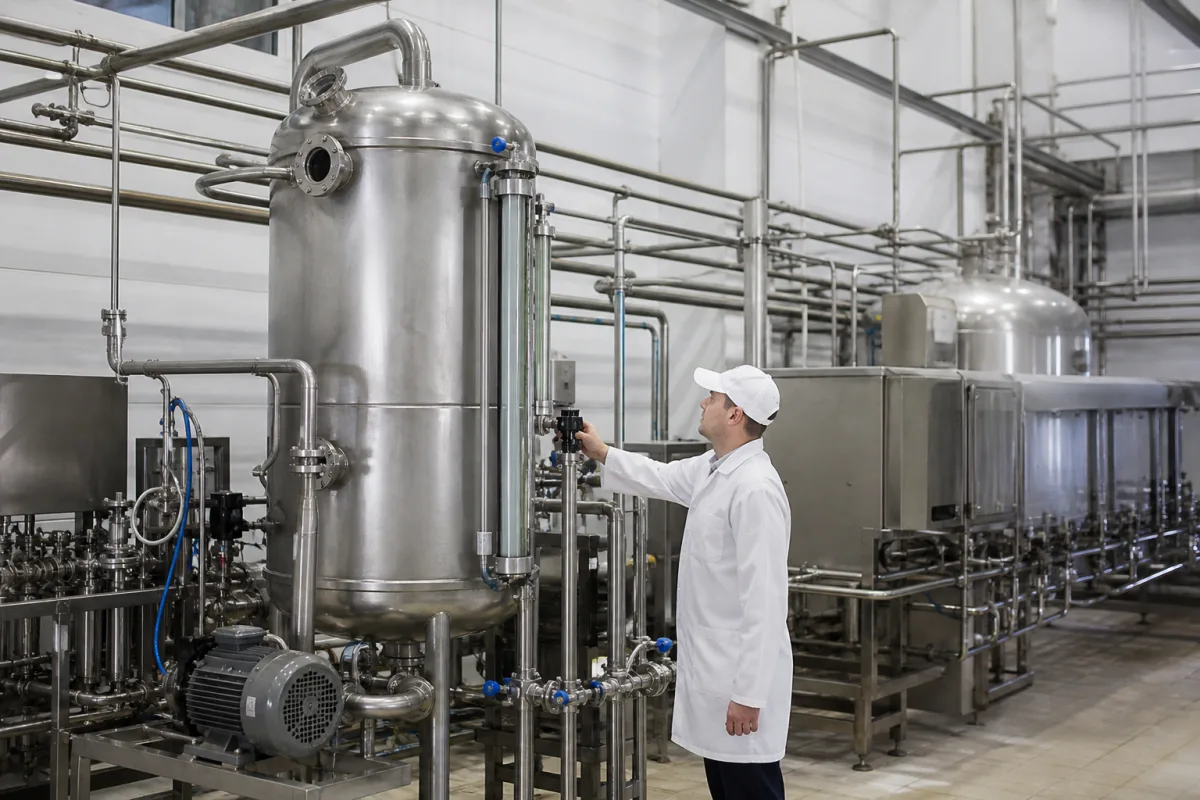
A sealed enclosure within an automated beverage container deoxygenation system where oxygen is removed from containers to extend shelf life and preserve product quality.
Product Specifications

Technical details and manufacturing context for Deoxygenation Chamber

Definition
The Deoxygenation Chamber is the core processing unit of the Automated Beverage Container Deoxygenation System. It is a precisely controlled, sealed environment where filled beverage containers undergo oxygen removal. This chamber interfaces with the system's gas evacuation and inert gas flushing mechanisms to create a low-oxygen atmosphere, crucial for preventing oxidation, maintaining flavor integrity, and inhibiting microbial growth in the packaged beverages.
Working Principle
The chamber operates by first creating a vacuum to evacuate ambient air (containing oxygen) from its interior and from the headspace of the containers placed within. Following evacuation, it is flooded with an inert gas (typically nitrogen or a nitrogen-carbon dioxide mix). This gas flushing cycle may be repeated to achieve the target residual oxygen level. The entire process is automated and monitored by sensors for pressure and gas concentration.
Common Materials
Stainless Steel (AISI 304/316), Tempered Safety Glass Viewport, Food-Grade Silicone Seals
Technical Parameters
  • Internal volume capacity of the deoxygenation chamber (liters) Standard Spec
Components / BOM
  • Main Chamber Body
    Provides the primary sealed volume for the deoxygenation process.
    Material: Stainless Steel (AISI 304/316)
  • Access Door with Seal
    Provides entry for loading/unloading containers and maintains vacuum/inert atmosphere integrity when closed.
    Material: Stainless Steel Frame with Food-Grade Silicone Gasket
  • Vacuum/Pressure Port
    Connection point for the vacuum pump and inert gas supply lines.
    Material: Stainless Steel
  • Pressure Sensor Port
    Mounting point for pressure transducers to monitor chamber vacuum and pressure.
    Material: Stainless Steel
  • Safety Relief Valve
    Prevents over-pressurization of the chamber.
    Material: Stainless Steel
Engineering Reasoning
0.1-1.5 bar absolute pressure, 15-35°C temperature, 0.5-5.0 m³/h gas flow rate
Pressure differential exceeding 2.0 bar across chamber walls, temperature exceeding 60°C, oxygen concentration >0.5% in purge gas
Design Rationale: Material yield strength of 316L stainless steel (205 MPa) exceeded by pressure differential, polymer seal degradation at glass transition temperature (Tg=120°C for FKM), Henry's law equilibrium disruption at elevated temperatures
Risk Mitigation (FMEA)
Trigger Vacuum pump cavitation at vapor pressure of water (2.34 kPa at 20°C)
Mode: Chamber pressure oscillation between 0.5-5.0 bar at 10 Hz frequency
Strategy: Liquid ring vacuum pump with 3.0 bar sealing pressure, anti-cavitation valve with 0.1 second response time
Trigger Nitrogen purge gas contamination with 2.0% oxygen concentration
Mode: Residual oxygen concentration of 0.8% in containers after processing
Strategy: Catalytic oxygen scavenger bed with palladium catalyst, real-time mass spectrometer monitoring with 0.01% detection limit

Industry Taxonomies & Aliases

Commonly used trade names and technical identifiers for Deoxygenation Chamber.

Applied To / Applications

This component is essential for the following industrial systems and equipment:

Industrial Ecosystem & Supply Chain DNA

Complementary Systems
Downstream Applications
Specialized Tooling

Application Fit & Sizing Matrix

Operational Limits
pressure: Vacuum: 0.1 to 0.5 bar absolute; Positive pressure: up to 2 bar gauge
flow rate: 10 to 500 containers per minute (depending on chamber volume)
temperature: Ambient to 60°C (140°F)
slurry concentration: Not applicable (dry process only)
Media Compatibility
✓ Carbonated beverages (soda, beer) ✓ Non-carbonated beverages (juice, water) ✓ Alcoholic spirits
Unsuitable: Highly viscous or particulate-laden liquids (e.g., pulpy juices, suspensions)
Sizing Data Required
  • Container volume (mL or L)
  • Production throughput (containers per hour)
  • Target oxygen residual level (ppm or % by volume)

Reliability & Engineering Risk Analysis

Failure Mode & Root Cause
Corrosion of internal surfaces
Cause: Exposure to dissolved oxygen and other corrosive agents in the water, accelerated by high temperatures and pressures, leading to material degradation and potential leaks.
Mechanical seal failure
Cause: Wear from particulate contamination in the water, misalignment of rotating components, or thermal cycling causing seal material fatigue and loss of containment.
Maintenance Indicators
  • Unusual hissing or bubbling sounds indicating gas leakage or cavitation
  • Visible rust stains, weeping, or moisture around welds, seals, or inspection ports
Engineering Tips
  • Implement regular water quality monitoring and treatment to control oxygen levels, pH, and particulate content to reduce corrosion and abrasion.
  • Establish a predictive maintenance program using vibration analysis and thermal imaging to detect early signs of seal wear, misalignment, or hot spots before catastrophic failure.

Compliance & Manufacturing Standards

Reference Standards
ISO 14644-1:2015 Cleanrooms and associated controlled environments ANSI/ASME BPE-2019 Bioprocessing Equipment DIN 25413-1:2013 Radiation protection - Decontamination of surfaces
Manufacturing Precision
  • Chamber pressure rating: +/- 0.5% of specified value
  • Sealing surface flatness: 0.05mm across entire mating surface
Quality Inspection
  • Helium leak test (vacuum integrity verification)
  • Residual oxygen content analysis via mass spectrometry

Factories Producing Deoxygenation Chamber

Verified manufacturers with capability to produce this product in China

✓ 94% Supplier Capability Match Found

T Technical Director from United Arab Emirates Feb 07, 2026
★★★★★
"Impressive build quality. Especially the Chamber Volume (L) is very stable during long-term operation."
Technical Specifications Verified
P Project Engineer from Australia Feb 04, 2026
★★★★☆
"As a professional in the Beverage Manufacturing sector, I confirm this Deoxygenation Chamber meets all ISO standards. (Delivery took slightly longer than expected, but technical support was excellent.)"
Technical Specifications Verified
S Sourcing Manager from Singapore Feb 01, 2026
★★★★★
"Standard OEM quality for Beverage Manufacturing applications. The Deoxygenation Chamber arrived with full certification."
Technical Specifications Verified
Verification Protocol

“Feedback is collected from verified sourcing managers during RFQ (Request for Quote) and factory evaluation processes on CNFX. These reports represent historical performance data and technical audit summaries from our B2B manufacturing network.”

15 sourcing managers are analyzing this specification now. Last inquiry for Deoxygenation Chamber from Germany (1h ago).

Supply Chain Compatible Machinery & Devices

Automated Beverage Batch Blending System

Automated system for precise multi-ingredient beverage batch preparation.

Explore Specs →
Automated Beverage Container Sterilization System

Automated system for sterilizing beverage containers before filling.

Explore Specs →
Automated Beverage Labeling and Coding System

Integrated system for applying labels and printing codes on beverage containers.

Explore Specs →
Automated Beverage Ingredient Dispensing System

Automated system for precise dispensing of beverage ingredients into production lines.

Explore Specs →

Frequently Asked Questions

What materials are used in the deoxygenation chamber construction?

The chamber is constructed from food-grade AISI 304/316 stainless steel with a tempered safety glass viewport and food-grade silicone seals for durability and compliance with beverage manufacturing standards.

How does the deoxygenation chamber extend beverage shelf life?

By creating a sealed environment where oxygen is removed from containers, the chamber prevents oxidation and microbial growth, significantly extending shelf life while maintaining product flavor and quality.

What safety features are included in the deoxygenation chamber?

The chamber includes a safety relief valve, pressure sensor port, and robust construction with tempered safety glass to ensure safe operation under vacuum and pressure conditions in beverage production environments.

Can I contact factories directly on CNFX?

CNFX is an open directory, not a transaction platform. Each factory profile provides direct contact information and production details to help you initiate direct inquiries with Chinese suppliers.

Get Quote for Deoxygenation Chamber

Request technical pricing, lead times, or customized specifications for Deoxygenation Chamber directly from verified manufacturing units.

Your business information is encrypted and only shared with verified Deoxygenation Chamber suppliers.

Thank you! Your message has been sent. We'll respond within 1–3 business days.

Need to Manufacture Deoxygenation Chamber?

Connect with verified factories specializing in this product category

Add Your Factory Contact Us
Previous Product
Cooling Section
Next Product
Drainage Tray