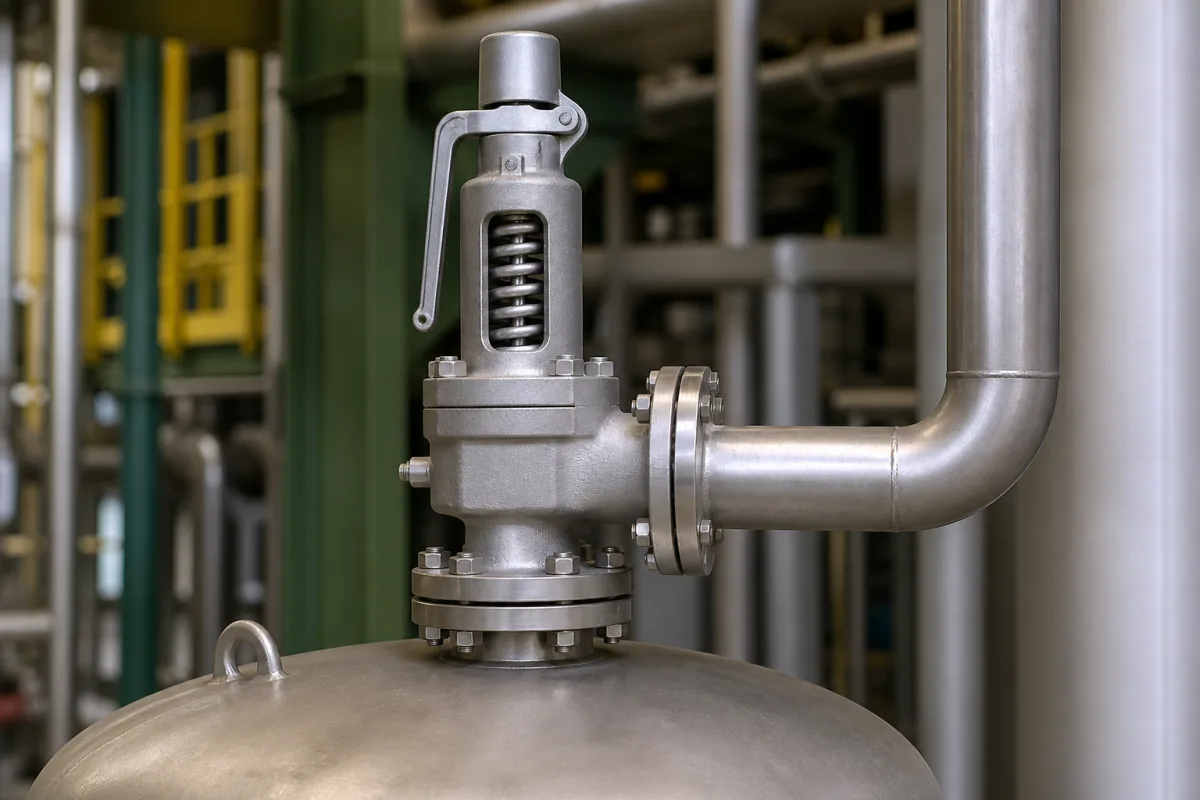
Spring safety relief valve on a pressure vessel, in service
The valve in the illustration sits on a flanged nozzle on a vessel head: an open bonnet showing the spring, a lift lever on top, and a side outlet flanged into a discharge pipe that turns upward. Choosing set pressure and capacity is only half the job. Once installed, the valve has to be testable, the discharge pipe has to take the jet's thrust, and a seat that starts to pass has to be noticed.
Covers installed spring-loaded safety and safety relief valves on pressure vessels and steam equipment: lift-lever requirements and lever types, vertical mounting and drains, discharge piping support and drip-pan or flexible connections, reaction force of open discharge and its time profile, safety (pop) versus relief (modulating) action and liquid chatter, and in-service seat leak detection by acoustic emission. Set pressure, overpressure, blowdown, back pressure, inlet losses and seat-tightness testing are on Pressure relief valve; multiple valves on one boiler are on Boiler safety relief system; replacement discs and seats are on Pressure relief valve disc and seat assembly; sanitary and breather valves have their own pages.
CNFX editorial research · Sources checked October 13, 2026 · 3 sources
Emerson's Kunkle technical reference for safety and relief valves sets out installation rules alongside its product data.
The ASME code requires all air, steam and hot-water (140 °F, 60 °C and above) pressure relief valves to have a lift lever, so the valve can be lifted by hand to prove it is free; Kunkle notes levers may be omitted on valves in hazardous or toxic gas service. The cap that covers the pressure screw or lever housing may be screwed, bolted, packed or a plain lever. Steam safety valves may be used on air but not the reverse, and liquid valves on liquid only.
Install the valve vertically with drain holes open or piped away, with inlet and outlet at least as large as the valve connections. On threaded inlets, use a pipe tap for clean threads, apply compound to male threads only and leave the first thread clean, and do not over-tighten, which can distort the seat. For steam equipment, Kunkle recommends a margin of 30 to 40% between operating pressure and the MAWP and valve setting.
Service
Lift lever (Kunkle, citing the ASME code)
Air
Required
Steam
Required
Hot water at 140 °F (60 °C) and above
Required
Hazardous or toxic gas
May be omitted
Example (Editorial calculation): with a 10 barg setting, a 30–40% margin puts normal operating pressure at about 6 to 7 barg. Ask for the lever and cap type, and whether a packed lever is needed to keep the bonnet sealed.
02
Discharge reaction force and pipe support
SST Systems' technical reference on relief valve load analysis describes the load an open valve puts on its installation.
When the valve opens, the discharging fluid forms a jet that acts on the piping. The force rises from zero to full value over about the valve's opening time, stays roughly constant while the valve relieves, and falls to zero as it closes. API 520 Part II gives a formula for the reaction force of vapour or two-phase discharge to atmosphere, from flow rate, specific-heat ratio, outlet temperature, molecular weight, outlet area and outlet static pressure; it does not cover liquid releases and leaves the acceptability of the installation to the designer. For closed discharge into a header, API 520 Part II notes that steady flow does not create large forces except at sudden expansions, and a time-history analysis may be needed.
SST's worked example applies a 6,854 lbf reaction force, about 30.5 kN (Editorial calculation), with 8 ms opening and closing times and a 1 s release at 475 psig, as a force spectrum at the bend after the valve. Kunkle's installation rule covers the static side: discharge piping must not hang its weight on the valve, and even separately supported pipe can strain the valve as temperature changes, so it recommends drip-pan elbows or flexible connections.
Load
What the sources say
Jet reaction at open discharge
Rises over the opening time, constant during release, falls on closing (SST); API 520 II formula for vapour or two-phase
Pipe weight
Must not be carried by the valve (Kunkle)
Thermal movement of the pipe
Can strain the valve even when supported; use drip-pan elbow or flexible connection (Kunkle)
Ask the vessel or piping designer for the reaction force at the outlet and the nozzle and support loads it creates, and for the valve maker's opening and closing times.
03
Safety action, relief action and liquid chatter
Kunkle distinguishes the two actions. Safety valves for gases, including air and steam, have a huddling chamber that uses gas expansion to pop the valve open and closed quickly, with blowdown the difference between opening and reclosing pressures. Relief valves for liquids have no accentuated huddling chamber or adjusting ring and open in a semi-modulating way in proportion to pressure, which suits protecting piping from water hammer.
On liquid, a small flow across the nozzle causes a large local pressure drop that lets the spring reclose the valve, and liquid in the huddling chamber drains away so pressure does not build on the secondary area. Liquid relief valves are therefore susceptible to chatter, rapid opening and closing that is destructive, especially at low flow. Because there is no pop, liquid set pressure is defined as the pressure at the first heavy, steady vertical flow.
Ask whether the valve offered is designed and tested for liquid, gas or both, and what minimum relieving flow keeps it from chattering in your service.
04
Catching seat leakage in service
Li and co-workers (Sensors 25, 5451, 2025) studied internal leakage of a PN25 DN100 spring full-lift safety valve, noting that the seat sealing face is easily damaged in long-term use and that leakage is a safety hazard and an economic loss.
They recorded acoustic emission from the valve with a high-frequency FPGA acquisition system, converted it to time–frequency images and classified leakage states with an improved convolutional network, reaching 99.7% average recognition accuracy. A 1 mm single slot produced a narrow peak at 25 kHz ± 500 Hz; a 2 mm double slot spread energy over 20 to 50 kHz. The authors caution that these signatures are tied to that valve's structure.
The practical point for a vessel valve is that a passing seat makes ultrasound well above audible frequency, so it can be checked from outside without lifting the valve.
Leak preset (Li et al.)
Acoustic signature
Φ1 mm single slot
Narrow peak at 25 kHz ± 500 Hz
Φ2 mm double slot
Broad energy across 20–50 kHz
The audible-range remark is an editorial reading. Ask whether the plant's inspection uses acoustic checks on relief valves and at what interval valves are removed for bench testing.
05
What to give a supplier for a vessel safety relief valve
Paste it into your enquiry below or into an email to a maker, then replace every bracket.
State fluid and phase, set pressure and relieving capacity, MAWP and normal operating pressure, temperature, inlet and outlet connection sizes and ratings, open or closed discharge and any back pressure, and whether the service is air, steam, hot water or toxic gas. Ask for lever and cap type, bonnet type, drain connections, opening and closing times, the reaction force basis, the liquid or gas certification of the valve, and recommended in-service checks.
5 companies list this product among what they make. Company figures are quoted from each
company's own website; every card states where the relationship came from.
CHINA YOY VALVE GROUP
TBC
YOY Valve's site lists pressure safety valves, safety relief valves, PSVs with change-over valves and breather valves.
Explore company information and manufacturing capabilities, then discuss the scope of your project with a relevant supplier.
Share this page
Compiled and source-reviewed by the CNFX editorial team.
Each manufacturer above links to the page on that company's own website where the product is listed, with the date we checked it. How we source and review
· Page last updated 13 October 2026
Buyer questions
When must a safety relief valve have a lift lever?
Kunkle cites the ASME code: on air, steam and hot water at 140 °F (60 °C) or above; levers may be omitted in hazardous or toxic gas service. [1]
Can the discharge pipe hang on the valve?
No. Kunkle says its weight must not be carried by the valve and recommends drip-pan elbows or flexible connections because thermal movement can still strain it. [1]
How is the reaction force at the outlet calculated?
SST describes the API 520 Part II formula for vapour or two-phase discharge to atmosphere and a load that rises over the opening time, holds, then falls on closing. [2]
Why do liquid relief valves chatter?
At low flow the local pressure drop lets the spring reclose the valve and the huddling chamber drains, so it opens and closes rapidly (Kunkle). [1]
Can seat leakage be detected without removing the valve?
Li et al. identified leakage states from acoustic emission at 20–50 kHz with 99.7% average accuracy on a PN25 DN100 full-lift valve. [3]
Sources and what still needs a direct check
Sources checked 2026-10-13. A relief valve maker's technical reference, a piping-analysis software maker's load-analysis reference and a peer-reviewed leak-detection study.