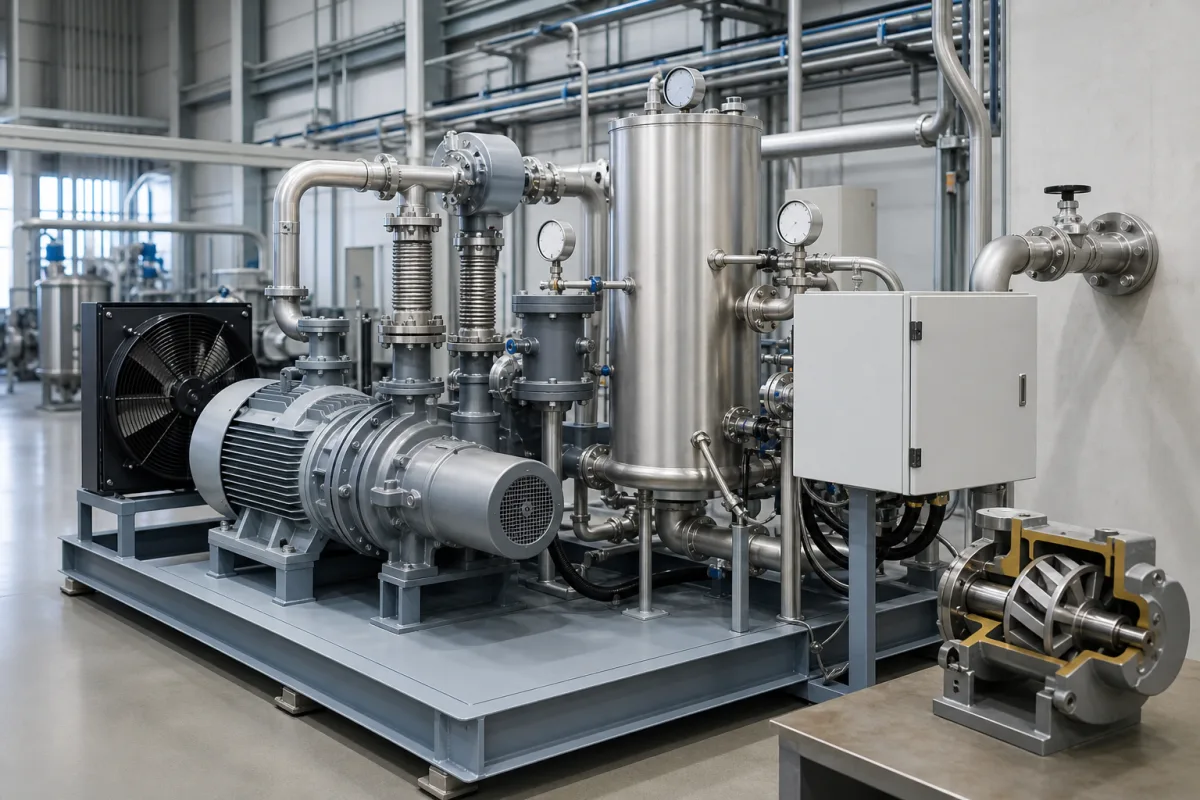
Packaged vacuum pump system (skid unit with separator, heat exchanger and booster stage)
Packaged vacuum systems · pumps, separator, heat exchanger, booster stage, receiver and controls on one base frame
A packaged vacuum pump system is the vacuum pump plus everything needed to run it as one unit: the motor and drive, a discharge separator and heat exchanger for the pump's service liquid, a Roots booster stage where a lower pressure or higher speed is needed, a receiver tank, valves, instruments, internal piping and controls, all on one base frame. Ask three things first: which service-liquid loop the package uses, whether a booster stage sits above the backing pump and at what pressure it cuts in, and which items are inside the supplier's skid boundary.
Complete vacuum packages built around a pump: once-through, partial-recirculation and closed-loop liquid ring units, Roots booster sets with liquid ring, rotary vane or dry screw backing pumps, and tank-mounted pump units with a receiver. The pumps on their own — choosing rotary vane, dry screw or liquid ring for the gas, gas ballast and pump-down time — are covered on the Vacuum pump page. Turbomolecular high-vacuum stations and vacuum furnaces are outside this page.
CNFX editorial research · Sources checked October 12, 2026 · 6 sources
Choose the seal-liquid loop on a liquid ring package
Atlas Copco describes three ways to package a liquid ring pump. A once-through power pack is the pump with motor, drive and base frame, sending the liquid and gas mixture to drain; Atlas Copco says it suits sites with an ample supply of seal liquid that can be discharged. In partial recirculation a discharge separator recovers service liquid and mixes it with fresh seal liquid to hold a constant pump temperature, which Atlas Copco says "offers typical water savings of 50% compared to once-through operation". Total recovery is a closed loop with a heat exchanger between the separator and the pump, and Atlas Copco states it "offers typical water savings of up to 95%" against once-through. [1]
Writing in Pumps & Systems, Busch's Benjamin Cameron ties the choice to the gas stream: once-through operation continuously flushes the pump where particulate carryover is expected, while full recovery suits cleaner gases and plants where continuous disposal of contaminated water or condensed solvents is unwanted. He adds that savings from partial recovery depend on the vacuum level, the fresh-water temperature and the heat added to the seal liquid, and that a water-cooled heat exchanger raises the plant's cooling-water demand while an air-cooled one raises power consumption. For rough-vacuum duty or large seal flows, a recirculation pump may be needed to overcome pipework losses from the separator back to the pump. [2]
Foryou's 2BW closed-loop unit shows the full-recovery layout: gas leaves the pump with some working liquid into a vapour-liquid separator; the gas then passes a spiral-wound heat exchanger where condensable vapours condense into a recovery tank, and non-condensable gas exits the system; the separated liquid is cooled in the heat exchanger and returns to the pump. Foryou says the pumped solvent can serve as the working liquid, and supplies the unit with pump, separator, heat exchanger, frame and internal piping as one set. [3]
Editorial calculation: at Atlas Copco's stated savings, a package that would draw 100 units of fresh seal liquid once-through would draw about 50 units with partial recirculation and as little as 5 units with total recovery, before the cooling duty moved to the heat exchanger is counted. [1]
Give the supplier the gas and vapour load, any solvents or particulates, the operating pressure, the seal liquid you can supply and its temperature, cooling water or ambient air available for the heat exchanger, and whether condensed solvent must be recovered.
02
Stage a booster pump above the backing pump
Souz's JZPS Roots–liquid ring systems put a Roots pump as the main pump on a liquid ring backing pump. Its table lists, for each pairing, the pumping capacity, the maximum inlet pressure for the set and the total installed power: the JZJ2S30-1 (ZJ30 on a 2SK-1.5) gives 30 L/s with a 12,000 Pa maximum inlet pressure and 4.75 kW; the JZJ2S600-2A (ZJ600 on a 2SK-12) gives 600 L/s with 4,000 Pa and 27.5 kW; the JZJ2S600-2B (ZJ600 on a larger 2SK-20) gives the same 600 L/s with 7,000 Pa and 42.5 kW. [4]
Editorial calculation: in the two 600 L/s Souz sets, moving to the larger backing pump raises the listed maximum inlet pressure from 4,000 to 7,000 Pa and the installed power from 27.5 to 42.5 kW, an increase of about 55%. 600 L/s × 3.6 = 2,160 m³/h. [4] Editorial note: the maximum inlet pressure bounds where the set works as a pair; ask how the booster is started and protected above that pressure (bypass, delayed start or variable speed).
Baosi lists a dry system pairing: the GSD160/1080D, a 1,080 m³/h system with a GSD160 dry screw backing pump, 0.1 Pa (1 × 10⁻³ mbar) ultimate pressure, motor power of 5.5 + 3.7 kW, 380 or 400 V three-phase supply, VG100 inlet and KF40 outlet, water cooling, 72 dB(A) and 495/520 kg. Baosi describes nitrogen purging to keep process gas out of the gearbox, automatic chamber cleaning at shutdown, and remote control through I/O and RS485 (Modbus). [5] Editorial calculation: 1,080 m³/h ÷ 3.6 = 300 L/s, and installed motor power totals 9.2 kW.
03
Once-through, total-recovery, Roots-boosted and dry-screw packages
Ask each supplier to draw the skid boundary: which valves, instruments, separators, heat exchangers and control panels are included, and which connections the plant must supply.
Package
Published layout
Published figures
Liquid ring power pack (once-through)
Pump, motor, drive and base frame; liquid to drain. [1]
Pump range 25–37,500 m³/h, down to 30 mbar(a). [1]
Packages differ by pump pairing: Roots boosters on liquid ring, rotary vane or rotary piston pumps, open- or closed-cycle water ring units, and dry screw systems such as a 1,080 m³/h set with GSD160 backing pump; tank-mounted oil-free units with 6.5 to 47 gallon tanks are also listed.
Ningbo Baosi Energy Equipment Co., Ltd.
Manufacturing site to be confirmed for the order
Lists a 1,080 m³/h dry screw vacuum pump system with GSD160 backing pump, and a 600 m³/h system.
Explore company information and manufacturing capabilities, then discuss the scope of your project with a relevant supplier.
Share this page
Compiled and source-reviewed by the CNFX editorial team.
Each manufacturer above links to the page on that company's own website where the product is listed, with the date we checked it. How we source and review
· Page last updated 13 October 2026
Buyer questions
How much water does a closed-loop liquid ring package save?
Atlas Copco states typical savings of 50% for partial recirculation and up to 95% for total recovery, compared with once-through operation. [1]
What is inside a closed-loop liquid ring unit?
Foryou lists the pump plus a gas-liquid separator, heat exchanger, valves, instruments, frame and internal piping; condensable vapours can be recovered in a tank. [3]
Why add a Roots booster to a vacuum pump system?
Souz's Roots–liquid ring sets reach 30 to 600 L/s on liquid ring backing pumps, with listed maximum inlet pressures of 4,000 to 12,000 Pa for the set. [4]
Sources and what still needs a direct check
Sources checked 2026-10-12. Atlas Copco, Souz, Baosi, Foryou and Brostun describe their own packages; the Pumps & Systems article is written by a Busch product marketing manager. Ask for the package datasheet of the exact configuration you are buying.