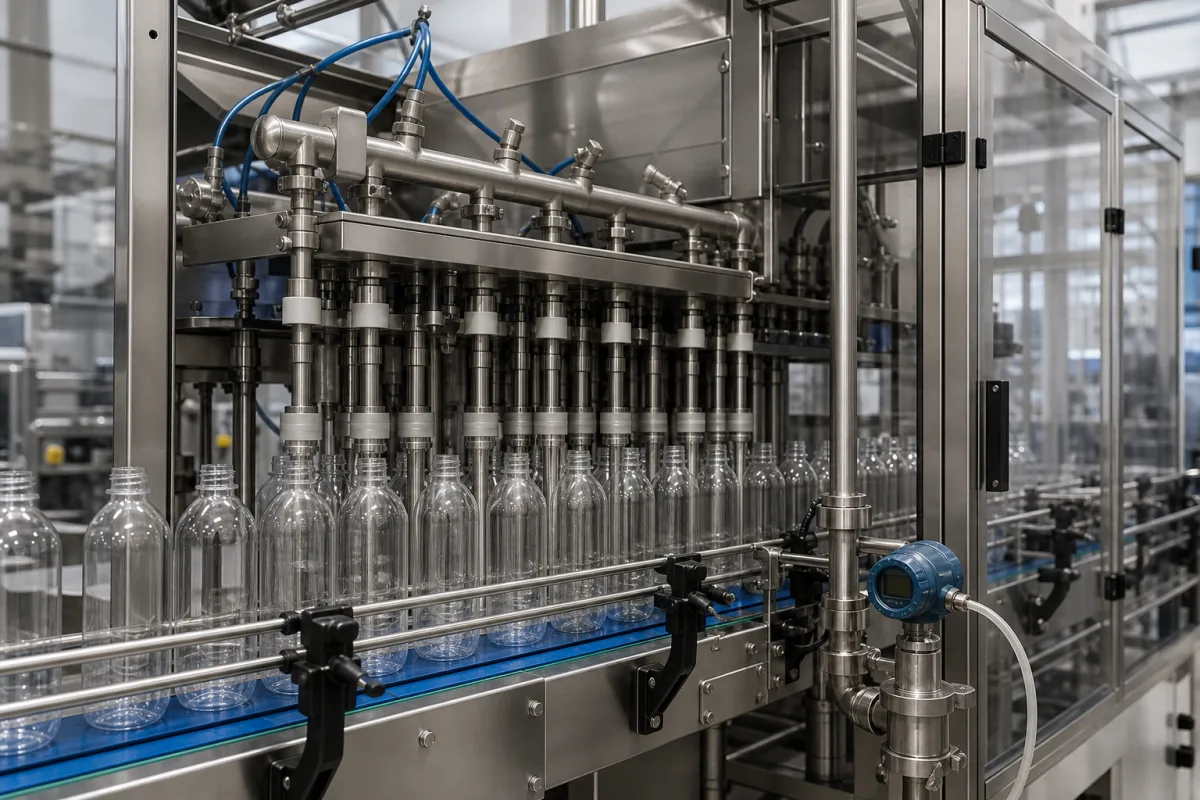
Beverage container deoxygenation (inert-gas purging) · Nitrogen flushing of empty bottles, liquid-nitrogen dosing, headspace purging before capping, total package oxygen
A container deoxygenation system displaces air from bottles, cans or pouches with an inert gas before or during filling so less oxygen ends up in the sealed package. Ask three things first: where in the line oxygen is removed (empty containers, headspace after filling, or the beverage itself), which inert gas and delivery method are used, and how residual or total package oxygen will be measured.
Inert-gas purging and liquid-nitrogen dosing equipment that reduces oxygen in beverage containers and headspace on filling lines. Beverage deaeration of water (see deaerator), carbonation control (see automated beverage carbonation control system), nitrogen generators and complete fillers are outside this page except where integrated.
CNFX editorial research · Sources checked October 11, 2026 · 4 sources
Atlas Copco describes nitrogen use across beverage packaging: in wine bottling, bottles are washed and dried with nitrogen before filling, and after filling and before corking the bottle is purged with nitrogen to avoid residual air in the neck; for juices, nitrogen in tanks, containers, pipes and bottles prevents oxidation of vitamin C. [2]
US patent 4,347,695 describes reducing both dissolved and headspace oxygen in non-carbonated beverages by injecting nitrogen into the beverage, letting it escape in the container to strip dissolved oxygen and purge the headspace before capping, with separate nitrogen supplies for sparging, filler pressurisation and headspace purge; it notes the nitrogen amount depends on line speed and container geometry. [3]
Give the supplier the containers (type, size, neck), line speed, beverage and its oxygen sensitivity, where purging is needed (empty, pre-capping headspace, both), inert gas source and purity, target headspace or total package oxygen, how it will be measured, and integration with the filler and capper.
02
Choose the inert-gas delivery method
Chart explains that in liquid-nitrogen dosing droplets of LN₂ entering the bottle immediately vaporise and displace oxygen in the headspace, purging the empty bottle of nearly all oxygen, reducing total package oxygen (TPO) and preserving CO₂ and nitrogen content; capping with some nitrogen gas still present also raises pressure, easing cork removal for 750 ml cork-and-cage bottles. A brewery quality director quoted by Chart reports O₂ content below 100 ppb with LN₂ dosing. [1]
Editorial calculation: 100 ppb equals 0.1 ppm; because this figure is a user testimonial, the result should be verified with an oxygen analyser on the actual line. [1]
03
Find automated beverage container deoxygenation system manufacturers
Chart Industries lists automated liquid nitrogen dosers that dispense a measured LN₂ dose into each container before sealing; the card below refers to its Changzhou entity.
Ask any supplier for the purging or dosing method, gas consumption per container at your speed, achievable headspace or total package oxygen with the measurement method, container formats and change-over, integration with filler and capper, materials and hygiene, and utilities.
04
Set a total package oxygen target and measure it after filling
The Australian Wine Research Institute (AWRI) defines total package oxygen (TPO) as the sum of dissolved oxygen (DO) and headspace oxygen (HSO), quantified immediately after packaging. It says DO increases during bottling are minimised by sparging empty bottles on the filler with an inert gas and keeping inert gas cover on the filler tank, with nitrogen, argon or carbon dioxide (as dry ice) used to keep DO below 0.5 mg/L, as Australian Grape & Wine's Packaging Guidelines recommend. [4]
AWRI reports that its oxygen management audits "have shown that typically more than 60% of the oxygen in the bottle is present in the headspace", and that "Most modern bottling lines are able to achieve displacement of ~60 – 80% of the oxygen from the headspace through vacuum or inert gas application", including liquid nitrogen droplets. AWRI case studies found that cylindrical closures applied without a vacuum can add 1 mg/L of HSO. [4]
These are wine figures. For beer, juice or other beverages, write the target TPO, the analyser, the sampling point and the time after capping into the order, and ask the supplier to demonstrate the result on your containers at your line speed.
Speed, residual oxygen, container range, gas pressure and utilities for a deoxygenation quotation
Published values in this table come from Chart's doser information and US patent 4,347,695; where neither states a value, the row says what to obtain from the supplier.
Find automated beverage container deoxygenation system manufacturers
1 company lists this product among what they make. Company figures are quoted from each
company's own website; every card states where the relationship came from.
Chart Industries lists automated liquid nitrogen dosers that dispense a measured LN2 dose into each container before sealing. The card refers to Chart's Changzhou entity.
Explore company information and manufacturing capabilities, then discuss the scope of your project with a relevant supplier.
Share this page
Compiled and source-reviewed by the CNFX editorial team.
Each manufacturer above links to the page on that company's own website where the product is listed, with the date we checked it. How we source and review
· Page last updated 13 October 2026
Buyer questions
How does liquid-nitrogen dosing remove oxygen?
Chart says LN₂ droplets vaporise in the bottle and displace headspace oxygen, purging nearly all oxygen. [1]
Where can nitrogen be used on a bottling line?
Atlas Copco describes washing and drying bottles with nitrogen before filling and purging the neck before corking. [2]
Does purging the headspace remove dissolved oxygen?
US patent 4,347,695 combines nitrogen sparging of the beverage, to strip dissolved oxygen, with headspace purging before capping. [3]
What total package oxygen should a filling line achieve?
For wine, the Australian Wine Research Institute rates TPO below 1.5 mg/L as best practice, 1.5–2.5 mg/L as acceptable and above 4 mg/L as poor practice. Agree the target and the measurement method for your own beverage with the supplier. [4]
Sources and what still needs a direct check
Sources checked 2026-10-11. Chart Industries makes liquid-nitrogen dosers; Atlas Copco makes nitrogen generators; US patent 4,347,695 describes a nitrogen bottling method.