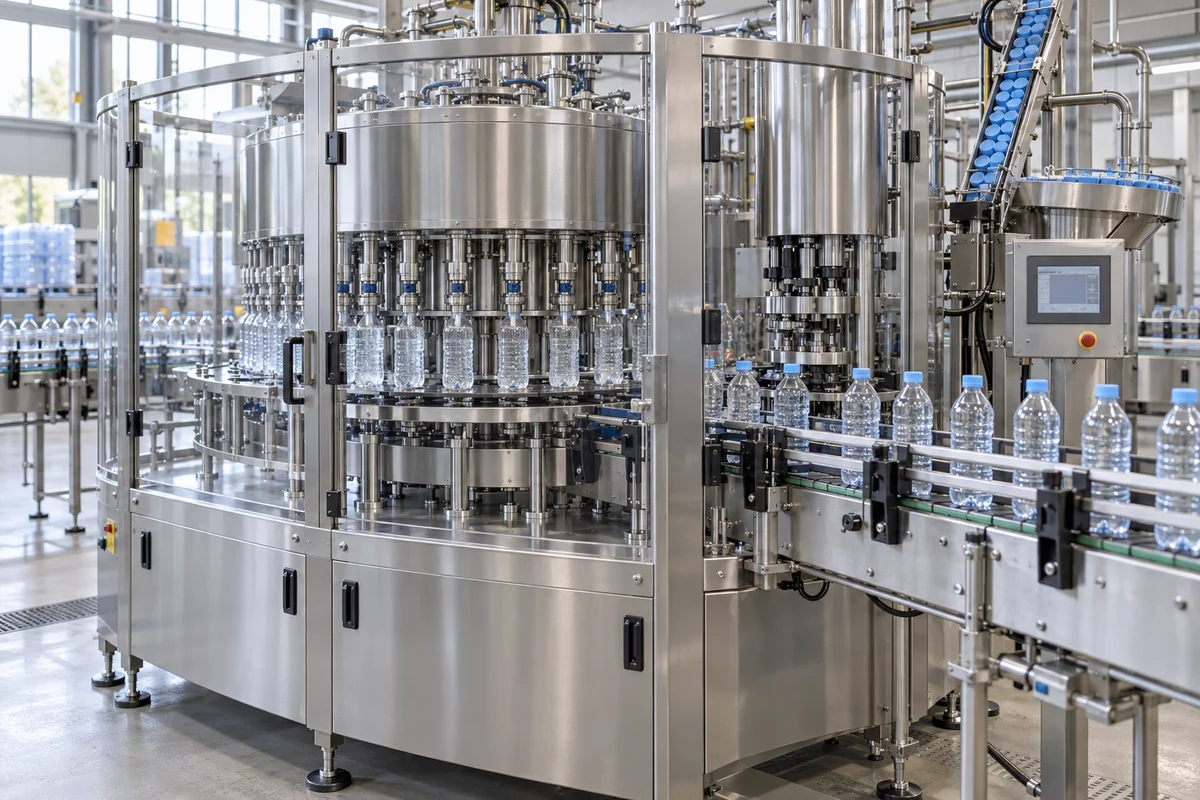
A rotary monoblock moves bottles through rinsing, filling and capping. Choose it around the beverage, bottle and closure—not a headline speed alone. This guide reads a 14–12–5 water-machine listing, compares Sidel's published filler features, and follows the package through flow control and closure checks.
CNFX editorial research · Sources checked October 12, 2026 · 6 sources
Track the bottle separately from the liquid and cap
ZONESUN's ZS-AFM 14–12–5 lists 14 rinsing, 12 filling and 5 capping heads. Those counts describe three different stations. Sidel documents star-wheel/guide format parts; Krones describes the product tank, flow measurement and valve sequence of its own Modulfill VFS design [1][2][3].
Part or assembly
Role, source and procurement boundary
Rotating carousel
Carry the bottle through the filling arc. The ZONESUN listing describes rotary sections, but does not provide carousel dimensions, pitch, drive ratios or a numbered assembly drawing [1].
Infeed star wheel and guides
Transfer and space bottles for the rotary process. Sidel's EvoFILL star wheels/guides use replaceable light-weight sectors. Their material and neck/body contact geometry must be specified for the ordered machine; an infeed table elsewhere in a line is a different component [2].
Rinsing heads and rinse circuit
Clean the bottle before filling; ZONESUN lists 14 heads and a washing-water requirement. Confirm the actual bottle gripping, rinse medium and discharge/reuse arrangement; no validated sterilization process is demonstrated by the listing [1].
Filling valve assembly
Control liquid delivery and cutoff. Krones' reference valve uses a flowmeter signal and electropneumatic closure after pressure equalization. Sidel describes no-contact volumetric flowmeter filling. Neither establishes the valve fitted to ZONESUN's machine or its seal material [3][2].
Product tank and distribution circuit
Supply the filling valves. The Krones VFS reference uses an adjacent product tank and feed from above; its VFS-M mixer variant instead feeds a manifold and removes the conventional filler bowl. A tank configuration cannot be transferred between these designs [3].
Control panel and recipe functions
Set and monitor the agreed machine functions. ZONESUN lists 24 V DC control-panel supply but no PLC model, recipe specification or electrical load in kW. Obtain the actual controller, interlocks and included format settings [1].
Cap feed and capping heads
Deliver and apply the selected closure. ZONESUN lists 5 capping heads and references a cap arranger. Silgan's closure checks evaluate the applied package; they do not establish a capping-head torque setting or parts list for this machine [1][4].
The assembly map identifies functions, not interchangeable spares. The reviewed ZONESUN data does not specify contact-metal grades, PTFE/silicone seals, star-wheel polymer, enclosure material, part numbers or installed quantities beyond the stated head counts. Require the contact-material schedule and model-specific drawings before ordering wear parts. A separate named reference below records Yundu's declared 316L contact parts and 304 exterior. Those grades cannot fill the missing ZONESUN material schedule [5].
02
Output per valve is a comparison tool, not filling dwell time
Divide a model's stated output by its filling-valve count only when both belong to the same configuration and bottle duty. Rinsing and capping head counts are not the divisor for filling-valve output.
Specify saleable line output on each bottle
Sidel's 99% is a manufacturer efficiency claim with no full test method on this page. It is not the yield of a complete line. As an acceptance proposal, agree saleable capped bottles per hour for each product/format, run duration, rejects and treatment of stops, including the upstream/downstream equipment. Do not multiply unrelated brochure percentages [2].
Body/table: 5,000 bph on 500 ml PET. Purchase options: 12,000 or 24,000 pcs/h [1]
Using the 5,000-bph statement: 5,000/12 ≈417 bottles per valve-hour; 3,600/(5,000/12)=8.64 s average repeat interval. This is arithmetic on a disputed listing, not a witnessed output or liquid-filling duration.
Model column: 4,000 bph on 500 ml PET. The page headline covers a broader capacity range [6]
The model column implies about 333 bottles per valve-hour. It is another supplier’s named configuration, not confirmation of the ZONESUN 5,000-bph listing.
Feature panel says over 90,000 bph and 99% efficiency [2]
The page does not pair an exact valve count, bottle volume and output. Dividing 90,000 by 144 would assume a configuration it does not specify; no verified per-valve figure is assigned here.
An average interval between bottles handled by one valve includes more than liquid entering the bottle. Krones' sequence separately includes pressurization, filling, settling and pressure release. The filling arc and those phases must be specified by the selected valve design [3].
03
Resolve ZS-AFM's conflicting product and utility labels
The following are the listing's actual statements, not a corrected specification. Ask ZONESUN for one dated model schedule tied to the purchased configuration [1].
Counter-pressure needs a documented valve sequence
Krones' carbonated/non-carbonated water reference pressurizes the bottle, opens the valve after tank/bottle pressure equalization, measures delivered quantity, then settles and releases headspace pressure. That demonstrates a named design—not a carbonated-product capability for ZONESUN just because its table mentions the drink [3][1].
Bottle geometry
The PET-size row gives body diameter Ø50–95 mm, height 160–310 mm and volume 250–2,000 ml. Introductory text also mentions glass, while the application section describes PET. Obtain each bottle and neck-finish drawing; a PET size range does not prove glass handling [1].
Beverage suitability
The table/introduction mention water and carbonated drinks; PET applications say drinking water and other non-carbonated beverages. Valve pressure design, product temperature and cleaning duty remain to be confirmed [1].
Rinse requirement
Washing water 1,500 L/h and washing pressure 0.25 MPa. These are rinse-circuit labels, not compressed-air pressure or product filling pressure [1].
Electrical labels
The supply row states 380 V AC, 60 Hz, three-phase, with other supply available. Both 'Working Power' and control-panel power are shown as 24 V DC. Voltage is not power in kW; obtain the total connected-load and actual-demand schedule [1].
Cap-arranger air rows
The pressure row says 0.6 m³/min, a flow unit; the consumption row says 2360×1770×2700 mm, dimensions. No air pressure or reliable consumption is established by these rows. Do not silently move the values into new headings [1].
Dimensions and mass
The current dimension row is merged with an approximate machine-weight label and 3,500 kg. The dimensional string appears under air consumption. Obtain an approved installation drawing and shipping/operating mass; this page's misplaced dimensions are not an installation specification [1].
04
Equal liquid level is a different accuracy measure from delivered volume
Yundu's YDGZ-18 page describes an 18-head rotary differential-pressure vacuum filler, rather than the complete rinse–fill–cap monoblock above. Its table gives a liquid-level error in millimetres. These are the maker's published model values; they do not establish witnessed production or bottle-to-bottle delivered-volume accuracy [5].
YDGZ-18 model field
Published value and boundary
Filling method / heads
Differential-pressure vacuum equal-level filling; 18 rotary heads. The source does not demonstrate carbonated counter-pressure duty or include 14 rinsing and 5 capping stations [5].
Dose and output
100–2,000 ml; 80–120 bottles/min. The table does not pair those speeds with a selected dose, bottle or product, so the maximum speed and maximum dose cannot be promised together [5].
Filling precision
≤±3 mm, explicitly labelled liquid-level error. Millimetres of level cannot be substituted for ±3% or ±3 ml: the source gives no bottle geometry, delivered-volume measurement or volume-error statistic [5].
Bottle geometry
Height 120–330 mm; diameter 40–100 mm. Obtain the neck finish and actual container drawing separately [5].
Electrical label
AC 220 V / 380 V, 50/60 Hz; 3 kW. Confirm the ordered supply and whether that load includes external pumps and line equipment [5].
Pressure label
0.4–0.6 MPa, headed only “Pressure Range”. The page does not identify the measurement point; do not relabel it as filling vacuum, product pressure or compressed-air supply without clarification [5].
Host size and mass
3,000×1,475×1,620 mm; 1,500 kg. These are host-machine labels, not the complete line envelope, maintenance clearance or lifted shipping assembly [5].
Declared materials
Maker states 316L for material-contact parts and 304 for the exterior. Obtain the actual wetted-part and seal schedule and material documents; this declaration is not an independently checked certificate and does not apply to ZS-AFM [5].
The same page labels a component illustration “Auger Feeder” within its liquid-vacuum description. Ask for the actual product-circuit drawing and included valve assembly rather than carrying that inconsistent caption into a purchase BOM. Its CIP feature claim does not establish a validated cleaning or aseptic process [5].
05
For carbonated duty, include settling and pressure release
Krones explains the Modulfill VFS with PFR valves in a sequence useful for reading a proposed carbonated-water filler. The following describes that equipment; a water-only gravity filler need not share its construction [3].
Seal and pressurize the bottle
The valve moves onto the PET container; the container is pressurized before liquid starts. Request the selected bottle/closure pressure suitability and valve pressure conditions rather than substituting rinse or air-supply pressure [3].
Fill after pressure equalization
Once tank and bottle pressures match, the valve opens. Liquid passes through a swirl insert and a flowmeter measures the delivered quantity; the valve closes on its cutoff signal [3].
Settle, then release pressure
After the settling phase, a snifting valve reduces bottle-headspace pressure before exit. These phases explain why an 8.64 s average per-valve output interval cannot be called 8.64 s of liquid flow [3].
Krones lists inductive or mass-flow measurement and water with/without conductivity, while a separate product-property block shows >20 μS/cm. Confirm the offered meter and product-property limits for the variant. Flowmeter terminology alone does not prove every beverage, pulp or conductivity level is supported [3].
06
Separate fill-level changes from bottle-format changes
Sidel's current feature panels describe EvoFILL PET's no-contact volumetric filling and replaceable star-wheel/guide sectors. These features explain what to ask for; they are not evidence that another supplier includes the same design [2].
Changing the fill setting
Sidel says changing fill levels does not require replacing components in its flowmeter system. Confirm the supplied machine's dosing method and recipe limits; a different valve may use different format adjustments [2].
Changing the physical bottle
Its star-wheel/guide sectors are designed for replacement, and an automatic format-change option is advertised at less than 5 minutes. That option needs the format pair, delivered parts and agreed start/end definition; it is not a universal manual changeover time [2].
Cleaning access
Sidel describes a highly accessible 'no base' design. Cleanability features and claims about residual product do not establish a validated sanitation process for the buyer's beverage [2].
CIP and external cleaning
Its feature panel separately discusses internal CIP and external surface cleaning, with evaluation conditions for its claimed cycle reductions. Specify the circuits, CIP equipment boundary and validation responsibility rather than transferring those percentages to the quoted line [2].
Request a change-parts list against each bottle/neck/closure drawing: star wheels, guide sectors, handling parts and capper components. Identify which settings are recipes and which require mechanical replacement.
As a handover requirement, obtain the valve/seal and product-circuit diagrams, approved cleaning instructions, chemical/temperature compatibility and the supplied cleaning connections. No universal concentration, temperature or interval is inferred from these product pages.
Define how filling valves, bottle transfers and cap-feed components will be inspected and serviced under the manufacturer's isolation instructions. Agree cleanability and product-quality acceptance separately from machine output.
Borun's CGF page calls for shift cleaning and fastener checks, regular lubrication checks and inspection of drive alignment; it specifically forbids water spray onto rotating or electrical parts. Obtain its actual isolation, cleaning and lubrication instructions for the delivered machine. A stainless exterior or a CIP product circuit does not authorize spraying every assembly [6].
07
Specify the package, utilities and measurement conditions
A bottle-machine schedule must distinguish body size from neck finish, utility supply from process pressure, and nominal dose from package acceptance. Missing model values below remain quotation requirements.
Parameter / unit
Evidence and required definition
Maximum filling speed · bottles/h
State bottle volume, beverage, valve configuration and run definition. ZONESUN's 5,000-bph table conflicts with 12,000/24,000 purchase options; Sidel's family maximum is not a ZONESUN duty [1][2].
Filling volume range · ml
The ZONESUN PET row says 250–2,000 ml. Check the product's dose and bottle geometry at both ends; a bottle-volume range is not a published accuracy guarantee at every dose [1].
Filling heads · count
Identify 12 filling heads separately from 14 rinse and 5 cap heads on ZS-AFM. Sidel's 24–144 range belongs to another filler family [1][2].
Container diameter · mm
ZONESUN's Ø50–95 mm is the PET bottle-size diameter, not the neck diameter. Specify body shape/diameter, height and neck finish as separate drawing dimensions [1].
Electrical power · kW
Require the connected load and measured demand, including the cap arranger and any external pumps/conveyors. The listed 24 V DC is a control-voltage label, not a kW value [1].
Machine footprint · mm
Require installed L×W, height, bottle paths and service access. The listing's 2360×1770×2700 mm string is in an air-consumption row; do not use it as a cleared installation envelope [1].
Filling accuracy · % or ml
Agree set dose, product conditions, sampling per valve and the error statistic. Sidel advertises accuracy without a numeric tolerance here; ZONESUN's reviewed table gives none. A visible fill level or correct cap alone does not quantify delivered volume [2][1].
Operating pressure · MPa or bar
List compressed-air pressure/flow, rinse pressure, product-tank/bottle pressure and any gas supply separately. ZONESUN's 0.25 MPa is washing pressure; its air-pressure row has a flow unit [1][3].
Operating temperature · °C
Obtain ambient limits separately from beverage filling temperature and cleaning temperatures. Cold/hot/aseptic process labels do not supply one universal environmental rating [4].
Ingress protection
Identify cabinet, sensors and drives and the cleaning exposure for which they are rated. The reviewed ZONESUN table contains no IP rating; stainless-looking construction cannot establish washdown protection [1].
Contact materials
Require wetted metal grades, seals and valve/cleaning compatibility by assembly. No SS316L, PTFE or silicone specification is established for ZS-AFM by the reviewed listing [1].
Machine weight · kg
The listing shows approximately 3,500 kg in a malformed dimension/weight row. Confirm operating/shipping mass and included equipment with the layout and lifting instructions [1].
08
Use the closure maker's checks for the actual bottle–cap pair
Silgan TAB 014 Rev C, issued April 22, 2022, describes checks for its plastic closures. Linerless plug closures and two-piece lined closures need different combinations of tests. Obtain the selected closure's current technical data sheet and method; this bulletin is not a universal PET-cap standard [4].
Check the bottle mark and gauge
The bulletin names "three most common pull-up mark degrees, 0°, 42°, 78°"; the correct pull-up range depends on that position. Use the appropriate gauge diameter and bottle/closure markings [4].
Measure pull-up before opening
Pull-up records cap-thread/bottle-thread relationship without opening the package, using a gauge with 1/16-inch divisions. These divisions are not a torque unit or a general number of cap turns [4].
Keep T1 separate from T2
T1 measures initial rotation torque before the tamper band breaks; optional T2 measures the peak needed to break its bridges. Silgan bases its recommended removal ranges on hand testing and calls for gauge repeatability/reproducibility work when changing to an automatic method [4].
Add tests appropriate to the closure
Two-piece lined closures also need security and touch-off checks; linerless plug closures use a different combination. Do not apply lined-closure tests or arbitrary torque limits to every bottle cap [4].
Control the sampling time
Its cold/ESL/aseptic guidance calls for at least 10 minutes after capping for removal readings. For hot fill it distinguishes checks within 1 minute of capping from checks immediately after cooler exit when product is at or below 27 °C. Use the appropriate route, not an unspecified 'after cooling' delay [4].
Run the relevant checks in the specified sequence on each package, then proceed to the next sample. Agree limits with the bottle/closure supplier; the bulletin itself says to confirm the latest revision with Silgan before implementation. These package tests do not certify the filler's hygiene or delivered dose [4].
09
Attach the bottle, closure and beverage schedule
Paste it into your enquiry below or into an email to a maker, then replace every bracket.
Machine: rotary rinse–fill–cap; selected model/station counts; quantity [ ]
Beverage: composition/viscosity/conductivity, carbonation, filling temperature and process [ ]
Package: bottle material/body/height/neck-finish drawings; closure model and supplier TDS [ ]
Output: saleable capped bottles/h for each dose/format, run duration and rejects/stops [ ]
Valve: gravity/counter-pressure/volumetric design, fill phases and pressure-release duty [ ]
Dose acceptance: set volume, temperature, method, per-valve samples and error statistic [ ]
Formats: mechanical change parts, recipes, capper settings and changeover test [ ]
Utilities: electrical connected loads; air flow at pressure; rinse/product/gas circuits [ ]
Hygiene/service: CIP equipment boundary, cleaning validation, wetted materials and wear parts [ ]
Closure acceptance: applicable pull-up/T1/T2/security checks, timing and agreed limits [ ]
Layout/weight, upstream/downstream scope, manuals/training, destination and target date [ ]
Manufacturers of High-Speed Rotary Bottle Filling Machine
The linked profiles cover beverage monoblocks, rotary vacuum fillers, can seamers, peristaltic pumps and pharmaceutical capsule equipment. Product scopes below follow the suppliers' actual published ranges. Reading a catalog establishes what it advertises, not certification, factory ownership or accepted production performance.
ZONESUN
Foshan, Guangdong (location of manufacturing entity), CN
ZS-AFM 14–12–5 is advertised as a rotary rinse–fill–cap machine. The current listing conflicts on output, PET/glass and carbonated/non-carbonated duty, and mislabels utility/dimension rows. Request one dated configuration sheet before agreeing production or installation.
Product scope checked 2026-10-10
Listed on the company's own website · profile compiled by CNFX from public sources
Its current catalog separates blow–fill–cap and blow–label–fill–cap systems and water, carbonated, hot-fill and aseptic lines. Specify the beverage, bottle and delivered process family; these catalog choices are not interchangeable configurations or validated performance figures.
Product scope checked 2026-10-10
Listed on the company's own website · profile compiled by CNFX from public sources
Its 3-in-1 page advertises rotary rinsing/filling/capping, but later describes filling/foil-sealing/capping and gives conflicting accuracy figures. Ask for the actual station drawing, model table and container/closure duty; no numeric accuracy or hygienic guarantee is adopted here.
Product scope checked 2026-10-10
Listed on the company's own website · profile compiled by CNFX from public sources
Listed there as: “Viscous Liquid Filling Machine” View source page ↗wanyingmachinery.com · recorded 2026-09-13
Supplies peristaltic pumps and the UTF01 pump-filling system for dosing and product transfer. Use it where the fill is pump-metered rather than a rotary carousel.
Product scope checked 2026-10-10
Dosing pump and pump-filling supplier · profile compiled by CNFX from public sources
Listed there as: “UTF01 Liquid Filling Machine Stepper Motor Cheap Price” View source page ↗crpump.com · recorded 2026-09-07
CGF14–12–5 is a gravity rinse–fill–cap water monoblock. Its own model column lists 4,000 bph on 500 ml PET, a 2.2 kW motor, 2,400×1,650×2,500 mm dimensions and 2,500 kg. Motor power is not a complete line load. The SUS304/SUS316 heading does not allocate grades to parts; request the selected bottle/closure and material schedule.
Product scope checked 2026-10-10
Listed on the company's own website · profile compiled by CNFX from public sources
Listed there as: “Oil & Chemical Liquid Filling Machine” View source page ↗borun-machinery.com · recorded 2026-09-04
Its bottle-machine category advertises inline and rotary fillers with overflow, gravity, pump, piston and net-weight options. It does not supply a dated rotary-model specification for the beverage/bottle duty in this guide. Ask for the actual rotary filling configuration and capper boundary rather than combining the category's methods.
Product scope checked 2026-10-10
Listed on the company's own website · profile compiled by CNFX from public sources
Listed there as: “Custom Liquid Filling Machine” View source page ↗fieaco.com · recorded 2026-09-03
Offers bottle filling, capping and labelling lines alongside pouch machinery. Ask for a named rotary bottle-filling model with its valve count and bottle range before comparing it with a monoblock.
Product scope checked 2026-10-10
Bottle line supplier; rotary model to confirm · profile compiled by CNFX from public sources
Listed there as: “Liquid Filling Machine” View source page ↗landpack.net · recorded 2026-09-17
Publishes inline filling, capping and labelling equipment with magnetic-pump filling, including small-bottle lines. Ask for the flow and fill-accuracy basis of the quoted model.
Product scope checked 2026-10-10
Inline filling line supplier · profile compiled by CNFX from public sources
Listed there as: “Liquid Filling Machine” View source page ↗ritopackmachinery.com · recorded 2026-08-30
YDGZ-18 is an 18-head rotary differential-pressure vacuum filler for equal liquid levels. Its ≤±3 mm claim is a level-error label, not volume accuracy. The page declares 316L wetted parts and a 304 exterior; request model drawings, seals and utility definitions. This filler is not presented as the 14–12–5 rinse–fill–cap monoblock.
Product scope checked 2026-10-10
Listed on the company's own website · profile compiled by CNFX from public sources
Listed there as: “Liquid Filling Machine” View source page ↗yundufillingmachine.com · recorded 2026-09-04
Explore company information and manufacturing capabilities, then discuss the scope of your project with a relevant supplier.
Share this page
Compiled and source-reviewed by the CNFX editorial team.
Each manufacturer above links to the page on that company's own website where the product is listed, with the date we checked it. How we source and review
· Page last updated 13 October 2026
Buyer questions
How do I compare filling machine outputs?
Use an output and filling-valve count for the same machine and bottle duty. ZONESUN's 5,000-bph statement with 12 filling valves gives about 417 bottles per valve-hour, but its purchase options conflict. The corresponding 8.64 seconds is an arithmetic repeat interval, not measured fill time. Sidel does not pair its family maximum output with an exact valve count and bottle size. [1][2][3]
Can a water filler run carbonated drinks?
The delivered valve and process must support the product. Krones' named VFS design equalizes tank/bottle pressure before filling, then settles and releases headspace pressure. That does not prove ZONESUN's conflicting carbonated/non-carbonated listing describes such a configuration; obtain written valve and product conditions. [1][3]
How is capping quality checked?
Use the current bottle/closure supplier's limits and method. Silgan's bulletin distinguishes pull-up, initial removal torque T1, optional band-break torque T2 and additional checks for two-piece lined closures. Sample timing and manual/automatic measurement method matter; one torque number cannot cover all caps. [4]
How fast can formats change?
Sidel advertises an optional automatic format-change system at less than five minutes, alongside replaceable star-wheel/guide sectors. Changing its flowmeter fill setting is a different task from replacing bottle-format parts. Agree the actual bottle pair, delivered option, change parts and start/end definition for the quoted machine. [2]
Sources and what still needs a direct check
Sources checked 2026-10-12. Standards bodies and regulations define the requirements; manufacturer pages show published ranges for those models only. CNFX does not certify products or suppliers.
ZS-AFM's output options, carbonated/non-carbonated and PET/glass wording, air-unit rows and dimension/weight row need one corrected model schedule from the supplier.
No witnessed output, filling accuracy, whole-line efficiency, washdown rating or material certificate is established by these listings.
Krones and Sidel explain their own systems. Their valve, meter, changeover and cleaning features must not be transferred to another supplied machine.
Silgan's 2022 bulletin is closure-specific and uncontrolled; confirm current revision and the actual bottle/closure technical data before adopting test limits.
Cleaning validation, service intervals, valve/seal replacement references and utility boundaries require the delivered equipment instructions.
YDGZ-18's speed/dose pairing, pressure measurement point and conflicting auger caption require the selected machine's approved schedule; millimetres of level do not establish volume accuracy.
Buyer enquiry
Request manufacturing insight
for High-Speed Rotary Bottle Filling Machine
Ask for use case, specification boundaries, supplier type, and RFQ preparation
information for this product.
Where it goes
Straight to the CNFX editorial desk, and to the manufacturer if this product is
linked to a claimed profile. Nothing is broadcast to a supplier list.
Your details stay here
We do not sell or rent enquiry data, and we do not add you to a mailing list.
Used only to answer this request.
No commission, no middleman
CNFX is a directory. We take no cut of any order and never negotiate on a
supplier's behalf.
What to include
Share your product specifications, quantity, destination and target delivery date.
Need to Manufacture High-Speed Rotary Bottle Filling Machine?
Compare manufacturer profiles with relevant product and process capability.