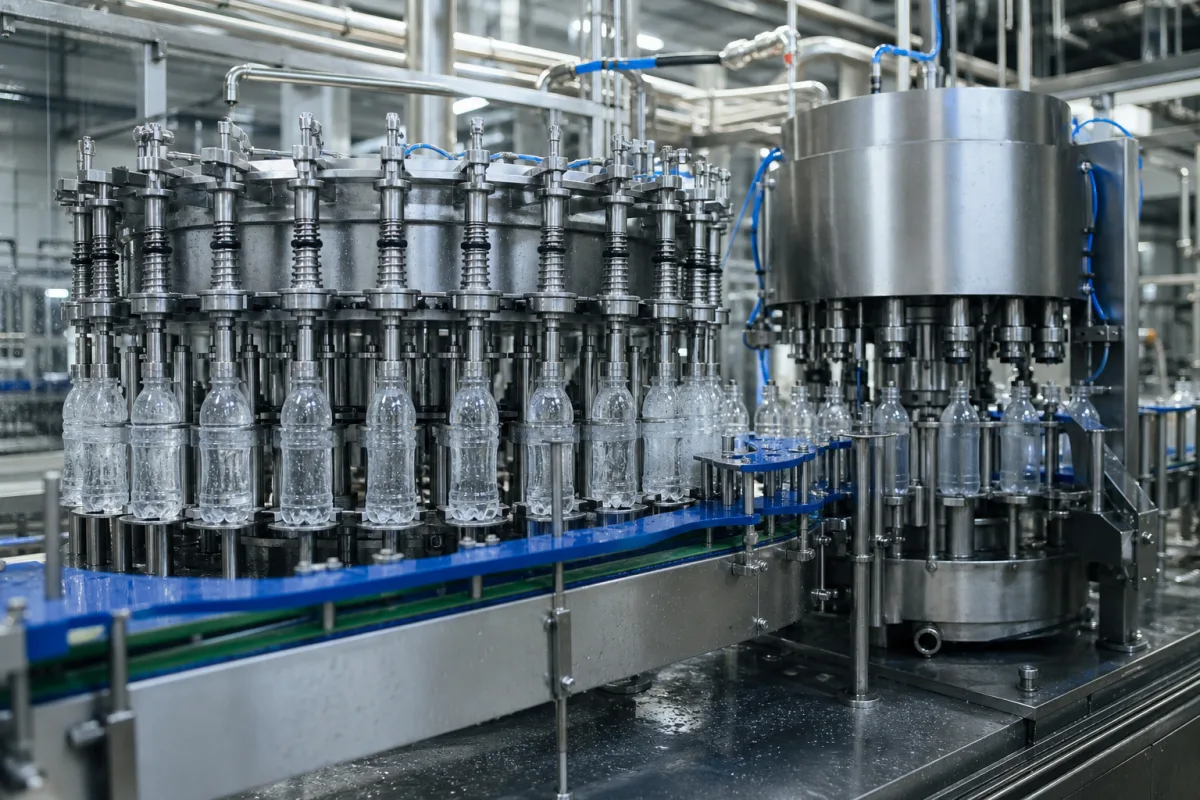
Blow-fill-cap combiblock: PET beverage filling and capping machine fed directly by a stretch blow moulder
Blow-fill-cap combiblocks for PET beverages · Blowing cavities, filling and capping stations, bottle envelope, compressed air and installed power
This page covers the automated filling and capping machine built as a combiblock with a stretch blow moulder: preforms are heated and blown into bottles, and the bottles go straight to the filler and the capper on the same machine. Ask three things first: how many blowing cavities, filling stations and capping heads the block has for your rated output, which bottle and preform envelope it accepts, and how much installed power, operating power and compressed air it needs.
Combined stretch-blow-moulding, filling and capping blocks (blow-fill-cap combiblocks) for still and carbonated beverages in PET bottles. Rotary rinse-fill-cap monoblocks that take bottles already blown elsewhere are covered on the High-speed rotary bottle filling machine page. Stand-alone blow moulders, glass-bottle and can fillers, and aseptic cold-fill lines are outside this page.
CNFX editorial research · Sources checked October 12, 2026 · 3 sources
Size the block: blowing cavities, filling stations and capping heads for the rated output
In a combiblock the blow moulder, filler and capper run as one machine, so each section is sized together. KHS's data sheet for the InnoPET BloFill stretch blow molder/filler/capper monoblock (edition 9/7/15) lists up to 81,000 bph for still beverages and up to 72,000 bph for carbonated beverages, a blow molder of 8–36 cavities, 40–144 filling stations for still beverages and 48–192 for carbonated beverages; the capacity figures carry an asterisk in the data sheet. [1]
At the smaller end, MIC lists a blowing filling capping machine with 8 blowing, 32 filling and 10 capping positions, a rated capacity of 18,000 BPH for 600 ml bottles, gravity filling and 200 kW installed power. [3] Wanplas lists nine BFC Combi-block models from the CGX6-32-10 to the CGX24-80-30 with theoretical capacities of 14,000 to 48,000 bottles per hour for a 500 ml bottle. [2]
Editorial calculation: MIC's 18,000 BPH from 8 blowing positions is 18,000 ÷ 8 = 2,250 bottles per hour per position, and 18,000 ÷ 32 = 562.5 bottles per hour per filling position; at 600 ml it delivers 18,000 × 0.6 = 10,800 L/h of beverage. Wanplas's 48,000 B/H is 800 bottles per minute.
KHS lists low-foam filling at filling temperatures of up to 20 °C for carbonated soft drinks, a volumetric filling system with fill levels determined by IFM, an airlock in the transfer area to the filler, and separation of the wet and dry areas. [1] Editorial note: ask each supplier whether its rated output applies to still or carbonated product and to which bottle size, because KHS publishes different maxima for the two and Wanplas states its figures for 500 ml.
Give the supplier the beverages (still or carbonated, fill temperature), bottle sizes with drawings, preform drawings and weights, neck finish and closure, and the output you need at each bottle size.
02
Check the bottle, preform and utility envelope
The block accepts only bottles and preforms within its stated limits. KHS lists bottle content of 0.2–3.0 l, bottle height 120–360 mm, bottle diameter 40–125 mm, filling temperature 4–20 °C and fill level accuracy of s = 1.0–3.0 ml. [1] Wanplas lists 250–2,000/2,500 ml capacity, 340 mm maximum bottle body height, 100/115 mm maximum body diameter, 150 mm maximum preform height and 38 mm maximum bottle mouth diameter for every model in its table. [2] MIC lists bottle diameters of Φ50–Φ92 mm and heights of 150–320 mm for its 18,000 BPH model. [3]
Utilities scale with the model. Wanplas lists installed capacity rising from 170 kW to 320 kW, operating power from 60 kW to 170 kW, compressed air consumption from 4.8 to 15.6 m³/min and weight from 16 t to 29 t across the range, and states that compressed air recovery reaches up to 30% depending on bottle volume. [2]
Editorial calculation: for the CGX24-80-30, 15.6 m³/min × 60 = 936 m³/h of air for 48,000 bottles per hour, about 19.5 litres of air per bottle at the theoretical rate; the CGX6-32-10's operating power of 60 kW is about 35% of its 170 kW installed capacity, so ask for both figures when sizing the supply. [2]
KHS lists options including hot filling, UV treatment, blowout with ionized air, camera quality control, bottle base cooling and dry air in the blow moulding area and the airlock. [1] MIC states that the combined machine "eliminates the need for air conveyors and multiple transfer points" between blowing and filling. [3]
03
KHS InnoPET BloFill and Wanplas CGX ratings in bottles per hour
Published ratings are tied to a stated bottle size or beverage type; compare them on the same basis.
Editorial calculation: the Wanplas CGX6-32-10 occupies 11.0 × 3.6 = 39.6 m² and the CGX24-80-30 occupies 15.0 × 5.3 = 79.5 m², before conveyors, preform feeding and cap feeding. [2]
Machine
Published rating
Configuration and envelope
KHS InnoPET BloFill
Up to 81,000 bph still; up to 72,000 bph carbonated. [1]
8–36 cavities; 40–144 or 48–192 filling stations; 0.2–3.0 l. [1]
5 companies list this product among what they make. Company figures are quoted from each
company's own website; every card states where the relationship came from.
Zhangjiagang Micmachinery Co., Ltd.
Manufacturing site to be confirmed for the order
Lists a combiblock blowing filling capping machine for PET bottles with 8 blowing, 32 filling and 10 capping positions.
Explore company information and manufacturing capabilities, then discuss the scope of your project with a relevant supplier.
Share this page
Compiled and source-reviewed by the CNFX editorial team.
Each manufacturer above links to the page on that company's own website where the product is listed, with the date we checked it. How we source and review
· Page last updated 13 October 2026
Buyer questions
How fast is a blow-fill-cap combiblock?
Published ratings run from 14,000 bottles per hour at 500 ml (Wanplas CGX6-32-10) to up to 81,000 bph for still beverages on the KHS InnoPET BloFill. [2][1]
What bottle sizes can a combiblock handle?
KHS lists 0.2–3.0 l and bottle heights of 120–360 mm; Wanplas lists 250–2,000/2,500 ml with a 150 mm maximum preform height and 38 mm maximum mouth diameter. [1][2]
How much power and air does a combiblock need?
Wanplas lists 170–320 kW installed, 60–170 kW operating power and 4.8–15.6 m³/min of compressed air across its models. [2]
Sources and what still needs a direct check
Sources checked 2026-10-12. KHS, Wanplas and MIC are machine builders describing their own combiblocks; their ratings are published maxima or theoretical capacities at a stated bottle size.