Structured Manufacturing Data (2026)

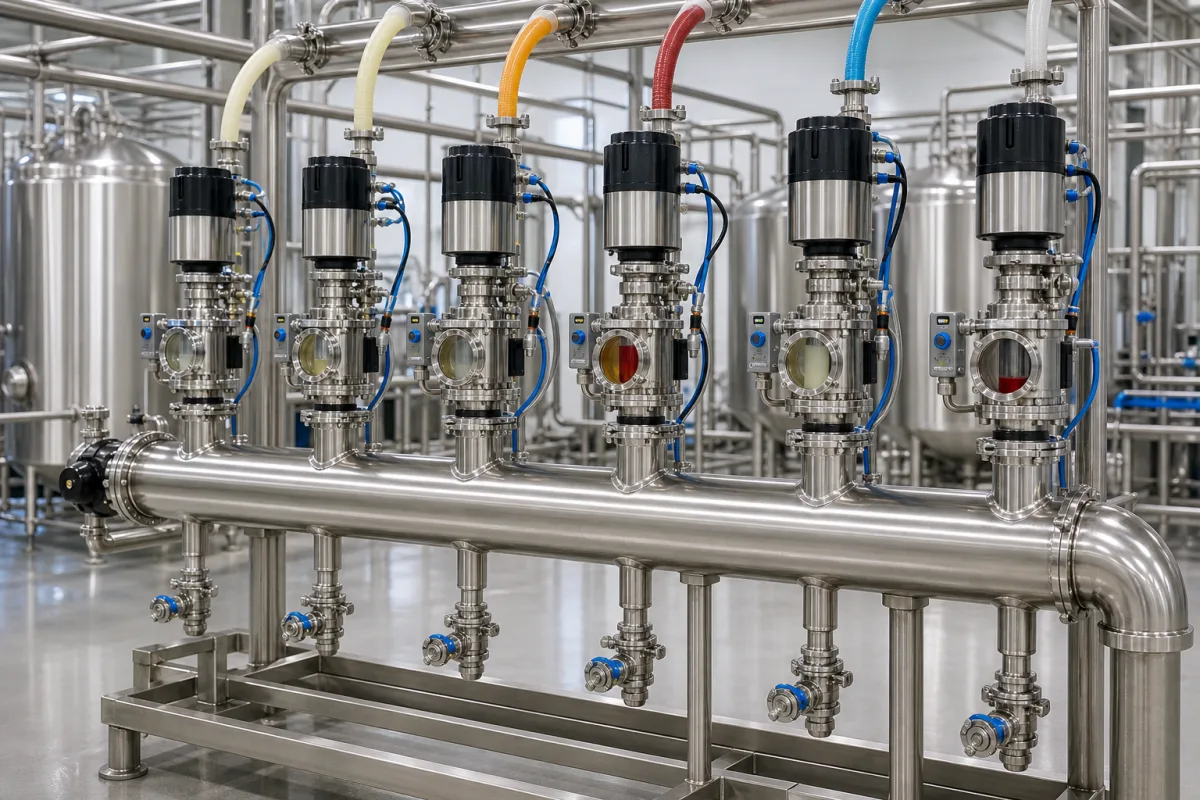
Ingredient Inlet Valve Manifold

Based on aggregated insights from structured factory profiles within the CNFX directory, the standard Ingredient Inlet Valve Manifold used in the Beverage Manufacturing sector typically supports operational capacities ranging from standard industrial configurations to heavy-duty production requirements.

Technical Definition & Core Assembly

A canonical Ingredient Inlet Valve Manifold is characterized by the integration of Solenoid Valve Assembly and Manifold Body. In industrial production environments, manufacturers listed on CNFX commonly emphasize Stainless Steel 316L construction to support stable, high-cycle operation across diverse manufacturing scenarios.

A multi-port valve assembly that controls and directs the flow of liquid ingredients into an automated beverage blending system.
Product Specifications

Technical details and manufacturing context for Ingredient Inlet Valve Manifold

Definition
The Ingredient Inlet Valve Manifold is a critical component of the Automated Beverage Batch Blending System that serves as the centralized entry point for all liquid ingredients. It manages the precise introduction of various components (such as water, syrups, flavorings, and additives) into the blending vessel, ensuring controlled flow rates, preventing cross-contamination between ingredients, and enabling automated sequencing of ingredient addition according to recipe specifications.
Working Principle
The manifold operates through a series of solenoid or pneumatic valves arranged in parallel, each dedicated to a specific ingredient line. When activated by the system's control unit, individual valves open to allow ingredient flow through dedicated ports into a common manifold chamber, which then directs the combined flow to the blending vessel. The valves close sequentially to prevent ingredient mixing in the supply lines and ensure precise volumetric control.
Common Materials
Stainless Steel 316L, Food-grade PTFE, EPDM Seals
Technical Parameters
  • Number of independent ingredient inlet connections supported by the manifold (ports) Customizable
Components / BOM
  • Solenoid Valve Assembly
    Electrically actuated valve that opens/closes individual ingredient lines
    Material: Stainless Steel Body, PTFE Seals
  • Manifold Body Part
    Central chamber that collects and directs ingredient flows
    Material: Stainless Steel 316L
  • Port Connections Part
    Standardized fittings for connecting ingredient supply lines
    Material: Stainless Steel
  • Pressure Sensor Port Part
    Connection point for system pressure monitoring
    Material: Stainless Steel

Industry Taxonomies & Aliases

Commonly used trade names and technical identifiers for Ingredient Inlet Valve Manifold.

Applied To / Applications

This component is essential for the following industrial systems and equipment:

Industrial Ecosystem & Supply Chain Structure

Complementary Systems
Downstream Applications
Specialized Tooling

Application Fit & Sizing Matrix

Operational Limits
pressure: 0 to 10 bar (gauge)
flow rate: Up to 100 L/min per port
temperature: -10°C to 120°C
slurry concentration: Max 40% solids by weight
Media Compatibility
✓ Food-grade syrups and concentrates ✓ Carbonated water ✓ Cleaning-in-place (CIP) solutions
Unsuitable: Abrasive particulate slurries with hardness >5 Mohs
Sizing Data Required
  • Required total flow rate (L/min)
  • Number of ingredient streams to be managed
  • Maximum allowable pressure drop across manifold (bar)

Reliability & Engineering Risk Analysis

Failure Mode & Root Cause
Abrasive erosion
Cause: Particulate-laden ingredient flow causing gradual material wear on valve seats and sealing surfaces, leading to leakage and reduced sealing efficiency.
Cavitation
Cause: Rapid pressure drops across valve orifices during throttling operations, causing vapor bubble formation and implosion that damages internal surfaces and degrades performance.
Maintenance Indicators
  • Audible hissing or whistling indicating gas or liquid leakage past valve seats
  • Visible ingredient residue buildup or weeping at manifold joints and valve stems
Engineering Tips
  • Install upstream filtration to remove abrasive particulates and implement regular valve cycling to prevent material buildup on critical surfaces
  • Optimize manifold piping layout to minimize pressure drops and consider using anti-cavitation trim or staged pressure reduction valves

Compliance & Manufacturing Standards

Reference Standards
ISO 5211:2017 - Industrial valves - Multi-turn valve actuator attachments ANSI/ASME B16.34-2020 - Valves - Flanged, Threaded, and Welding End DIN EN 12266-1:2012 - Industrial valves - Testing of metallic valves
Manufacturing Precision
  • Bore diameter: +/-0.02mm
  • Surface flatness: 0.1mm per 100mm
Quality Inspection
  • Dye Penetrant Test for surface defects
  • Pressure Test (hydrostatic/pneumatic) for leak tightness

Factories Producing Ingredient Inlet Valve Manifold

Manufacturer profiles with relevant production capability in China

Manufacturer listings support early research and capability understanding. They are not certification, ranking, or transaction guarantees.

Technical documentation
4/5
Manufacturing capability
4/5
Inspection readiness
5/5
Supplier transparency
3/5

These scores are example evaluation dimensions, not real customer ratings, country-specific buyer feedback, or live inquiry activity.

Supply Chain Compatible Machinery & Devices

Automated Beverage Filling and Capping Machine

Automated machine for filling and sealing beverage containers at high speed.

Explore Specs →
Automated Beverage Batch Blending System

Automated system for precise multi-ingredient beverage batch preparation.

Explore Specs →
Automated Beverage Container Sterilization System

Automated system for sterilizing beverage containers before filling.

Explore Specs →
Automated Beverage Labeling and Coding System

Integrated system for applying labels and printing codes on beverage containers.

Explore Specs →

Frequently Asked Questions

What materials are used in the Ingredient Inlet Valve Manifold to ensure food safety?

The manifold is constructed with Stainless Steel 316L for corrosion resistance, food-grade PTFE for sealing surfaces, and EPDM seals, all compliant with beverage manufacturing hygiene standards.

How many ingredient streams can this valve manifold control simultaneously?

The manifold features multiple ports (specific number configurable) that allow simultaneous control and direction of different liquid ingredients into your beverage blending system.

What is the maximum pressure rating for this ingredient manifold?

The manifold is rated for high-pressure operation (specific psi rating available) to handle various beverage ingredient viscosities and maintain consistent flow control in automated systems.

Can I contact factories directly on CNFX?

CNFX is an open directory, not a transaction platform. Each factory profile provides direct contact information and production details to help you initiate direct inquiries with Chinese suppliers.

Data Basis

CNFX manufacturer profiles, technical classification, publicly available product information, and ongoing plausibility checks.

Preliminary Technical Classification
This page supports structured research, RFQ preparation, and supplier evaluation. It does not replace buyer-led supplier qualification, standards review, or technical approval.

Request Manufacturing Insight for Ingredient Inlet Valve Manifold

Ask for use case, specification boundaries, supplier type, and RFQ preparation information for Ingredient Inlet Valve Manifold.

Your business information is used only to process this request.

Thank you! Your message has been sent. We'll respond within 1–3 business days.

Need to Manufacture Ingredient Inlet Valve Manifold?

Compare manufacturer profiles with relevant product and process capability.

Create Manufacturer Profile Contact Us
Previous Product
Infeed/Outfeed Conveyor Section
Next Product
Ingredient Storage Tank