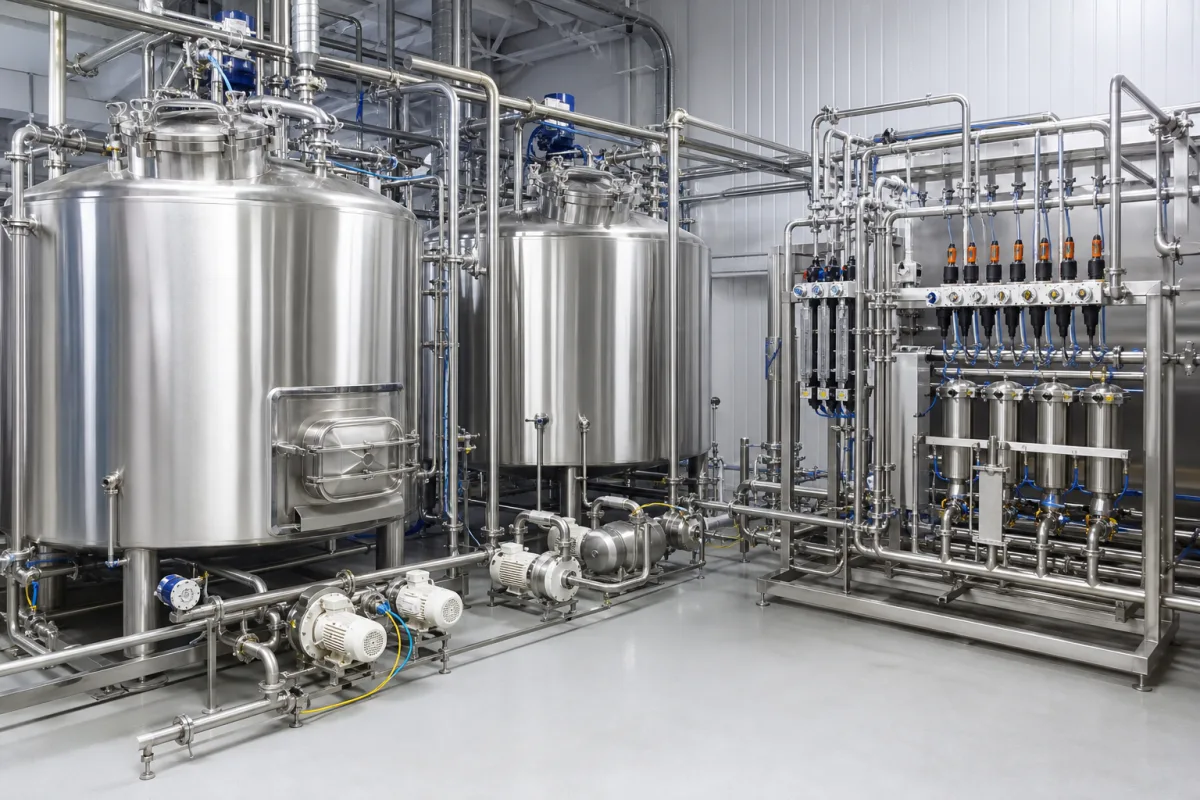
Syrup room and beverage blending · Batch tanks on load cells versus in-line ratio blending, Coriolis mass flow and density for Brix, sugar dissolving and syrup filtration, ingredient streams, recipe control, buffer and recovery tanks
An automated beverage batch blending system is the syrup-room equipment that doses water, sugar or liquid sweetener, concentrates, acids and flavours into mixing tanks or an in-line blender under recipe control, measures the blend — by weight, mass flow and density or Brix — and delivers finished syrup or beverage to the filling line. Ask three things first: whether the recipes suit batch tanks, in-line ratio blending or a combination, how each ingredient will be metered and the blend verified, and what output, changeover and cleaning regime the line needs.
Recipe-controlled blending of beverage syrups and finished drinks: batch mixing tanks with weighing or flow metering, in-line multi-ingredient blenders, sugar dissolving and syrup preparation, and the instruments and controls that hold the recipe ratio. Water treatment plants, pasteurisers, carbonators (see automated beverage carbonation control system), fillers and powder-only batching are outside this page except where compared.
CNFX editorial research · Sources checked October 11, 2026 · 4 sources
Krones describes its SyPro syrup room as modular units for preparing beverage ingredients — powder, liquid or frozen raw materials — into finished syrups or finished products, run either continuously or in batches depending on the manufacturing philosophy, with output adjusted to the line; it offers three mixing concepts: batch mixing of the components followed by a Contiflow mixer for the finished product, a fully automatic recipe-controlled Multiblend system feeding a Contiflow, or the Contiflow used alone as a multi-ingredient mixer combining syrup mixing and finished-product manufacture for up to 8 ingredients. [1]
Sonic Corporation, writing in Processing Magazine, describes the conventional batch method as ingredients added one at a time by weight into a large agitated tank on load cells or floor scales; because the scale must carry the tank's own weight, its resolution for small additions is poor, giving weak ratio control, and flow meters used to add liquids do not account for material left in piping or drains. An in-line system instead meters ingredients simultaneously with positive-displacement pumps, flow meters and PID ratio control into one shared pipeline with static or shear mixers, and the article puts ratio control at 0.25–0.35% across two or more feeds with Coriolis meters, and up to four fluids at 100 GPM total flow under 10 HP in some cases. [2]
Editorial calculation: 100 US gal/min × 3.785 L/gal × 60 min/h ≈ 22,700 L/h, which sits just above the smallest in-line blender capacity Tetra Pak lists (20,000 l/h). [2][4]
Editorial note: the Krones three-concept description shows that batch preparation of a syrup and in-line dilution to finished beverage can be combined in one syrup room; decide per recipe which ingredients are batched and which are blended in line.
Give the supplier the recipe list (ingredients, ratios, Brix or density targets, viscosities, powders or frozen concentrates), batch sizes or line output in l/h, number of products and changeovers per day, sugar supply (crystalline, liquid, silo), required verification (weight, mass flow, density, Brix, lab sampling), tank and buffer volumes, CIP regime, materials and finishes, control system and data interfaces, and the space and utilities available.
02
Set the metering, Brix control and recovery
KROHNE reports a European juice producer that doses fruit-juice concentrate, vitamins and other additives into mixing tanks and then adds water according to the sugar content (Brix); it fitted OPTIMASS 7300 Coriolis meters that measure mass and volume flow of the additives and use their integrated density measurement to calculate sugar concentration, with a single straight measuring tube chosen because the slightly viscous media needed a meter without constrictions or bends and with very little pressure loss; the customer's PLC controls dosing and mixing automatically, and the meter is certified to EHEDG and 3A. [3]
Tetra Pak describes its Tetra Alblend Final Syrup unit as continuous blending in 20,000, 40,000 and 60,000 l/h ranges (other capacities on request) with up to 10 ingredient streams and minimum dosing of 10 l/h; software calculates and corrects the amount of each ingredient, checks run 4–5 times per second, a sensor monitors Brix or density in the buffer tank, the buffer evens out start and end of a run and lets production continue for a time if the filler stops, and a recovery system returns lost product to the blender. [4]
Krones lists the sugar side of a syrup room as a receiving station for liquid sugar or a silo, dissolving in batch or continuously depending on quantity and economics, and filtration for decolouration or cleaning by candle, sheet, ion-exchange, kieselguhr or activated-carbon filters; stirring and mixing equipment for concentrates and powders is designed for viscosity, batch size and solubility, with suction lances, drum dumpers and crushers and melters for deep-frozen concentrates. [1]
03
Load-cell tanks, metered additions, batch syrup with in-line dilution, and continuous ratio blending
Krones runs batch syrup preparation and in-line dilution to finished beverage in one syrup room, so a plant can use more than one row of this table. [1]
The first two rows depend on how sugar arrives: Krones receives liquid sugar or sugar from a silo and dissolves it in batch or continuously according to quantity and economics, then filters it by candle, sheet, ion-exchange, kieselguhr or activated-carbon filters. [1]
Output, ingredient lines, ratio accuracy and recipe control for a syrup room
The 0.25–0.35% ratio figure comes from an article by a blending-system maker, measured across two or more feeds with Coriolis meters, not from a test on your recipes; ask for the accuracy at your smallest ingredient dose. [2]
Field
What it means and published values
Ask the supplier for
Max batch volume / output
Tank size or l/h; in-line ranges of 20,000–60,000 l/h in one range. [4]
Volume or l/h for your line.
Number of ingredient lines
Up to 8 in one mixer; up to 10 streams in another. [1][4]
Lines and spare capacity.
Metering accuracy
0.25–0.35% ratio with Coriolis meters, per one article. [2]
Accuracy per ingredient and blend.
Control interface
PLC with HMI and drives in one description; recipe control. [2][1]
PLC, HMI, MES links.
Recipe storage capacity
Number of stored recipes.
Recipes and versioning.
Operating pressure
Line pressure of the blend and utilities.
Design pressure.
Operating temperature
Product and CIP temperatures.
Temperature limits.
Power supply
Voltage and frequency for pumps and controls.
Supply and installed power.
Ingress protection
Protection of electrical parts in wash-down.
IP rating of panels and motors.
Material of wetted parts
Contact materials; hygienic certification of instruments is stated by one maker. [3]
Grades, finish, hygienic design.
Weight / footprint
Skid or room size.
Dimensions and weights.
06
Send the recipes, output and verification needs together
Paste it into your enquiry below or into an email to a maker, then replace every bracket.
Recipes: [ingredients; ratios; Brix or density targets; viscosity]
Output: [batch volume or l/h; products; changeovers]
Sugar: [crystalline; liquid; silo; dissolving]
Metering: [weighing; mass flow; density; Brix]
Tanks: [mixing; syrup; buffer; recovery]
Controls and cleaning: [PLC; recipes; CIP]
Supply: [materials; utilities; documents]
Find automated beverage batch blending system manufacturers
2 companies list this product among what they make. Company figures are quoted from each
company's own website; every card states where the relationship came from.
Zhangjiagang Lvye Machinery Co.,Ltd.
Manufacturing site to be confirmed for the order
Lists beverage blending systems with sugar dissolving, juice and powder reconstitution, blending to volume and CIP units.
Explore company information and manufacturing capabilities, then discuss the scope of your project with a relevant supplier.
Share this page
Compiled and source-reviewed by the CNFX editorial team.
Each manufacturer above links to the page on that company's own website where the product is listed, with the date we checked it. How we source and review
· Page last updated 13 October 2026
Buyer questions
Why can a batch tank on load cells blend small ingredients poorly?
The scale must carry the tank's weight, so its resolution for small additions is low, which weakens ratio control. [2]
How is Brix measured in an automated blending system?
One example uses Coriolis meters whose density measurement calculates sugar concentration; another monitors Brix or density in the buffer tank. [3][4]
Can a syrup room combine batch and in-line mixing?
Yes. Krones describes batch mixing of components followed by an in-line Contiflow mixer as one of three concepts. [1]
Sources and what still needs a direct check
Sources checked 2026-10-11. The Krones brochure, Tetra Pak page and KROHNE note describe their own equipment, and the Processing Magazine article is written by a blending-system maker; values for your recipes must come from the supplier offered.