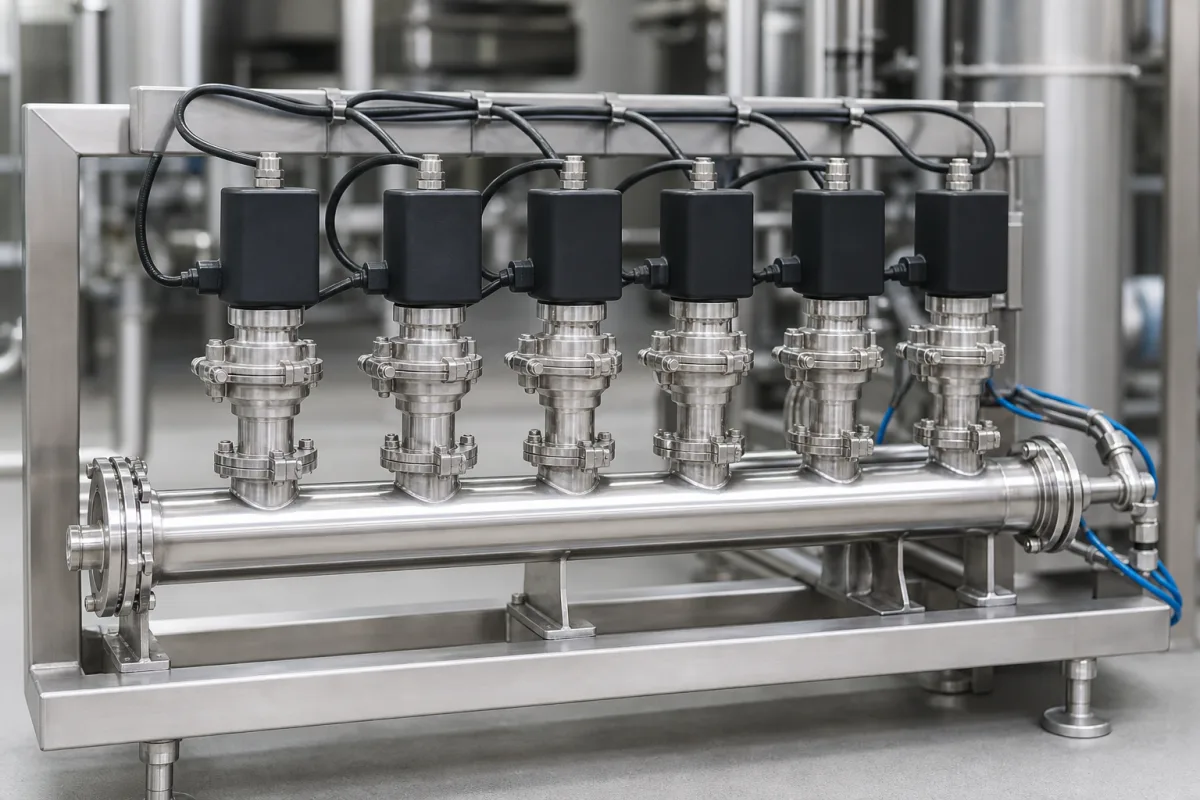
Solenoid valve manifold assembly for ingredient dosing
Ingredient dosing manifold · Two or more solenoid valves on one stainless header: flow per valve, pressure and temperature, and food-contact seals
A solenoid valve manifold assembly for ingredient dosing is a set of solenoid valves mounted on a shared header or block, wired to one controller, so that water, syrups, flavours or other liquid ingredients can be released through separate outlets for set times. Ask three things first: what flow each valve must pass at the available pressure, what media and cleaning temperatures the valves and seals see, and which food-contact rules the wetted seals and seats must meet.
Assemblies of two or more solenoid valves on a shared header, manifold block or frame, with wiring and connections, used to dose liquid ingredients in food, beverage and similar process plants. Single on-off solenoid valves, with their operating principles, coils and seals, are covered on the Solenoid valve page. Pneumatic valve islands, proportional dosing valves and complete dosing skids with pumps and tanks are outside this page.
CNFX editorial research · Sources checked October 12, 2026 · 4 sources
Size the flow, pressure and temperature for each dosing valve
Danfoss lists its EV210BW 1.5–6 as a direct-operated 2/2-way solenoid valve for universal use, naming dosing applications and food processing among its uses. The valve has a flow range of Kv 0.08 to 0.7 m³/h, a differential pressure range of 0 to 10 bar, a media temperature range of –30 °C to 90 °C, ambient temperature up to 50 °C, thread connections G 1/8, G 1/4 and G 3/8, and a clip-on coil with enclosure up to IP67. [1]
Its body is lead-free, dezincification-resistant ECO brass with EPDM seals recommended for drinking water, and Danfoss states that the wetted materials meet the drinking-water rules of Germany (DVGW W270), the Netherlands (KTW), France (ACS), the UK (WRAS) and Denmark. [1] A brass body is a drinking-water choice; where the manifold header is stainless steel, as in hygienic dosing frames, ask whether stainless valve bodies are available for the same flow range.
Editorial calculation: with the conversion Cv ≈ 1.156 × Kv, the 0.08–0.7 m³/h range is about 0.09–0.81 Cv. Valves that open together on one header add their flow capacities, so six valves at Kv 0.7 can call for up to 6 × 0.7 = 4.2 m³/h from the header at the same pressure drop; size the header and supply for the number of valves that can be open at once. [1]
Give the supplier the number of valves and outlets, each ingredient and its viscosity and temperature, the flow and dose volume per outlet, the supply pressure and allowable pressure drop, the cleaning method and temperatures, the coil voltage and enclosure rating, the header material and connection type (thread or clamp), the frame and mounting, and the food-contact documents required for every wetted part.
02
Qualify the food-contact seals and seats
In the United States, elastomer seals that contact food repeatedly fall under 21 CFR 177.2600. Its list of permitted elastomers includes ethylene-propylene copolymer elastomers (with limits on certain diene units), vinylidene fluoride-hexafluoropropylene copolymers, silicone elastomers, natural rubber and acrylonitrile-butadiene copolymer, among others. [2]
For aqueous food, the food-contact surface of the finished rubber article, extracted with distilled water at reflux, must yield total extractives not exceeding 20 mg per square inch in the first 7 hours and 1 mg per square inch in the following 2 hours. For fatty food the test uses n-hexane at reflux and the limits are 175 mg per square inch in the first 7 hours and 4 mg per square inch in the next 2 hours. [2] Editorial calculation: 20 mg/in² ÷ 6.4516 cm²/in² = 3.1 mg/cm².
Valve seats and plunger seals made of PTFE and other perfluorocarbon resins fall under 21 CFR 177.1550 instead. It requires molded articles of at least 100 in² (6.45 dm²) and 1.27 mm thickness to be extracted at reflux for 2 hours separately with distilled water, 50% ethanol, n-heptane and ethyl acetate, and sets extractability limits of 3.1 mg/dm² (0.2 mg/in²) total extractives and 0.46 mg/dm² (0.03 mg/in²) fluoride. [3] Editorial note: the fatty-food limit for rubber is higher than the aqueous one, so ask which test the seal supplier's declaration covers and match it to the ingredients being dosed.
03
Compare seal and seat materials by the rule that covers them
The seal materials named in the component list for this product map onto two FDA sections. The table states only what the sections and the Danfoss listing say.
Material
Where it appears
Rule or published note
EPDM (ethylene-propylene)
Diaphragm and seat seals; Danfoss uses EPDM for drinking water [1]
Explore company information and manufacturing capabilities, then discuss the scope of your project with a relevant supplier.
Share this page
Compiled and source-reviewed by the CNFX editorial team.
Each manufacturer above links to the page on that company's own website where the product is listed, with the date we checked it. How we source and review
· Page last updated 13 October 2026
Buyer questions
What flow does a small dosing solenoid valve pass?
Danfoss lists its EV210BW 1.5–6 dosing-capable valve at Kv 0.08–0.7 m³/h with a 0–10 bar differential pressure range. [1]
Which FDA rule covers rubber valve seals for food?
21 CFR 177.2600 covers rubber articles for repeated use; for aqueous food, extractives must not exceed 20 mg/in² in the first 7 hours and 1 mg/in² in the next 2 hours. [2]
Which rule covers PTFE seats?
21 CFR 177.1550 covers perfluorocarbon resins, with extractability limits of 0.2 mg/in² total and 0.03 mg/in² fluoride. [3]
Sources and what still needs a direct check
Sources checked 2026-10-12. 21 CFR 177.2600 and 177.1550 are US Food and Drug Administration regulations; Danfoss and Airkert describe their own solenoid valves.