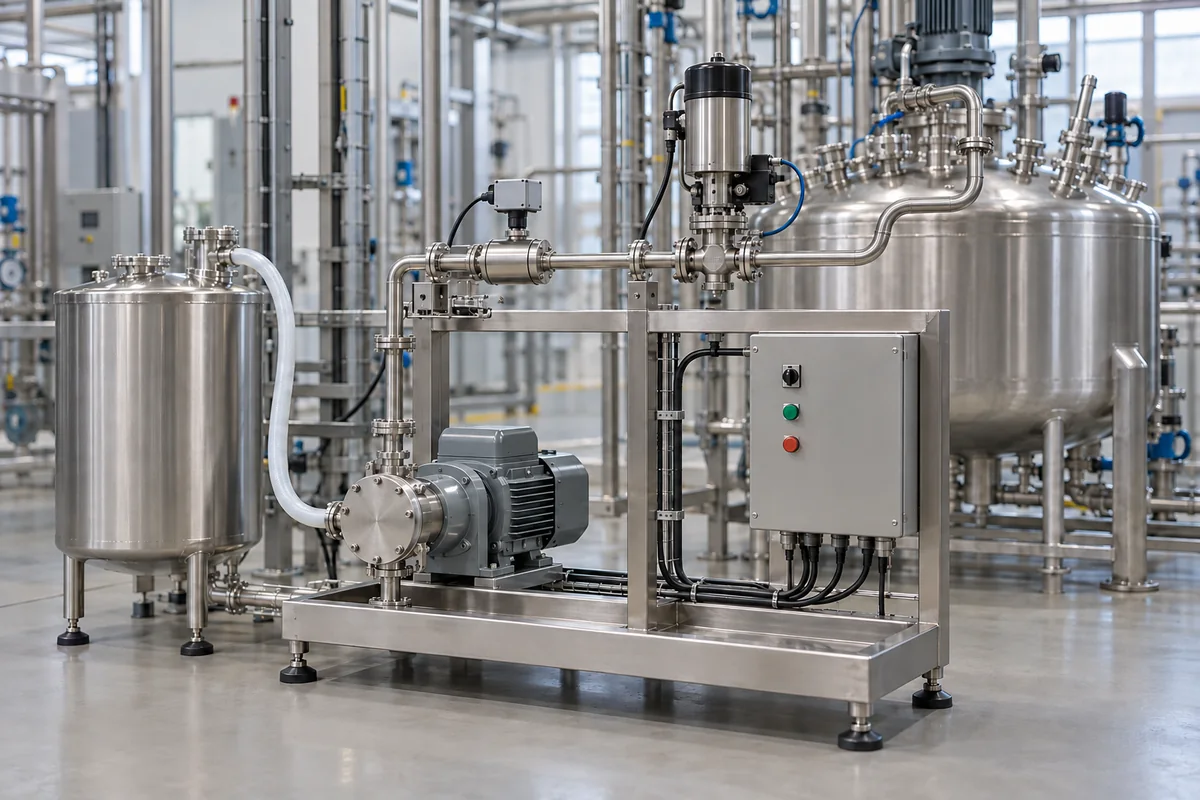
An emulsifier dosing unit delivers a recipe quantity of emulsifying agent into the aqueous phase before it reaches the bitumen emulsion mill. The purchase boundary includes chemical storage, the measured feed, dedicated delivery lines and the receiving batch-tank interface. Emulsification in the mill is a separate operation.
An emulsifier feed and weighing unit that delivers recipe quantities into water-phase batch tanks before bitumen emulsification. Metering pump, product 4303, covers individual pump mechanisms; Chemical dosing pump skid, product 822, covers water-treatment packages. CIP chemical dosing unit, product 2856, covers detergent and sanitizer strength control. Automated beverage batch blending system, product 130, covers beverage formulation rather than bitumen-emulsion water-phase preparation.
The chemical storage tanks feed the water-phase batch tanks
DenimoTech’s BFA Compact process description separates chemical storage in the optional Easy Weigh Unit from the water-phase preparation tanks. Emulsifier, acid and stabilizer enter the water phase; the prepared water phase then meets bitumen at the mill. The plant uses two water batch tanks so that preparation and supply can alternate. [1]
Keep emulsifier concentrate, prepared aqueous phase and finished emulsion as distinct streams on the process drawing. A.P. Technic describes variable-frequency-driven bitumen, soap and emulsifier pumps on its emulsion plants. That identifies separate duties; it does not provide a shared pump size or a universal dosing-accuracy figure. [3]
02
A minimum display value is not a percentage dosing accuracy
DenimoTech’s EWU-IBC-4 example uses load cells beneath the storage frame, PLC-controlled feed pumps and a separate delivery line for each chemical. Its recipes use direct mass measurement. The technical table separates minimum display from repeatability; neither should be rewritten as a relative accuracy guarantee. [2]
Agree the smallest recipe addition, the required delivered-mass tolerance and the acceptance test. Specify how the unit handles valve closure, remaining chemical in the delivery line and an interrupted batch. The published display and repeatability fields alone do not answer those application questions.
An absolute mass statistic, not percentage accuracy.
03
How much emulsifier per tonne, at what pH, and how often the IBC empties
The dosing unit has to cover the dose range of the emulsifier grade in use. Two Nouryon technical bulletins for liquid cationic emulsifiers give the recipe window as a percentage of the finished emulsion, together with the hydrochloric-acid pH of the soap phase and the handling data that decide whether the storage IBC needs heat. [4][5]
Editorial calculation: DenimoTech rates its BFA Compact batch plant at 6–12 t/h of emulsion. [1] At 12 t/h a rapid-set recipe with C-580 at 0.20–0.35% draws 24–42 kg of emulsifier per hour, so one 907 kg IBC lasts roughly 22 to 38 hours of production; at 6 t/h the draw halves and the IBC lasts twice as long. Those figures set how often the refill or IBC change happens and how large the reorder buffer has to be.
Nouryon notes that changing the pH at a given emulsifier dose also changes emulsion viscosity, demulsibility and particle size, and that the optimum dose depends on the binder and should be set by laboratory trials; SBS-modified binders may need more emulsifier. [4] The acid line on the water-phase tank therefore needs the same recipe discipline as the emulsifier line.
Handling temperature matters for the feed pump. C-580 is stored at 10–30 °C, and EM24 at 15–35 °C with a pour point of 10 °C. [4][5] DenimoTech offers each IBC position with an agitator, heating elements and insulation as options, which is where a grade with a high pour point is kept pumpable in a cold plant. [2]
On refill and valve position: the Easy Weigh Unit sequence starts with filling the IBC and then opening the IBC valve before the PLC-controlled pump transfers chemical to the water-phase tank, while the load cells under the frame track the mass leaving. [2] Where the search is for a refill valve position sensor, the practical point is that the PLC should see the valve open, and see the IBC mass fall once the pump runs, before it counts a dose as delivered; ask the supplier which of those two signals the control logic uses.
04
Confirm the receiving-tank arrangement before accepting compatibility
The BFA Compact brochure describes the Easy Weigh Unit as fitting batch emulsion plants regardless of brand. The dedicated EWU sheet states compatibility with DenimoTech batch plants. These are different stated scopes; require a connection and control-interface review for a plant from another manufacturer. [1][2]
The BFA Compact brochure makes automatic switching between the water-phase tanks optional. Its chemical quantities are documented in the PLC. Specify which controller owns the recipe, which receiving tank is enabled, and whether switching is manual or actuated. [1]
A.P. Technic places metered feed within an automated emulsion production unit. Keep the requested emulsifier package distinct from the mill, bitumen feed and finished-product storage when defining the supply boundary. [3]
05
Define the emulsifier addition and the receiving batch-tank interface
Paste it into your enquiry below or into an email to a maker, then replace every bracket.
Formulation: [emulsifier grade; dose % per emulsion type; soap pH and acid; pour point]
Consumption: [plant t/h; hours per day; IBC or bulk size; refill signal]
Recipe: [minimum/maximum mass addition; sequence; delivered-mass tolerance]
Storage: [IBC/tank; heating or agitation; containment]
Delivery: [dedicated line; receiving tank; valve arrangement; drain/flush]
Measurement: [mass basis; acceptance test; line hold-up]
Controls: [recipe owner; tank enable; batch switching; interruption recovery]
Boundary: [chemical feed unit versus water-phase tanks and mill]
Explore company information and manufacturing capabilities, then discuss the scope of your project with a relevant supplier.
Share this page
Compiled and source-reviewed by the CNFX editorial team.
Each manufacturer above links to the page on that company's own website where the product is listed, with the date we checked it. How we source and review
· Page last updated 11 November 2026
Buyer questions
Does the dosing unit make the final bitumen emulsion?
In the BFA process, the chemical unit supplies ingredients to the water phase. The mill subsequently combines the water phase and bitumen; it is a separate equipment duty. [1]
Can the minimum display value be quoted as the delivered-dose accuracy?
The EWU table lists minimum display and repeatability as separate mass quantities. A delivered-dose tolerance needs its own defined acceptance conditions. [2]
How much emulsifier goes into a cationic bitumen emulsion?
Nouryon gives 0.20–0.35% of C-580 or 0.18–0.25% of EM24 for rapid-set emulsions and up to 0.60% for medium-set grades, with the soap phase acidified with hydrochloric acid to about pH 2–3. [4][5]
How long does one IBC of emulsifier last?
Editorially, about 22–38 hours at 12 t/h for a 907 kg IBC dosed at 0.20–0.35%, and twice as long at 6 t/h. [4][1]
Sources and what still needs a direct check
Sources checked 2026-11-11T05:07:56+08:00. The DenimoTech documents describe a particular chemical weighing unit and its batch-plant integration. A.P. Technic confirms separate emulsifier, soap and bitumen feed duties in an emulsion production unit. Nouryon's technical bulletins give doses, pH and handling data for two of its own emulsifiers.