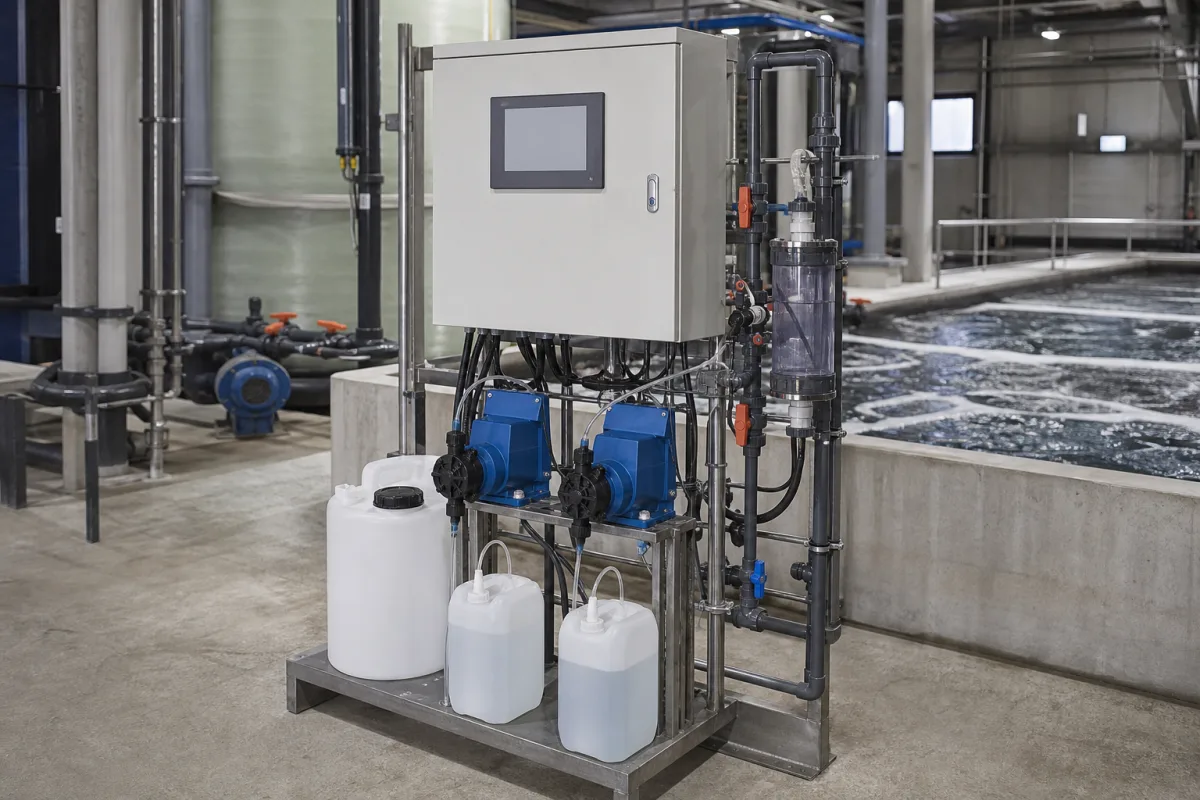
Automated pH monitoring and dosing systems · Discharge limits that set the target, number and size of neutralisation tanks, time delay in mixing and measurement, proportional dosing and alarms, pump flow against back-pressure, recorder output
An automated pH monitoring and dosing system measures the pH of a process or waste stream with an online electrode and controller and drives a metering pump that adds acid or alkali to hold the pH at a set point, with alarms and records; larger duties put the control in one or more stirred tanks in series. Ask three things first: what pH limit the outlet must meet and how far and how fast the inlet pH swings, how many tanks, what volume and what loop delay the control needs, and what controller, pump capacity, wetted materials and outputs the installation requires.
Packaged and engineered pH control systems with online pH measurement, controller, reagent metering pumps, reagent tanks and, for continuous neutralisation, mixing tanks. pH electrodes and metering pumps sold alone have their own pages; laboratory pH meters, ORP-only and chlorine dosing systems are outside this page except where compared.
CNFX editorial research · Sources checked October 11, 2026 · 4 sources
Set the pH target and size the neutralisation tanks
In the US, 40 CFR 403.5(b)(2) prohibits introducing into a publicly owned treatment works pollutants that cause corrosive structural damage and, in any case, discharges with pH lower than 5.0 unless the works is specifically designed to accommodate them; local limits and permits can add further requirements, so the outlet target comes from the permit for the site. [1]
Faanes and Skogestad (NTNU, Computers and Chemical Engineering 28, 2004) give control as a reason for carrying out neutralisation in a series of mixing tanks with gradual concentration change. Delays from mixing, measurement and valve or pump response limit how fast feedback can act; they assume an effective delay of 10 s in each tank. For a flow of 0.01 m³/s and a disturbance gain of 2.5 × 10⁶ (strong acid to pH 7 ± 1), their reference total volume falls from 250,000 m³ with one tank to 316 m³ with two, 40.7 m³ with three, 15.9 m³ with four and 9.51 m³ with five; they recommend identical tanks with a total volume of twice this reference value and advise keeping measurement delay as small as possible. [2]
Editorial calculation: doubling the paper's reference values gives about 632 m³ for two tanks and 81 m³ for three at 10 L/s; 81 m³ at 0.01 m³/s is a residence time of about 8,100 s (2.25 h). The numbers apply to the paper's strong acid case; ask the designer to calculate the disturbance gain, delay and tank count for your stream, buffering and reagent. [2]
Editorial note: weak acids, bases and buffering chemicals change the titration curve; give the supplier a titration curve of the real stream with the chosen reagent.
Give the supplier the stream flow (normal and peak), inlet pH range and how fast it changes, titration curve with the chosen reagent, outlet pH limit and permit, reagents and concentrations, temperature, solids and fouling, tank sizes available, hazardous area, power supply, outputs and data logging needed, and wetted-material requirements.
02
Check where the outlet set point may move
The outlet set point comes from the discharge route. For a US sewer connection the federal floor is pH 5.0. [1] For direct discharge, Meng and Jiao (Xiamen University, The Innovation, 2025) reviewed effluent standards across Asia, the Americas, Europe and the Global South and report lower pH limits set at 6.0, or lower in some instances, against natural seawater at about pH 8.1. They calculate that wastewater at pH 6.0 holds about 158 times more hydrogen ions than seawater at pH 8.2, and they propose a minimum effluent pH above 8.0 for marine outfalls, which would cut hydrogen ion concentration about 100-fold relative to pH 6.0. [4]
Editorial note: the proposal is a policy perspective, not an adopted rule, but it shows why a dosing system should allow the set point and alarm limits to be changed without hardware changes. In Faanes and Skogestad's method, the required volume per tank is proportional to flow, loop delay and the scaled disturbance gain kd raised to the power 1/n, and kd scales the outlet by the maximum tolerated effluent concentration, so ask the supplier to re-run tank sizing for any new set point. [4][2]
Alkali dosing to above 8.0; check the upper permit limit too.
03
Choose the controller, dosing pump and outputs
Hanna Instruments' BL7916 pH controller and pump combines measurement and dosing in one unit: 0.00–14.00 pH range, 0.01 pH resolution, ±0.01 pH accuracy, 10¹² Ω input impedance, proportional dosing selectable for acid or base that slows the pump as pH approaches the set point to avoid over-dosing, an alarm contact that operates when pH is more than 2 pH units from the set point, auxiliary contacts for a mixer or priming pump, and an isolated 4–20 mA recorder output; listed pump flow rates run from 13.3 down to 7.8 L/h, at 0–50 °C and up to 95% RH. [3]
Faanes and Skogestad show that local PI or PID control in each tank can hold the outlet within limits when the tanks are sized for the loop delay; they prefer adding a single reagent type where possible to save equipment, which requires a nominal reagent flow and different pH set points in each tank. [2]
Editorial note: the pump's listed flow falls across its five values, so ask the supplier for the flow at your injection back-pressure and confirm that the maximum reagent demand at peak flow and worst-case inlet pH stays inside the pump's range.
04
Sourcing the controller, pump and tanks
No dosing-system maker is linked to this page yet. The Hanna BL7916 figures cited above describe one controller-and-pump unit; the mixing tanks, mixers and reagent storage listed below are separate items to specify. [3][2]
05
Electrode, controller, pump, tanks and recorder output
The mixing tanks are the row the Faanes and Skogestad sizing changes; the instrument rows follow the Hanna unit. [2][3]
Explore company information and manufacturing capabilities, then discuss the scope of your project with a relevant supplier.
Share this page
Compiled and source-reviewed by the CNFX editorial team.
Each manufacturer above links to the page on that company's own website where the product is listed, with the date we checked it. How we source and review
· Page last updated 13 October 2026
Buyer questions
What pH can be discharged to a US sewer?
40 CFR 403.5 prohibits discharges below pH 5.0 to publicly owned treatment works unless the works is designed for them; local permits can be stricter. [1]
Why use more than one neutralisation tank?
In one strong-acid example at 10 L/s, the reference tank volume fell from 316 m³ with two tanks to 40.7 m³ with three. [2]
How does proportional dosing avoid overdosing?
It slows the pump as the measured pH approaches the set point. [3]
What effluent pH limits apply outside the US sewer rule?
Meng and Jiao report that the effluent standards they reviewed in Asia, the Americas, Europe and the Global South set the lower pH limit at 6.0 or lower; they propose above 8.0 for marine outfalls. [4]
Sources and what still needs a direct check
Sources checked 2026-10-11. 40 CFR 403.5 is a US federal pretreatment rule; the NTNU paper gives a design method with a worked strong-acid case; the Hanna page describes one controller-and-pump unit; the Xiamen University perspective reviews effluent pH limits. Your system design must come from your stream data, permit and the supplier.