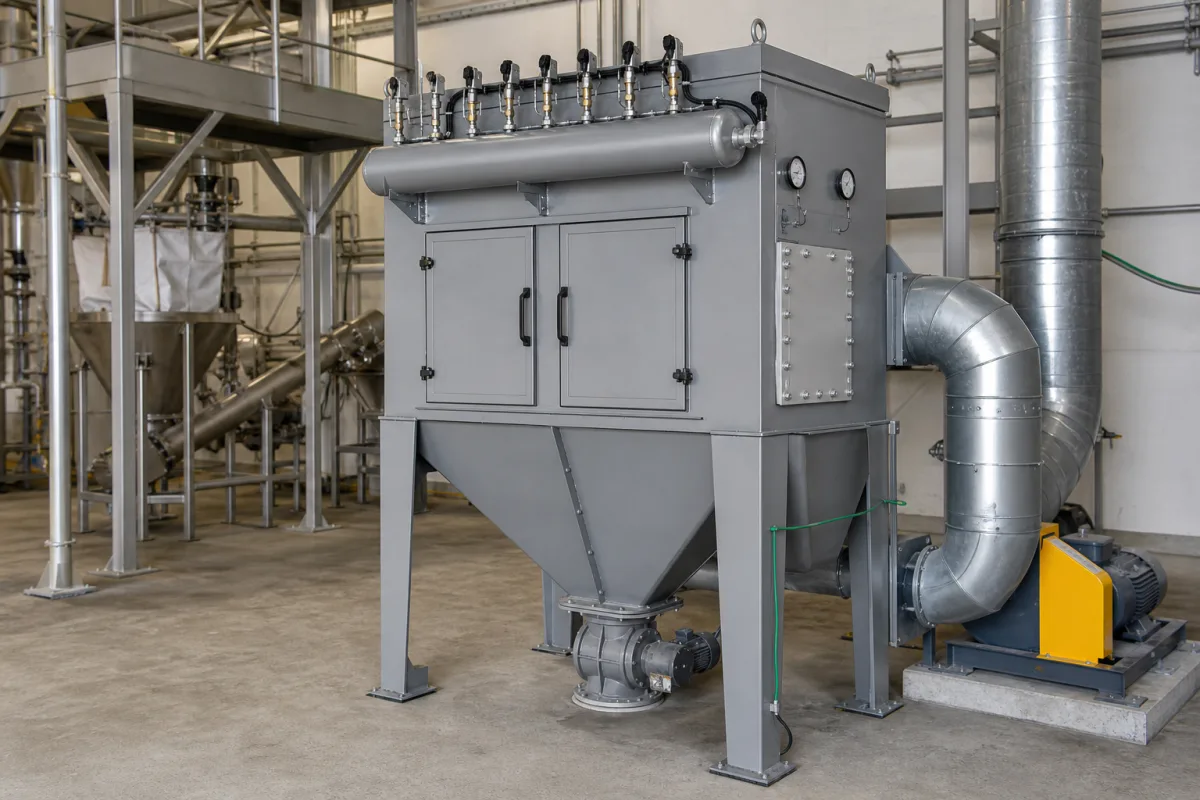
Dust collection unit for catalyst loading, unloading and screening: negative-pressure capture at the chute and drum, metal dust limits and self-heating fines
Catalyst handling in refineries and chemical plants · extraction at the dump chute, loading hopper and drum, metal-bearing dust limits, and self-heating spent catalyst
When a hydrotreater, reformer or other fixed-bed reactor is emptied, refilled or screened, catalyst pellets abrade and the fines become airborne at every transfer: big bag to hopper, hopper to reactor, dump nozzle to drum. The dust collection unit for this work is a compact filter unit with its fan, pulse-cleaned filters and a discharge valve over a drum, connected to sleeves and hoods at those transfer points. What sets it apart from a general workshop collector is the dust: metal-bearing, sometimes carcinogenic, sometimes self-heating in air, and worth reclaiming.
Filter units used to extract and collect catalyst dust during reactor loading, unloading, screening and drumming of fixed-bed catalysts in refineries and chemical plants: capture at chutes, hoppers, sleeves and drums, filtration and fines collection, exposure limits for catalyst metals, and handling of self-heating or pyrophoric spent catalyst. Collector type selection, air-to-cloth ratio and combustible dust measures for process and workshop dust collectors are covered on the Dust collector page; pulse-jet valves and headers on the Pulse-jet cleaning system page; hood, duct and fan networks on the Dust extraction system and Industrial exhaust system pages; potent pharmaceutical powders on the Potent-powder containment page; woodworking and steel melt-shop collection systems on their own pages.
CNFX editorial research · Sources checked October 13, 2026 · 3 sources
Capture at the dump chute, loading hopper, vacuum cyclone and drum
The European Catalyst Manufacturers Association (Catalysts Europe, part of Cefic) lists the points of highest exposure. In loading: pre-bagging into the intermediate lifting hopper, transfer from hopper or big bag to the loading hopper or vessel, the manway, and inside the reactor. In unloading: the manway, work inside the vessel, the dump nozzles and spent-catalyst packaging area, the outlet of the vacuum cyclone where spent catalyst is packaged, and the dust collection and vacuum system bag house when it is cleaned. [1]
CONCAWE's 1995 report on refinery catalyst handling sets out how the capture should work. During unloading, the dumping chute and its drum or container are enclosed in a close-weave cloth or metal sleeve; if the sleeve is kept under negative pressure, the exhausted air is filtered through high-efficiency filters before release. The extract fan should sit as close as possible to the filter to keep the length of duct under positive pressure short, and the filtered dust and fines are collected in a drum or other container for reclamation. Screening equipment is run the same way, under negative pressure with a sleeve around the discharge chute and drum. [2]
The ECMA guide's checklist asks for dust removal equipment at the pre-bagging area, the reactor loading point, other reactor openings, the reactor discharge point and the receiving drum, plus a maintenance and cleaning programme for that equipment and direct loading of the collected dust into a receiving vessel such as a drum. [1]
List every transfer point the unit must serve, whether loading, unloading or screening, the sleeve or hood at each, and how collected fines leave the hopper: straight into a drum, closed, for reclamation.
02
Nickel at 1 mg/m³ and cobalt at 0.1 mg/m³, against 15 mg/m³ for nuisance dust
CONCAWE describes fixed-bed catalysts as an alumina or silica-alumina support with metals or metal salts, ranging from 100% aluminium oxide to 50% nickel or chromium on alumina, with zinc oxide, cobalt, molybdenum and silica also used. [2] OSHA's Table Z-1 sets 8-hour limits for the metals involved. [3]
Editorial calculation: assuming the dust has the same composition as a catalyst that is 50% nickel, the upper end in CONCAWE's description, 2 mg/m³ of total dust already holds 1 mg/m³ of nickel, the OSHA limit; that is 7.5 times lower than the 15 mg/m³ that applies to unregulated particulates. For a cobalt-bearing catalyst the margin is tighter still. The metal content of the actual catalyst, from its safety data sheet, sets the capture and filtration required. [2][3]
Spent catalyst adds other substances. The ECMA guide names residual chemicals from the process stream, such as benzene, butadiene or ethylene oxide, and incidental substances formed in the reactor, such as nickel carbonyl and vanadium carbonyl; CONCAWE notes that nickel subsulphide, a suspected carcinogen, may be found in minute quantities in some spent catalyst. [1][2]
Self-heating spent catalyst: nitrogen at the reactor, nitrogen in the drum, and a 2% oxygen limit
ECMA defines self-heating catalysts as mixtures that, in large quantities and over hours or days, can heat up in contact with air without an energy supply; this can include some fresh and spent catalysts, because the catalyst is in a reduced state or contaminated with iron sulphide. Their loading and unloading take place under nitrogen, fed up through the reactor, and wet dumping with water is an alternative. [1]
CONCAWE names platinum, cobalt-molybdenum and nickel-molybdenum catalysts as pyrophoric. Where anyone must enter a nitrogen-purged reactor, oxygen is monitored continuously and the vessel is vacated if oxygen exceeds 2%; drums for spent pyrophoric catalyst are filled under a nitrogen blanket, with sand or a suitable extinguishant on hand for smouldering catalyst. [2]
ECMA adds two points that bear on the collector itself: vacuum systems and hoses can generate enough static electricity to ignite a combustible atmosphere, so conductive hoses and similar measures are needed; and the reactor is ideally below 37 °C, and at most around 40 °C, before work starts. [1] Editorial note: a collector receiving fines from a self-heating catalyst is a place where those fines accumulate in air, so ask how its hopper discharges into an inerted, closed drum and how the unit and its hoses are earthed.
Tell the supplier whether the catalyst is self-heating or pyrophoric, whether work is under nitrogen, and the required earthing of the unit, hoses and drums.
04
Keeping dust down at the source: sock height, vacuum unloading and wet dumping
Less dust made means less for the unit to collect. In sock loading, ECMA says the sock is shortened as the bed rises and the drop from the sock end to the bed surface should be kept under 1 metre to limit abrasion and dust; tube reactors are loaded from the top with a flexible vacuum duct for dust removal. [1]
For unloading, vacuuming transfers spent catalyst with its dust straight from the reactor into drums, limiting exposure, but can cause attrition that matters if the catalyst is to be regenerated. Wetting with water, or coating with oil, reduces dust and, with water, limits self-heating, at the cost of contaminated liquid to deal with. [1] CONCAWE also allows wet collection systems but notes that disposing of the slurry can be a problem. [2]
05
What to send for a catalyst-handling dust collection unit
Paste it into your enquiry below or into an email to a maker, then replace every bracket.
Catalyst: [type; metals and content from SDS; fresh or spent]
Hazards: [self-heating or pyrophoric; work under nitrogen]
Operations: [loading, unloading, screening, drumming]
Capture points: [chute, hopper, sleeve, drum, vacuum cyclone outlet; number]
Airflow: [per capture point; total]
Filtration: [high-efficiency stage; emission target]
Fines: [discharge to closed drum; inerting; reclamation]
Earthing: [unit, hoses, drums]
Explore company information and manufacturing capabilities, then discuss the scope of your project with a relevant supplier.
Share this page
Compiled and source-reviewed by the CNFX editorial team.
Each manufacturer above links to the page on that company's own website where the product is listed, with the date we checked it. How we source and review
· Page last updated 13 October 2026
Buyer questions
Where does catalyst dust escape during a changeout?
ECMA lists pre-bagging, hopper transfers, manways, dump nozzles and packaging areas, the vacuum cyclone outlet, and the collector's own bag house when cleaned. [1]
How should the dump chute be enclosed?
CONCAWE recommends a close-weave cloth or metal sleeve over the chute and drum, kept under negative pressure, with the exhaust filtered through high-efficiency filters. [2]
What exposure limits apply to catalyst metals?
OSHA Table Z-1 sets 0.1 mg/m³ for cobalt dust and 1 mg/m³ for nickel and its compounds, against 15 mg/m³ total dust for unregulated particulates. [3]
What is different about pyrophoric spent catalyst?
CONCAWE requires drums to be filled under a nitrogen blanket and a reactor to be vacated if oxygen exceeds 2% during inert entry. [2]
Sources and what still needs a direct check
Sources checked 2026-10-13. The European Catalyst Manufacturers Association's catalyst handling best practice guide (2018), CONCAWE's report 95/57 on catalyst handling procedures to minimise exposures (1995), and the OSHA air contaminants table in 29 CFR 1910.1000.