Industry-Verified Manufacturing Data (2026)

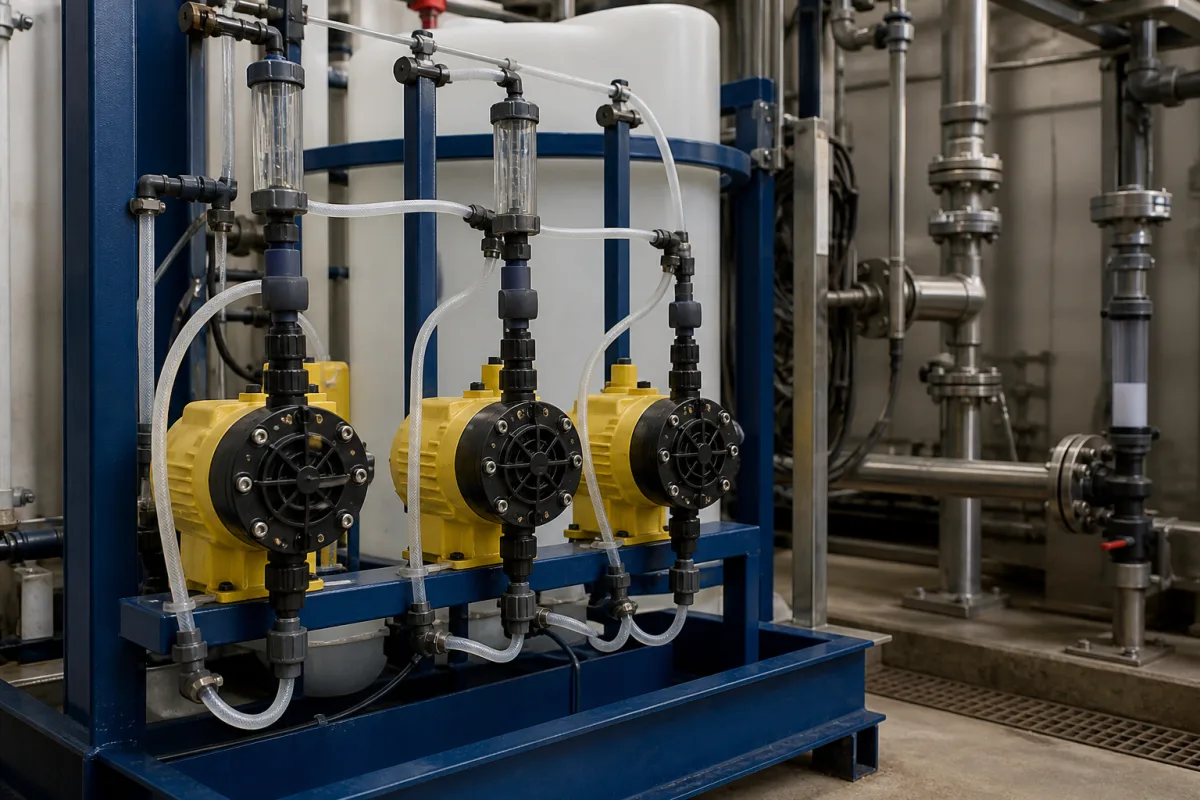
Chemical Dosing Pumps

Based on aggregated insights from multiple verified factory profiles within the CNFX directory, the standard Chemical Dosing Pumps used in the Chemical Manufacturing sector typically supports operational capacities ranging from standard industrial configurations to heavy-duty production requirements.

Technical Definition & Core Assembly

A canonical Chemical Dosing Pumps is characterized by the integration of Diaphragm Head and Check Valves. In industrial production environments, manufacturers listed on CNFX commonly emphasize Polypropylene construction to support stable, high-cycle operation across diverse manufacturing scenarios.

Precision pumps designed to inject specific volumes of chemicals into industrial neutralization systems for pH control and treatment.
Product Specifications

Technical details and manufacturing context for Chemical Dosing Pumps

Definition
Chemical dosing pumps are critical components within Industrial Chemical Neutralization Systems that precisely meter and inject neutralizing agents, pH adjusters, or other treatment chemicals into wastewater or process streams. They ensure accurate chemical delivery to maintain optimal neutralization reactions, prevent equipment corrosion, and meet environmental discharge requirements.
Working Principle
These pumps operate by creating a controlled displacement mechanism (typically diaphragm, piston, or peristaltic) that draws chemical solutions from storage tanks and injects them at precise flow rates into the neutralization system. Flow control is achieved through adjustable stroke length, frequency, or speed, often integrated with pH/ORP sensors for automated feedback control.
Common Materials
Polypropylene, PVDF (Polyvinylidene Fluoride), 316L Stainless Steel, PTFE (Polytetrafluoroethylene)
Technical Parameters
  • Maximum flow capacity (L/h) Per Request
Components / BOM
  • Diaphragm Head
    Creates pumping action through flexible diaphragm movement, providing chemical isolation from mechanical components
    Material: PTFE-coated rubber or PVDF
  • Check Valves
    Prevent backflow and ensure unidirectional chemical flow during suction and discharge cycles
    Material: PVDF or 316L Stainless Steel
  • Stroke Length Adjustment Mechanism
    Allows precise control of chemical volume per stroke for flow rate adjustment
    Material: Stainless Steel
  • Motor and Drive Assembly
    Provides mechanical power and controls pump speed/stroke frequency
    Material: Aluminum housing with copper windings
Engineering Reasoning
0.5-15.0 bar
18.0 bar differential pressure
Design Rationale: Diaphragm material yield strength (316L stainless steel: 205 MPa) exceeded, causing permanent plastic deformation and loss of volumetric accuracy
Risk Mitigation (FMEA)
Trigger Chemical crystallization at 25°C saturation point
Mode: Check valve blockage
Strategy: Integrated heating jacket maintaining 35°C fluid temperature
Trigger 24V DC power supply voltage drop below 21.6V
Mode: Solenoid coil demagnetization
Strategy: Buck-boost voltage regulator with 20-30V input range

Industry Taxonomies & Aliases

Commonly used trade names and technical identifiers for Chemical Dosing Pumps.

Industrial Ecosystem & Supply Chain DNA

Complementary Systems
Downstream Applications
Specialized Tooling

Application Fit & Sizing Matrix

Operational Limits
pressure: Up to 10 bar (145 psi) discharge pressure
flow rate: 0.1-100 L/h (0.026-26.4 gph)
temperature: 0-80°C (32-176°F)
slurry concentration: Up to 20% solids by weight
Media Compatibility
✓ Acids and bases for pH adjustment (e.g., sulfuric acid, sodium hydroxide) ✓ Coagulants and flocculants (e.g., ferric chloride, polyacrylamide) ✓ Oxidizing agents (e.g., sodium hypochlorite, hydrogen peroxide)
Unsuitable: Highly viscous fluids (>500 cP) or abrasive slurries with large particle sizes (>500 microns)
Sizing Data Required
  • Required flow rate (L/h or gph)
  • System pressure (bar or psi)
  • Chemical concentration and viscosity (cP)

Reliability & Engineering Risk Analysis

Failure Mode & Root Cause
Diaphragm rupture
Cause: Chemical incompatibility leading to material degradation, over-pressurization, or fatigue from cyclic loading
Check valve failure
Cause: Wear from abrasive media, fouling from chemical crystallization, or improper seating due to contamination
Maintenance Indicators
  • Irregular or pulsating flow output (audible knocking or visual pressure gauge fluctuations)
  • Visible chemical leakage at pump head connections or diaphragm housing
Engineering Tips
  • Implement regular chemical compatibility verification and material selection reviews based on actual process conditions
  • Establish preventive maintenance schedules for diaphragm inspection/replacement and check valve cleaning based on runtime hours rather than calendar time

Compliance & Manufacturing Standards

Reference Standards
ISO 2858:2012 - End-suction centrifugal pumps (Designation, nominal duty point and dimensions) ANSI/HI 7.1-7.5-2017 - Rotodynamic (Centrifugal) Pumps for Nomenclature, Definitions, Application, and Operation DIN EN 809:1998 - Pumps and pump units for liquids - Common safety requirements
Manufacturing Precision
  • Stroke length adjustment: +/-0.5% of full scale
  • Discharge pressure: +/-2% of rated pressure
Quality Inspection
  • Hydrostatic pressure test at 1.5x maximum working pressure for 30 minutes
  • Calibration verification test for dosing accuracy across full flow range

Factories Producing Chemical Dosing Pumps

Verified manufacturers with capability to produce this product in China

✓ 94% Supplier Capability Match Found

S Sourcing Manager from United Arab Emirates Feb 21, 2026
★★★★★
"Standard OEM quality for Chemical Manufacturing applications. The Chemical Dosing Pumps arrived with full certification."
Technical Specifications Verified
P Procurement Specialist from Australia Feb 18, 2026
★★★★☆
"Great transparency on the Chemical Dosing Pumps components. Essential for our Chemical Manufacturing supply chain. (Delivery took slightly longer than expected, but technical support was excellent.)"
Technical Specifications Verified
T Technical Director from Singapore Feb 15, 2026
★★★★★
"The Chemical Dosing Pumps we sourced perfectly fits our Chemical Manufacturing production line requirements."
Technical Specifications Verified
Verification Protocol

“Feedback is collected from verified sourcing managers during RFQ (Request for Quote) and factory evaluation processes on CNFX. These reports represent historical performance data and technical audit summaries from our B2B manufacturing network.”

18 sourcing managers are analyzing this specification now. Last inquiry for Chemical Dosing Pumps from Mexico (1h ago).

Supply Chain Compatible Machinery & Devices

Automated Batch Crystallization System

Automated system for controlled crystallization of chemical compounds in batch processes.

Explore Specs →
Automated pH Monitoring and Dosing System

Automated system for continuous pH monitoring and chemical dosing in process streams.

Explore Specs →
Automated Powder Dispensing and Blending System

Automated system for precise dispensing and homogeneous blending of powdered chemicals.

Explore Specs →
Automated Solvent Recovery and Purification System

Automated system for recovering and purifying industrial solvents.

Explore Specs →

Frequently Asked Questions

What materials are best for chemical dosing pumps in corrosive environments?

For corrosive chemical applications, PVDF (Polyvinylidene Fluoride), PTFE, and 316L Stainless Steel offer excellent resistance, while Polypropylene is suitable for less aggressive chemicals.

How do stroke length adjustment mechanisms improve dosing accuracy?

Stroke length adjustment allows precise control over the volume of chemical injected per cycle, enabling fine-tuning for exact pH control and treatment requirements in neutralization systems.

What maintenance do chemical dosing pumps typically require?

Regular maintenance includes inspecting and replacing check valves and diaphragm heads as needed, lubricating moving parts, and verifying calibration of the stroke adjustment mechanism to ensure consistent dosing accuracy.

Can I contact factories directly on CNFX?

CNFX is an open directory, not a transaction platform. Each factory profile provides direct contact information and production details to help you initiate direct inquiries with Chinese suppliers.

Get Quote for Chemical Dosing Pumps

Request technical pricing, lead times, or customized specifications for Chemical Dosing Pumps directly from verified manufacturing units.

Your business information is encrypted and only shared with verified Chemical Dosing Pumps suppliers.

Thank you! Your message has been sent. We'll respond within 1–3 business days.

Need to Manufacture Chemical Dosing Pumps?

Connect with verified factories specializing in this product category

Add Your Factory Contact Us
Previous Product
Chemical Distillation Column System
Next Product
Chemical Reactor Agitator Blade