Industry-Verified Manufacturing Data (2026)

3D Pattern Scanner

Based on aggregated insights from multiple verified factory profiles within the CNFX directory, the standard 3D Pattern Scanner used in the Computer, Electronic and Optical Product Manufacturing sector typically supports operational capacities ranging from standard industrial configurations to heavy-duty production requirements.

Technical Definition & Core Assembly

A canonical 3D Pattern Scanner is characterized by the integration of Structured Light Projector and Stereo Camera Array. In industrial production environments, manufacturers listed on CNFX commonly emphasize Aluminum Alloy Housing construction to support stable, high-cycle operation across diverse manufacturing scenarios.

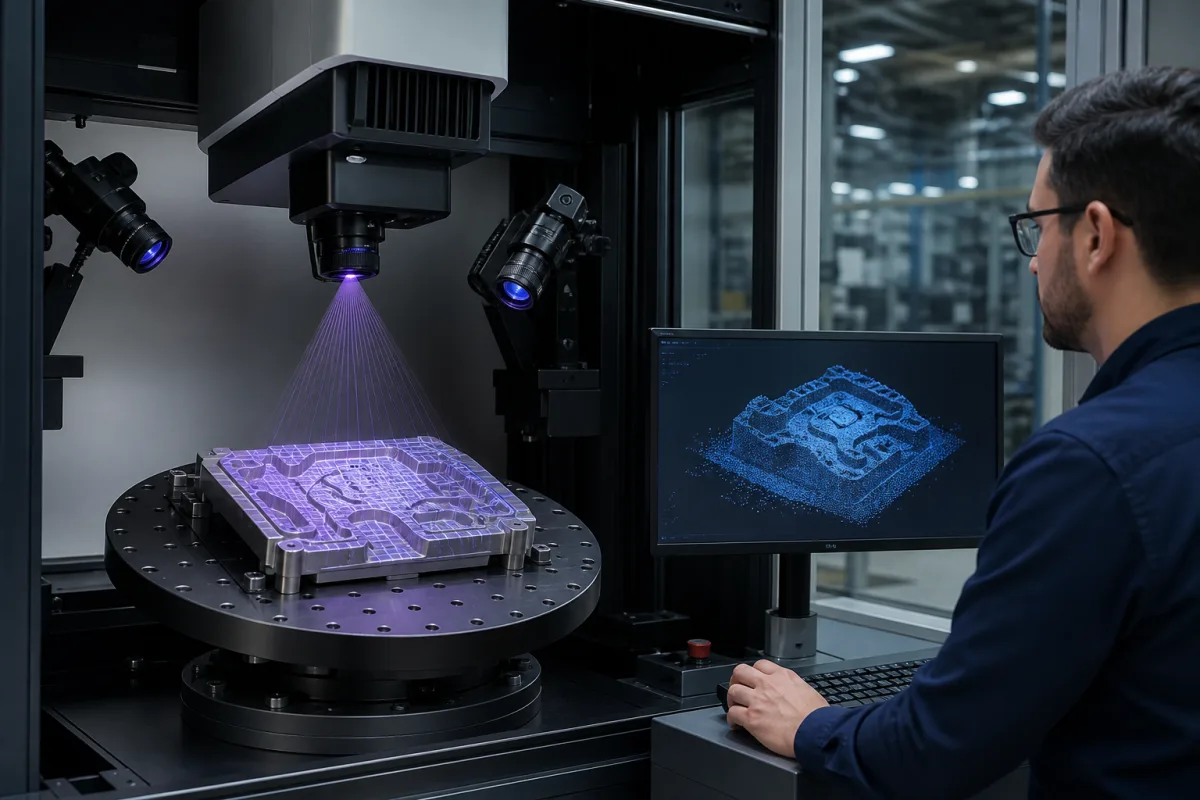
A component that captures three-dimensional surface patterns and textures of objects within an industrial system.
Product Specifications

Technical details and manufacturing context for 3D Pattern Scanner

Definition
The 3D Pattern Scanner is a critical component within the Industrial System that performs non-contact scanning of object surfaces to create detailed three-dimensional models of patterns, textures, and surface geometries. It enables precise quality control, pattern recognition, and dimensional analysis by capturing high-resolution spatial data that traditional 2D imaging cannot provide.
Working Principle
The scanner operates by projecting structured light patterns onto the target surface while simultaneously capturing images from multiple calibrated cameras. As the object moves through the scanning zone or the scanner head traverses the surface, triangulation algorithms calculate depth information from the distortion of the projected patterns. This creates a point cloud that is processed into a complete 3D model with texture mapping and pattern recognition capabilities.
Common Materials
Aluminum Alloy Housing, Optical Glass Lenses
Technical Parameters
  • Scanning resolution indicating the minimum detectable surface feature size (micrometers) Per Request
Components / BOM
  • Structured Light Projector
    Projects precise light patterns onto the target surface for triangulation measurements
    Material: LED Array with Optical Diffuser
  • Stereo Camera Array
    Captures multiple synchronized images of the distorted light patterns from different angles
    Material: CMOS Sensors with Protective Glass
  • Calibration Target Optional
    Reference pattern used for system calibration and accuracy verification
    Material: Ceramic Plate with Precision Markings
Engineering Reasoning
0.5-3.0 m
Surface reflectivity <0.05 or >0.95 at 650 nm wavelength
Design Rationale: Specular reflection saturation at high reflectivity (>0.95) causes sensor blooming; diffuse reflection signal-to-noise ratio drops below 10 dB at low reflectivity (<0.05)
Risk Mitigation (FMEA)
Trigger Ambient light intensity >2000 lux at 400-700 nm spectrum
Mode: Structured light pattern washout
Strategy: Install 650 nm bandpass optical filter with 10 nm bandwidth and 0.8 OD attenuation
Trigger Vibration amplitude >0.5 mm at 50-200 Hz frequency
Mode: Projector-camera misalignment exceeding 0.1° angular tolerance
Strategy: Implement active vibration isolation platform with 40 dB attenuation at 100 Hz resonance

Industry Taxonomies & Aliases

Commonly used trade names and technical identifiers for 3D Pattern Scanner.

Applied To / Applications

This component is essential for the following industrial systems and equipment:

Industrial Ecosystem & Supply Chain DNA

Complementary Systems
Downstream Applications
Specialized Tooling

Application Fit & Sizing Matrix

Operational Limits
pressure: 0 to 1.5 bar
resolution: 0.01 mm to 0.1 mm
temperature: -10°C to 50°C
scanning range: 50 mm to 500 mm
scanning speed: Up to 1000 points/second
Media Compatibility
✓ Metallic surfaces ✓ Plastic components ✓ Textured rubber parts
Unsuitable: Highly reflective or transparent surfaces
Sizing Data Required
  • Maximum object dimensions (LxWxH)
  • Required scanning resolution
  • Required scanning speed/throughput

Reliability & Engineering Risk Analysis

Failure Mode & Root Cause
Laser Diode Degradation
Cause: Thermal stress from continuous operation exceeding rated duty cycles, leading to reduced output power and beam quality degradation.
Optical Sensor Calibration Drift
Cause: Vibration-induced misalignment and thermal expansion/contraction cycles causing progressive deviation from factory calibration settings.
Maintenance Indicators
  • Inconsistent or 'jittery' scan patterns during operation
  • Audible high-pitched whine or clicking from cooling fans/laser modulation components
Engineering Tips
  • Implement scheduled thermal cycling protocols during idle periods to minimize thermal stress accumulation on sensitive components
  • Establish vibration isolation mounting and regular optical path verification using certified reference artifacts

Compliance & Manufacturing Standards

Reference Standards
ISO 10360-2:2009 (Geometrical product specifications - Acceptance and reverification tests for coordinate measuring machines) ANSI/ASME B89.4.10360.2 (Acceptance and Reverification Tests for Coordinate Measuring Systems) DIN EN ISO 10360-2 (Geometrical product specifications - Acceptance and reverification tests for coordinate measuring machines)
Manufacturing Precision
  • Linear Measurement Accuracy: +/-0.005 mm
  • Volumetric Accuracy: +/-0.015 mm
Quality Inspection
  • Laser Interferometer Calibration Test
  • Step Gauge Verification Test

Factories Producing 3D Pattern Scanner

Verified manufacturers with capability to produce this product in China

✓ 94% Supplier Capability Match Found

P Procurement Specialist from United Arab Emirates Jan 07, 2026
★★★★★
"Standard OEM quality for Computer, Electronic and Optical Product Manufacturing applications. The 3D Pattern Scanner arrived with full certification."
Technical Specifications Verified
T Technical Director from Australia Jan 04, 2026
★★★★★
"Great transparency on the 3D Pattern Scanner components. Essential for our Computer, Electronic and Optical Product Manufacturing supply chain."
Technical Specifications Verified
P Project Engineer from Singapore Jan 01, 2026
★★★★★
"The 3D Pattern Scanner we sourced perfectly fits our Computer, Electronic and Optical Product Manufacturing production line requirements."
Technical Specifications Verified
Verification Protocol

“Feedback is collected from verified sourcing managers during RFQ (Request for Quote) and factory evaluation processes on CNFX. These reports represent historical performance data and technical audit summaries from our B2B manufacturing network.”

16 sourcing managers are analyzing this specification now. Last inquiry for 3D Pattern Scanner from UAE (1h ago).

Supply Chain Commonly Integrated Components

Stereo Camera Array

A multi-camera system that captures synchronized images from multiple perspectives to enable 3D depth perception and pattern recognition.

Explore Specs →
Structured Light Projector

Optical device that projects precisely controlled light patterns onto surfaces for 3D scanning applications

Explore Specs →
Main Processor Board

The central computing and control unit of a 5-axis CNC controller that processes motion commands, executes algorithms, and coordinates all system operations.

Explore Specs →
Alignment Sensor Array

A multi-sensor component that detects and measures positional alignment in industrial systems.

Explore Specs →

Frequently Asked Questions

What industrial applications is this 3D pattern scanner designed for?

This scanner is designed for computer, electronic, and optical product manufacturing applications, including quality control, surface texture analysis, and dimensional verification of components in industrial systems.

How does the structured light projector enhance scanning accuracy?

The structured light projector projects precise patterns onto objects, allowing the stereo camera array to capture detailed 3D surface data by analyzing pattern distortions, ensuring high-resolution texture and pattern capture.

What maintenance is required for the optical glass lenses?

Regular cleaning with lens-safe solutions and periodic calibration using the included calibration target are recommended to maintain optimal scanning accuracy and prevent dust or residue buildup on the optical surfaces.

Can I contact factories directly on CNFX?

CNFX is an open directory, not a transaction platform. Each factory profile provides direct contact information and production details to help you initiate direct inquiries with Chinese suppliers.

Get Quote for 3D Pattern Scanner

Request technical pricing, lead times, or customized specifications for 3D Pattern Scanner directly from verified manufacturing units.

Your business information is encrypted and only shared with verified 3D Pattern Scanner suppliers.

Thank you! Your message has been sent. We'll respond within 1–3 business days.

Need to Manufacture 3D Pattern Scanner?

Connect with verified factories specializing in this product category

Add Your Factory Contact Us
Previous Product
3D Optical Sensor Head
Next Product
A/D Converter