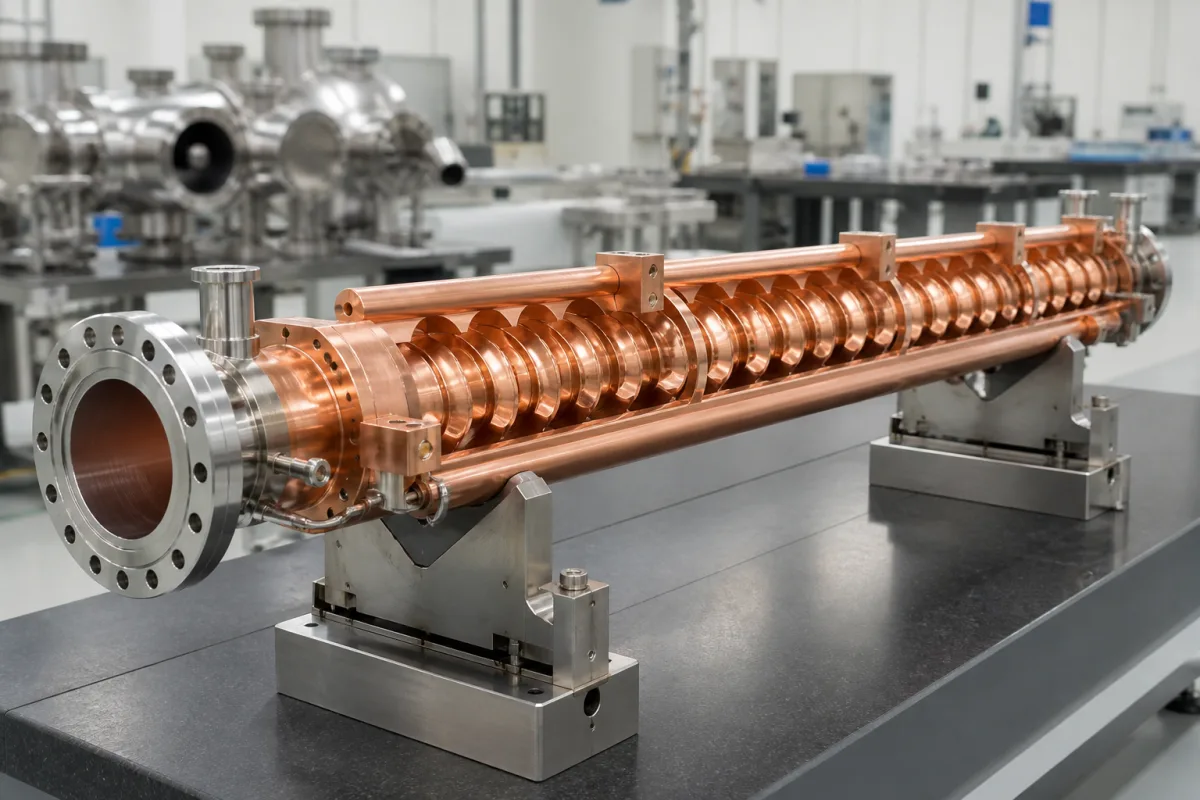
Accelerating waveguide for a 6 MV radiotherapy linac: choosing the standing-wave structure by band, cell coupling, length, shunt impedance and RF feed
6 MeV standing-wave accelerating guides for radiotherapy · 2998 MHz S-band against 9.3 GHz X-band, side-coupled or on-axis cells, π or π/2 mode, 35–42 cm long, 104–116 MΩ/m, 1.7–3.2 MW magnetron feed
In a 6 MV medical linac the accelerating waveguide is the chain of copper cavities, brazed into one vacuum-tight tube, that turns pulses of microwave power from a magnetron into an electric field strong enough to take electrons from a few tens of keV at the gun to about 6 MeV at the X-ray target in well under half a metre. When specifying or comparing one, settle three things: which frequency band and cell coupling the structure uses, what length, shunt impedance and field it reaches, and how much RF power it needs, through which coupler and waveguide, and how its frequency is held as it warms.
Standing-wave accelerating waveguides (accelerating tubes or guides) for low-energy medical electron linacs around 6 MeV: S-band and X-band structures, side-coupled and on-axis coupled cells, operating mode, bunching and accelerating cell counts, length, shunt impedance and quality factor, accelerating field, beam energy and current at the exit, RF input coupler and feed waveguide, magnetron peak power, duty cycle and frequency control. The complete radiotherapy machine, with its treatment head, multileaf collimator, imaging and couch, is covered on the Medical linear accelerator page; the electron gun that injects into the guide on the Electron gun for a medical linear accelerator page; the treatment console and interlocks on the Centralized control system page; patient couches on the Six-degree-of-freedom radiotherapy treatment couch and Radiotherapy patient positioning couch pages. Machining and brazing of the individual copper cells, and mechanical tuners, are referred to here only where they set a structure's performance.
CNFX editorial research · Sources checked October 13, 2026 · 4 sources
2998 MHz S-band or 9.3 GHz X-band, side-coupled or on-axis cells, π or π/2 mode
Published 6 MeV medical guides split first by band. The Synchrotron Light Research Institute in Thailand designed a 2998 MHz S-band standing-wave structure fed by a 3.1 MW magnetron for a 6 MV prototype, using side-coupled cells that emulate a Varian 600C structure; in a side-coupled structure the coupling cavities sit alternately beside the accelerating cavities, so the beam and RF paths are separated and the two cavity types can be optimised independently. [1] Two Korean institutes built 9.3 GHz X-band guides instead, which KAERI justifies by the smaller size and weight of an accelerator mounted on a gantry or a robot arm and by the availability of 9.3 GHz magnetrons. [3]
KERI gives the reasons for its choices: side coupling for higher acceleration per unit length, so the linac can be shorter, and π/2 mode because it has the largest mode spacing, which helps performance and stability. [4] USTC's bridge hole is meant to reduce the interaction between accelerating and coupling cavities when either is tuned, and a nose cone on the inner end plate of its first cavity focuses the low-energy beam. [2] KAERI's cells have a bell-shaped curvature instead of a nose cone, for easier fabrication. [3]
Editorial calculation: the free-space wavelength is c / f, about 100 mm at 2998 MHz and about 32 mm at 9.3 GHz, a ratio of about 3.1. The published lengths do not shrink by that ratio: USTC's S-band tube is 35 cm and the two X-band guides 38–42 cm; the X-band guides carry 24 and 25 cells against the 7 bunching and uniform cavities of USTC's tube. [2][3][4]
π/2 mode; 4 bunching and 20 accelerating cells (24 in the table) [4]
38 cm in the specification table; 42 cm including the assembly flange [4]
Ask the supplier for the frequency, coupling type and operating mode, the number of bunching and accelerating cells, the overall length with and without flanges, and the beam energy and current the guide is designed to deliver at the target.
02
Shunt impedance of 104–116 MΩ/m, 16.8 MV/m and 1.7–3.2 MW: what the guide asks of the magnetron
The published 6 MeV designs quote shunt impedances within about 12 MΩ/m of each other. SLRI's S-band structure is quoted at 115 MΩ/m with an unloaded Q of 17,500, and particle tracking needed a peak field of 55 MV/m to take electrons from 30 keV to 6.1 MeV. [1] USTC's whole tube came out at 104 MΩ/m and a Q of 15,052 after tuning, against 106.9 MΩ/m and 16,646 for the optimised cavity, accelerating a 10 keV beam to 6.17 MeV at 130 mA with 21.75 % energy spread. [2] KERI's X-band guide in OFHC copper is listed at 116 MΩ/m and designed for 16.8 MV/m, 6.2 MeV and about 90 mA, with 26 % of the beam current transmitted to the end of the accelerating cells. [4]
USTC sizes the input coupler from the beam load: with 3.2 MW in and 130 mA of beam, its optimum coupling coefficient is 2.23, deliberately over-coupled. [2] Editorial calculation: a coupling coefficient of 2.23 corresponds to a reflection coefficient of (2.23 − 1) / (2.23 + 1) ≈ 0.38 with no beam, consistent with the S11 of 0.375 USTC reports for its coupler. KERI's 1.58 MW delivered out of 1.7 MW means about 7 % of the magnetron's peak power is lost before the cavity, and 1.7 MW at a duty cycle of 0.0008 is about 1.36 kW of average RF power. [4]
The guide's resonant frequency moves as RF power heats its walls. KAERI pairs its X-band guide with an automatic frequency control unit that compares forward and reflected RF power and drives a stepper-motor tuner, so that the source and cavity stay matched and the beam remains stable. [3] KERI holds its cavity surface roughness below 30 nm to reduce RF loss and breakdown, and conditions it by stepping up pulse repetition frequency and pulse width until full power runs without arcing, with RF transmission kept at about 95 % or more. [4]
Give the supplier the RF source available (magnetron or klystron, peak power, pulse width, repetition rate), the beam energy and dose rate needed, and ask for the shunt impedance, Q, coupling coefficient, field flatness and the frequency-control method, with cold-test and high-power conditioning records.
03
Data for a medical linac accelerating waveguide
Paste it into your enquiry below or into an email to a maker, then replace every bracket.
Beam: [energy at target; peak current; dose rate goal]
Band: [S-band or X-band; exact frequency]
Structure: [side-coupled or on-axis; mode; cells; length with and without flanges]
RF source: [magnetron or klystron; peak power; pulse width; repetition rate]
Feed: [waveguide size; circulator; coupling coefficient]
Gun interface: [gun voltage and type; injection energy]
Frequency control: [AFC and tuner; cooling water temperature]
Documents: [shunt impedance and Q; field flatness; cold test; conditioning record]
Explore company information and manufacturing capabilities, then discuss the scope of your project with a relevant supplier.
Share this page
Compiled and source-reviewed by the CNFX editorial team.
Each manufacturer above links to the page on that company's own website where the product is listed, with the date we checked it. How we source and review
· Page last updated 13 October 2026
Buyer questions
What frequency does a medical linac accelerating waveguide run at?
Published 6 MeV designs use 2998 MHz S-band (SLRI, USTC) or 9.3 GHz X-band (KAERI, KERI); KAERI cites smaller size and weight for gantry- or robot-mounted machines as the reason for X-band. [1][2][3][4]
How long is a 6 MeV accelerating waveguide?
USTC's S-band tube is 35 cm, KAERI's X-band guide 0.4 m, and KERI lists 38 cm, or 42 cm including the assembly flange, for its X-band guide. [2][3][4]
What shunt impedance do 6 MeV medical structures reach?
SLRI quotes 115 MΩ/m, USTC 104 MΩ/m for the tuned tube, and KERI 116 MΩ/m. [1][2][4]
How much RF power does a 6 MeV guide need?
USTC's S-band tube takes 3.2 MW; the X-band guides run on magnetrons of 1.7 MW minimum peak, of which KERI delivers 1.58 MW to the cavity. [2][3][4]
Sources and what still needs a direct check
Sources checked 2026-10-13. Four conference papers published by JACoW from four research institutes that designed and built 6 MeV medical accelerating structures: the Synchrotron Light Research Institute (Thailand), the National Synchrotron Radiation Laboratory at USTC (China), the Korea Atomic Energy Research Institute and the Korea Electrotechnology Research Institute.