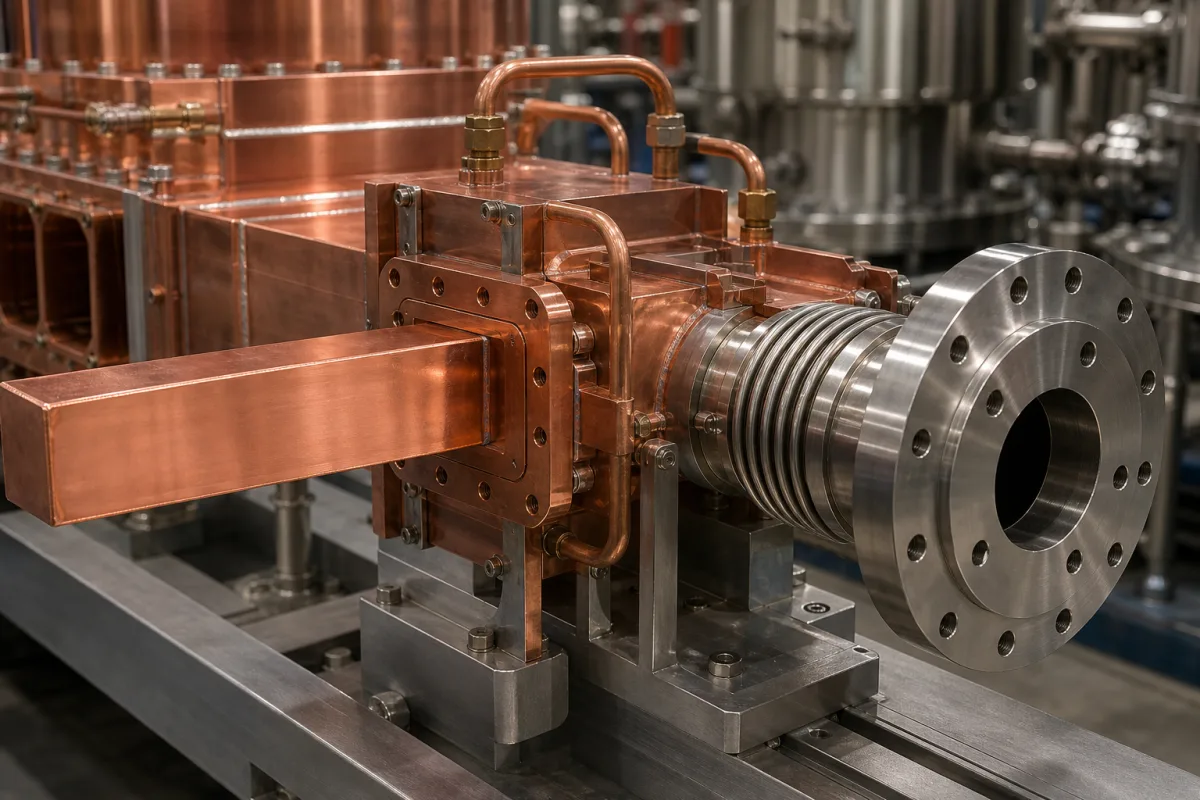
Output coupler of a travelling-wave accelerating structure (the coupler cell that takes unused RF power out to a load, and why its symmetry matters)
The coupler cell at the end of a travelling-wave accelerating structure · taking the RF power the structure did not use out to an external load, single-feed against symmetric dual-feed couplers, dipole and quadrupole field components that kick the beam, and the match, vacuum and finish checked at acceptance
In a travelling-wave accelerating structure, RF power enters at an input coupler cell, travels along the cells and accelerates the beam, and what is left is taken out at the last cell by an output coupler into a waveguide and an external load. The coupler cell sits on the beam axis, so its shape affects the beam as well as the RF match.
Output (and paired input) coupler cells of travelling-wave accelerating structures in electron linacs, with their waveguide ports to the RF load. Standing-wave medical linac guides and their input couplers are covered on the Accelerating waveguide for a 6 MV radiotherapy linac page; waveguide-to-coax parts on the Waveguide transition and waveguide-to-coax adapter page; directional couplers on the Directional coupler page; plasma RF generators on the RF power generator for plasma page.
CNFX editorial research · Sources checked October 13, 2026 · 3 sources
The EuroGammaS technical design report for the ELI-NP gamma beam system describes its S-band constant-gradient structures (86 copper cells, 2π/3 mode at 2.856 GHz): RF enters through a rectangular slot into the first cell, and "The power not dissipated in the structure (about 1/3rd) is coupled-out from the last RF cell and dissipated on external load." [3]
In the dual-feed structures Research Instruments built for Elettra's FERMI injector, "The fraction of the power that is not dissipated in the structure is decoupled from the cavity by an also symmetric output coupler cell". Elettra reports ion pumps installed at the output coupler as well as near the input coupler, and measured S11 at the operating frequency of −28.9 dB and −33.5 dB for the two structures at factory acceptance. [2]
Give the structure maker the RF power at the output coupler, pulse length and repetition rate, and ask for the load rating, the output coupler match and how the coupler region is pumped.
02
Single feed or symmetric dual feed
Latina, Grudiev and Schulte (CERN, IPAC2012) note that for the CLIC double-feed coupler cell "the lowest multipole is a quadrupole (m=2) due to 2 plane symmetry", while in a single-feed coupler the dipolar RF kick is non-zero: it can be reduced by optimising the cell geometry, but not set to zero when the coupler cell also accelerates the beam. [1]
Elettra reports that FERMI's earlier injector structures had single-feed RF couplers and "an evident head-tail kick was affecting the beam, slightly worsening the beam emittance"; at maximum gradient the input coupler kicked the bunch centroid by about 5 mrad. The replacement dual-feed structures use racetrack-shaped coupler cells "to suppress the quadrupole component of the fields to less than 0.01%". The ELI-NP report likewise plans to replace single-feed couplers with a dual-feed design for its injector. [2][3]
Coupler
Lowest field multipole / effect
Source
Single feed
Dipolar kick; reducible by geometry, not zero if the cell accelerates
State the beam's emittance budget and whether the structure is in an injector, and ask for the coupler's computed multipole components and the measured field symmetry.
03
Accelerating structure coupler details
Paste it into your enquiry below or into an email to a maker, then replace every bracket.
Explore company information and manufacturing capabilities, then discuss the scope of your project with a relevant supplier.
Share this page
Compiled and source-reviewed by the CNFX editorial team.
Each manufacturer above links to the page on that company's own website where the product is listed, with the date we checked it. How we source and review
· Page last updated 13 October 2026
Buyer questions
How much power reaches the output coupler?
In the ELI-NP S-band structures, about one third of the input power is coupled out of the last cell to an external load. [3]
Why use a dual-feed coupler?
CERN's CLIC study shows single-feed couplers bring a dipolar kick; double feed leaves a quadrupole as the lowest multipole. [1]
How small can the quadrupole be made?
Elettra's racetrack coupler cells keep it below 0.01% in the beam aperture. [2]
What match was measured on delivered structures?
S11 of −28.9 dB and −33.5 dB at 2998.01 MHz on FERMI's two dual-feed structures. [2]
Sources and what still needs a direct check
Sources checked 2026-10-13. CERN authors published the CLIC coupler study at IPAC2012; Elettra and Research Instruments published the FERMI dual-feed structures at LINAC2016; the EuroGammaS consortium's ELI-NP design report is on arXiv.