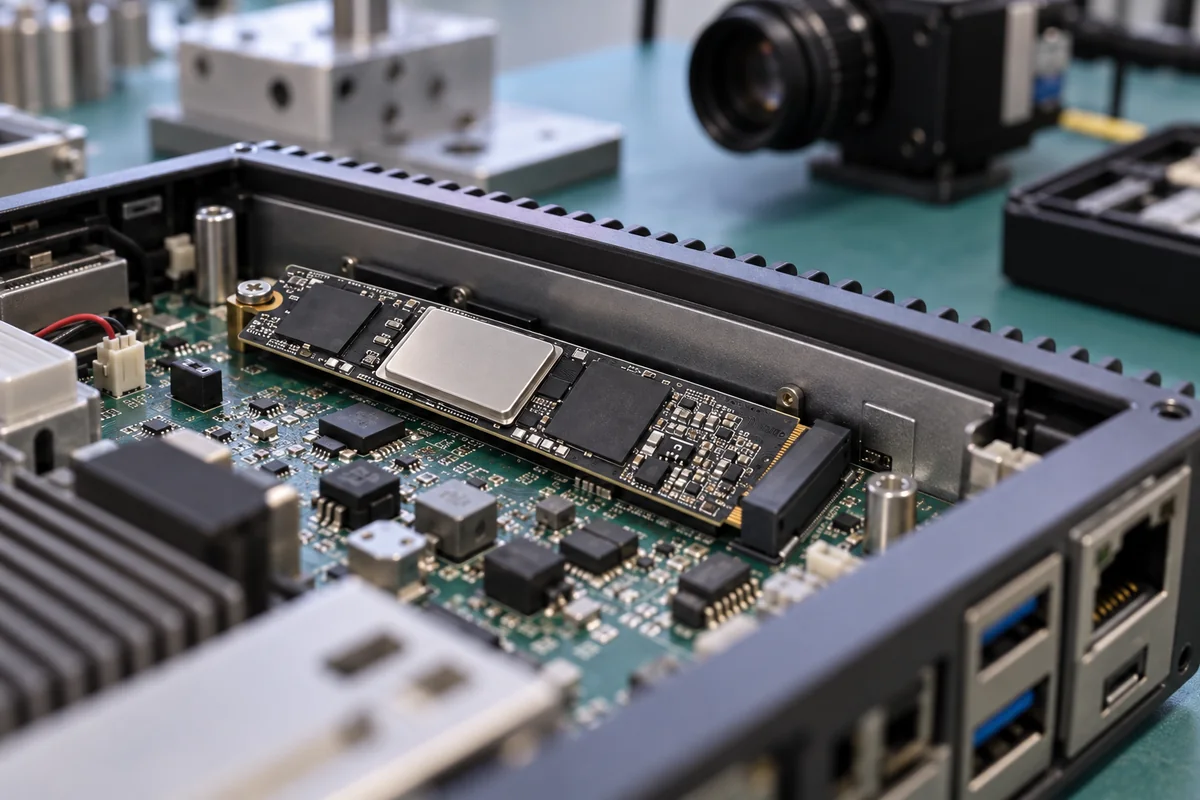
AI accelerator module (edge AI M.2 card and AI system-on-module)
Edge AI accelerator modules · M.2 NPU accelerator cards or system-on-modules, AI performance (TOPS) and precision, power envelope, memory and bandwidth, host interface and connector, video and camera I/O, temperature range and software support
An edge AI accelerator module adds dedicated neural-network processing to equipment such as cameras, robots and industrial PCs, so inference runs on the device instead of in a data centre. Settle three things before choosing one: whether you need an accelerator card for an existing host or a complete compute module, the AI performance, memory and power budget the model and enclosure allow, and the interface, I/O, temperature range and software stack the product depends on.
AI accelerator modules sold for integration: M.2 and similar NPU accelerator cards that plug into a host, and AI system-on-modules (GPU/NPU compute modules with CPU and memory) that mount on a carrier board. Finished edge AI gateways and boxes, embedded computers, single-board computers, discrete graphics cards and data-centre accelerators are outside this page; edge AI gateways, embedded computers and GPUs have their own pages.
CNFX editorial research · Sources checked October 12, 2026 · 4 sources
Geniatech's AIM-M-H8 is an M.2 AI acceleration module built on the Hailo-8 NPU, connecting to a host processor through PCIe Gen3 on an M.2 Key M slot; it lists up to 26 TOPS (INT8), 3.3 W power consumption, −40 to 85 °C operation, 22 × 42, 22 × 60 or 22 × 80 mm sizes, Linux and Windows support, model support for TensorFlow, TensorFlow Lite, Keras, PyTorch and ONNX, and host platforms including NXP, Renesas, TI, Rockchip, SocioNext and Xilinx. [2]
NVIDIA's Jetson Orin family is a set of compute modules with identical architecture, each combining an Ampere GPU with Tensor cores, Arm Cortex-A78AE CPU cores and LPDDR5 memory: AGX Orin modules up to 275 TOPS at 15–60 W on a 699-pin connector (100 × 87 mm), Orin NX modules up to 157 TOPS at 10–40 W and Orin Nano modules up to 67 TOPS at 7–25 W, both on a 260-pin SO-DIMM connector (69.6 × 45 mm). [1]
A second M.2 card shows that some accelerator cards carry their own memory. DEEPX lists its DX-M1 M.2 module at 25 TOPS (INT8) over PCIe Gen3 x4 (supporting Gen 1/2/3 and x1/x2/x4), with 4 GB LPDDR5 at 5,600 MT/s on the module, 1 W minimum to 5 W maximum power, −40 to 85 °C operation, an optional heatsink, and the M.2 2280 M-key form factor (22 × 80 mm); it lists Windows 11/10, Debian-based Linux (Ubuntu 24.04/22.04/20.04 LTS), Yocto and Docker, the Ultralytics, PyTorch, TensorFlow, ONNX and Keras frameworks, and x86 and Arm host systems. The DX-M1 chip itself is a 17 × 17 mm 625-ball FC-BGA supporting up to 8 GB of LPDDR4x or LPDDR5, offered in commercial (0 to 70 °C), industrial (−40 to 85 °C) and AEC-Q100 Grade 3 grades, with Grade 2 (−40 to 105 °C) on request. [3]
Editorial note: an M.2 card needs a host CPU, memory, operating system and an M.2 slot with the right key and PCIe lanes; a system-on-module needs a carrier board but brings its own CPU, memory and I/O. [2][1]
Give the supplier the model types and input sizes, required throughput (frames or inferences per second) and precision, host platform or carrier board, interface and connector, power and thermal budget, memory needs, camera and video I/O, operating temperature, operating system and AI framework, supply life and quantity.
02
Size AI performance, power and memory
NVIDIA's comparison table lists AI performance of 275 TOPS (AGX Orin 64GB), 248 TOPS (AGX Orin Industrial), 241 TOPS (AGX Orin 32GB), 157 TOPS (Orin NX 16GB), 117 TOPS (Orin NX 8GB), 67 TOPS (Orin Nano 8GB) and 34 TOPS (Orin Nano 4GB), with power modes from 7–25 W (Orin Nano) to 15–75 W (AGX Orin Industrial) and memory from 4 GB 64-bit LPDDR5 at 51 GB/s to 64 GB 256-bit LPDDR5 at 204.8 GB/s, the industrial version adding ECC. [1]
The same table lists 2× NVDLA v2 deep-learning accelerators on AGX Orin, video encode up to 2× 4K60 H.265 and decode up to 1× 8K30, up to 16 lanes of MIPI CSI-2 camera input, PCIe Gen4 lanes and up to 10 GbE networking on the AGX Orin module. [1]
Editorial calculation: 26 TOPS at 3.3 W is about 7.9 TOPS/W for the Hailo-8 card; 157 TOPS at the 40 W top power mode is about 3.9 TOPS/W for Orin NX 16GB — but peak TOPS and maximum power are not necessarily measured together, so ask for performance at your power mode. 204.8 GB/s on a 256-bit bus is 204.8 ÷ 32 bytes = 6.4 GT/s. [2][1]
Editorial calculation: the DX-M1 M.2 module's 25 TOPS at its 5 W maximum is 5 TOPS/W, against about 7.9 TOPS/W for the Hailo-8 card at its listed 3.3 W; as with the Jetson figures, these divide peak TOPS by a maximum or listed power and are not measured efficiency on your model. [3][2]
03
Check that the M.2 slot can power and cool the card
MemryX's datasheet for its MX3 M.2 AI Accelerator Module, which carries four MX3 chips that appear to the software as one logical unit, gives the numbers a host design must meet. It lists a 3.3 V ± 5% input, PCIe Gen 3 with 2 lanes, the M.2-2280-D5-M (Socket 3) form factor at 22 × 80 mm, ARM, x86 and RISC-V host support, −40 to +85 °C operation and CE / FCC Class A and RoHS compliance. Citing the PCI Express M.2 Specification Rev 3.0, it gives two power limits: 3,500 mA, or 11.55 W, in the power rating table, and 4,500 mA (500 mA per pin), or 14.85 W, in the adaptor power section. [4]
The datasheet's board power table puts the module's total maximum load power at 12.97 W and maximum input power at 14.85 W, and states that the module is designed to fulfil the maximum power the host can provide. Its thermal simulation table gives a system TDP of 9.27 W in the worst case at 70 °C ambient with a heatsink and at least 3 CFM of airflow, 7.7 W at 70 °C with 2 CFM, 7.7 W at 50 °C with 1 CFM, and 5.15 W at 25 °C without a heatsink and with 1 CFM. [4]
Editorial calculation: 3.3 V × 3.5 A = 11.55 W and 3.3 V × 4.5 A = 14.85 W, matching the two limits above. The Hailo-8 card's listed 3.3 W and the DX-M1's 5 W maximum sit well inside 11.55 W, while a 14.85 W maximum input does not, so for a higher-power card confirm that the host's M.2 slot or adaptor can deliver the current, and that the enclosure gives the airflow the maker's thermal case assumes at your ambient temperature. [4][2][3]
Suppliers linked to this page list AI accelerator modules; each card links to the page reviewed.
The listing reviewed covers M.2 NPU accelerator cards. Ask each supplier for benchmark results on your model at your power mode, the thermal design, driver and SDK versions and the product's supply life. [2]
05
Trace what each part controls
This is a functional reference built from the sources cited; it is not one maker's specification.
Fill the specification fields with values for your device
An AI accelerator module quotation needs values for your device. The table explains each field, gives published values where a reviewed source states them, and says what to obtain from the supplier.
Field
What it means and published values
Ask the supplier for
Computing Power
26 and 25 TOPS INT8 (M.2 cards); 34–275 TOPS. [2][3][1]
Explore company information and manufacturing capabilities, then discuss the scope of your project with a relevant supplier.
Share this page
Compiled and source-reviewed by the CNFX editorial team.
Published product pages show what a company offers, not tested performance. Confirm the legal seller, maker and datasheet for your order. How we source and review
· Page last updated 13 October 2026
Buyer questions
What is the difference between an M.2 AI accelerator and a Jetson module?
An M.2 card such as Geniatech's Hailo-8 AIM-M-H8 adds an NPU to a host over PCIe; a Jetson Orin module is a complete compute module with CPU, GPU and memory. [2][1]
How many TOPS do edge AI modules deliver?
Geniatech lists 26 TOPS for its Hailo-8 card; NVIDIA lists 34–275 TOPS across Jetson Orin modules. [2][1]
How much power do edge AI modules draw?
Geniatech lists 3.3 W for its M.2 card; Jetson Orin modules run in 7 W to 75 W power modes. [2][1]
Can edge AI modules run in industrial temperatures?
Geniatech rates its Hailo-8 M.2 card for −40 to 85 °C; NVIDIA offers an AGX Orin Industrial version with ECC memory. [2][1]
Does an M.2 AI accelerator have its own memory?
Some do: DEEPX lists 4 GB LPDDR5 at 5,600 MT/s on its DX-M1 M.2 module, rated 25 TOPS INT8 at 1–5 W. [3]
How much power can an M.2 slot supply to an AI accelerator card?
MemryX's MX3 M.2 datasheet, citing the PCI Express M.2 Specification Rev 3.0, gives 3,500 mA (11.55 W) in the power rating table and 4,500 mA (14.85 W) in the adaptor power section. [4]
Sources and what still needs a direct check
Sources checked 2026-10-12. NVIDIA's Jetson Orin family page, the Geniatech AIM-M-H8 and DEEPX DX-M1 product pages and MemryX's MX3 M.2 module datasheet are used to show what an edge AI module specification covers; values for your order must come from the supplier's current datasheet.